
Sewer Line Repair · Venice Gardens, FL
Sewer Line Repair in Venice Gardens, FL
Camera-verified diagnosis first, always. Licensed master plumber CFC1434139. Emergency service available — call 239-388-3631.
Call Now239-388-3631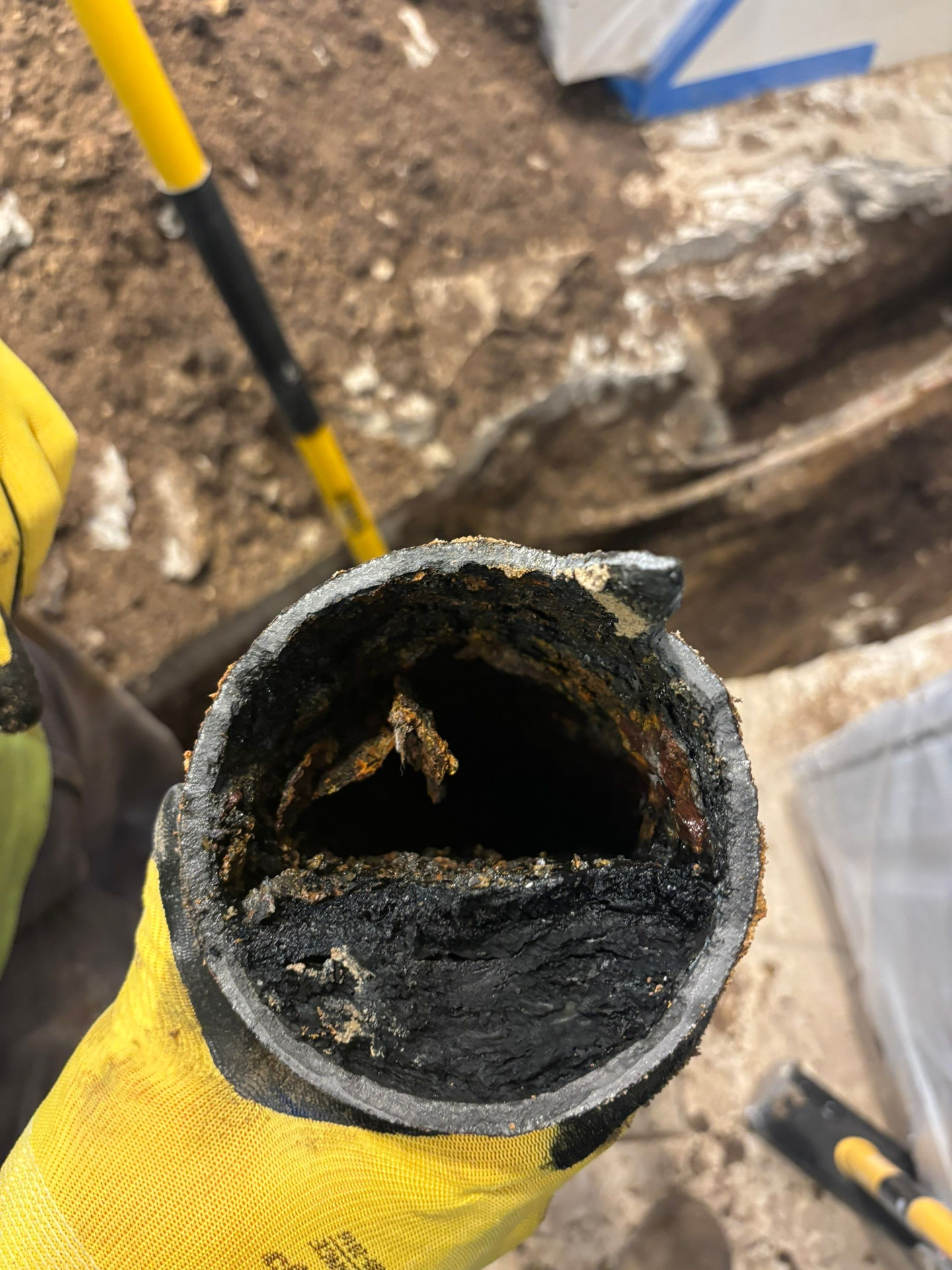
Camera log · one line, 43 feet
What the camera actually found, foot by foot
These are real stills off one inspection, with the footage counter burned into the picture. Nothing staged, nothing borrowed — this is how a failing line reads on camera from the cleanout out to the collapse, including a second belly at 37 feet.
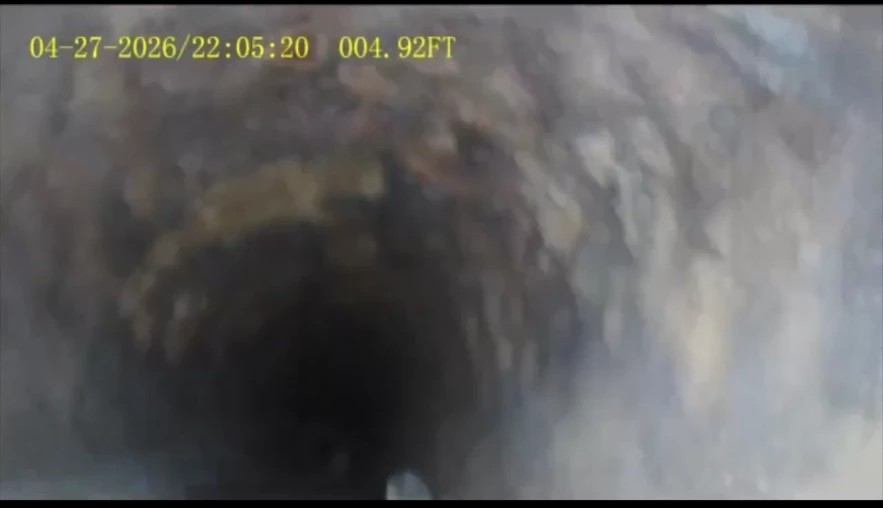 4 ft
4 ftScale building on the pipe wall
Four feet in and the scale is already obvious — the inside of the pipe is no longer smooth. That rough, built-up surface is what catches paper and grease and starts the backups.
I live in Venice Gardens. I’ve said that on other pages on this site and I’ll say it again here, because it isn’t a marketing line — it means I know exactly what’s under this neighborhood’s slabs, because it’s the same thing that’s under mine.
Every original home in Venice Gardens was built between 1956 and 1972 by a single developer, across 34 recorded plats, in one continuous construction window. Sarasota County’s own neighborhood plan documents the average build year as 1969. That single fact tells you almost everything about the sewer lines under this community: they’re cast iron, they’re now 54 to 70 years old, and every home here is on the same clock — no newer pockets, no mixed eras, no exceptions.
Cast iron was the correct material for its time. It’s not a defect that Venice Gardens was built this way — it’s simply age catching up with an entire neighborhood at once. I’ve run cameras through Venice Gardens lines that looked more like caves than pipes on the inside. Sometimes the camera can’t get through at all.
My name is Mike Reynolds. I’m the owner of Plumbing Detectives LLC and a licensed master plumber, license CFC1434139. I live on Chestnut Road, inside the same four boundary roads that define this neighborhood — Center Road, US-41, Briarwood Road, Bal Harbour Drive. Here’s everything a Venice Gardens homeowner needs to understand about sewer line repair before spending a dollar.
The Same Clock
Why Every Venice Gardens Sewer Line Is at the Same Point in Its Life
Most neighborhoods I work in have some spread in construction era — a historic core surrounded by later infill, a mix of decades on the same street. Venice Gardens doesn’t have that spread. The last plat was recorded in 1972 and nothing has been built here since. Every home’s drain-waste-vent system is cast iron, installed during the same 16-year window, sitting in the same soil, exposed to the same water, for the same number of decades.
Here’s what that cast iron has been going through the entire time. Wastewater sitting in the line generates hydrogen sulfide gas, which reacts with moisture in the upper portion of the pipe and converts to sulfuric acid — eating the pipe from the inside, most aggressively along the crown and the waterline. At the same time, decades of scale and buildup accumulate along the pipe walls and the bottom channel. A 2023 study by the Utah State University Water Research Laboratory found cast iron pipes fail at a rate of 28.6 breaks per 100 miles annually — nearly ten times the failure rate of modern PVC at 2.9 breaks per 100 miles. Every Venice Gardens home sits somewhere on that failure curve right now.
On my camera, 60-plus-year-old cast iron doesn’t always look like a pipe anymore. Sometimes it looks like a cave. The buildup narrows a 4-inch trunk line until it behaves like 2-inch pipe. Sometimes I can’t get the camera through at all — and if a self-leveling camera head can’t get through, waste isn’t flowing the way it should either.
Underneath all of that is Venice Gardens’ soil. This area sits on poorly drained sandy soil with a water table that commonly runs 2 to 6 feet below grade. Sand shifts, especially when rainy season saturates it. When it shifts under a 60-plus-year-old cast iron line, the pipe settles unevenly — creating bellies, sags at fittings, and joint separations that weren’t manufacturing defects. They’re six decades of Florida sand moving under pipe that was never engineered to be supported the way I support a replacement line today.
What the Camera Found
A Real Venice Gardens-Era Job — What the Camera Found
I’ve documented a job in a 1980 South Venice slab home — same era of construction as Venice Gardens, same cast iron, same story — that shows exactly what six decades does to this pipe. The homeowner’s only symptom was a guest toilet gurgling louder and louder over the course of a week.
The toilet was cemented in — I had to break the bowl for camera access. Within the first ten feet, the camera hit standing water under a bedroom closet in the next room. Past that section, the pipe was bone dry — the water wasn’t flowing, it was pooling in a sag and seeping into the sand through pipe that had rotted from the inside out. Further along, in the kitchen run, the 4-inch trunk line had narrowed to what looked like 2-inch pipe from interior buildup. Near the end of the kitchen the camera could barely pass at all — the line had sunk so badly it was remarkable there hadn’t been a backup yet. When the floor came open, the pipe was more than half full of black, soot-like buildup, with a sagging fitting that had to be seen to be believed.
Here’s the part that matters most for a Venice Gardens homeowner: the camera also showed the last fifteen feet of that run — past the master bath — was still in good condition. So it stayed. Roughly three-quarters of that home’s drain system was replaced; the sound section was left alone. That’s what the camera buys you in a neighborhood this uniform in age: not just finding what’s broken, but proving what isn’t, so you never pay to replace pipe that’s fine.
375 Venice East Blvd
The Water Reclamation Facility That Shares This Neighborhood’s Name
Venice Gardens isn’t just named on the water supply side — the neighborhood has its own Water Reclamation Facility as well, at 375 Venice East Blvd, serving unincorporated south Sarasota County including Venice Gardens. Sarasota County broke ground in May 2025 on an Advanced Wastewater Treatment conversion and capacity expansion, doubling the facility from 3 million gallons per day to 6 million gallons per day, with construction targeted for completion in 2027 to 2028.
That expansion matters for a specific reason: during Hurricane Milton in October 2024, a power supply failure at this facility caused a 126,000-gallon raw sewage spill, with a nearby lift station contributing additional spillage. The county has documented the event and is investing in the infrastructure upgrade partly to prevent a recurrence.
I bring this up not to alarm anyone but because Venice Gardens homeowners who were on the sewer system during Milton — which is the large majority of this neighborhood — may have experienced backflow risk during that event without fully realizing it. If your home sits in one of the lower-lying sections of the neighborhood and you’re uncertain whether your home has any backflow protection on the drain side, that’s worth asking about during a plumbing evaluation.
What Your House Is Telling You
The Warning Signs — What Your House Is Telling You
A gurgling toilet is the most common early symptom. When a toilet gurgles while other fixtures run — the washing machine drains, the dishwasher cycles — air is being pulled through the water in the bowl because the drain system isn’t venting and flowing the way it’s designed to.
How long do you have once the gurgling starts? Honestly, it’s hard to say — I don’t know what each household is putting down that line. It could be a day. It could be three weeks. But a gurgle caused by a belly or a separating fitting only moves in one direction. In a neighborhood where every home is on the same 60-plus-year-old cast iron, waiting doesn’t make it cheaper.
Other signs worth acting on: slow drains in multiple fixtures at once, recurring clogs in the same line, sewage odors inside or outside the home, wet or unusually green patches in the yard along the lateral path, backups during heavy rain, and — in slab homes — unexplained moisture at the floor.
The Camera Comes First
Diagnosis First — The Camera Comes Before the Quote
I will not quote a sewer repair I haven’t seen from the inside. In a neighborhood where every home shares the same pipe material and the same age, it’s tempting for a company to assume every gurgling toilet in Venice Gardens needs the same fix. It doesn’t.
Every sewer job here starts with a camera inspection. I run a camera with a self-leveling head, a distance counter, and a 512 Hz locator — which means I can see the condition of the pipe, measure exactly where each problem is, and mark its location on your floor from above. If I see something, I call you over and show you on the screen in real time. Then you get a written report of the findings.
That’s a separate service with its own transparent pricing, explained in full on my Venice Gardens sewer camera inspection page: Camera Inspection & Surface Locate is $325, and the optional recorded-video add-on is +$70 — the full footage is delivered by Google Drive within 24 to 48 hours ($395 total). In a neighborhood this uniform in age, the camera is what tells me whether your specific home needs a spot repair, a partial replacement, or something more extensive — not the neighborhood’s build year alone.
Plumbing Detectives LLC Professional Opinion
Every home in Venice Gardens has cast iron from the same 16-year construction window. That does not mean every home needs the same repair. I’ve camera’d Venice Gardens lines that were still structurally sound at 60-plus years, and I’ve camera’d others that were more buildup than pipe. Age tells you the risk category. The camera tells you what your specific home actually needs. Never let anyone quote a Venice Gardens sewer repair off the neighborhood’s build year alone — and if anyone proposes lining your pipe, Florida code now requires a video camera survey before and after, so ask to see it.
The Honest Decision Tree
Repair, Reline, or Replace — The Honest Decision Tree
Spot repair. When the camera shows an isolated problem — one separated joint, one crushed section, one root intrusion point — in an otherwise sound line, the answer is a targeted repair: open the floor or yard at the marked location, replace the failed section with new PVC at correct pitch, and put everything back. Not every Venice Gardens home needs a whole-house sewer replacement.
Trenchless relining (CIPP). Right when the host pipe has internal corrosion and scaling but is still structurally intact and still holding its pitch. But lining does not fix gravity — if six decades of sandy soil has shifted a section out of pitch, a liner follows the shape of the pipe it’s installed in, and the same low spot holds water regardless of the new interior finish. Since April 2024, Florida Building Code Section 717 requires a video camera survey of the line both before any CIPP relining begins and after it’s complete, before the code official signs off. Any company proposing to line a Venice Gardens sewer without showing pre-lining camera footage is skipping a step the state requires.
Excavation and replacement. When the line has collapsed sections, severe bellies, rotted-through pipe, or buildup so advanced the line can’t be restored — like the South Venice job described above — the answer is opening the floor and replacing the failed cast iron with new PVC at correct pitch and grade, properly bedded in this neighborhood’s sandy soil so the replacement doesn’t repeat the same failure in another 60 years.
Section by Section, Not All or Nothing
How I Replace a Sewer Line — Section by Section, Not All or Nothing
Here’s something I explain to every Venice Gardens customer: sometimes the camera can’t get through the worst section. I’m not going to quote work on pipe I haven’t seen. So I give you a price for the section the camera has documented. Once the floor is open and I’ve cleared the bad section, I run the camera upstream and diagnose the next stretch, and tell you honestly whether we should keep going or stop there — the same way I handled the South Venice job, where we stopped once the camera confirmed the remaining fifteen feet was sound.
The white glove approach. A sewer replacement inside a Venice Gardens home means concrete saws, excavation, and spoil. On every interior job: wall protection goes up, floor protection goes down, dust control is in place, and the work area stays clean and contained. Everything is documented in photos and video — the condition we found, the work in progress, and the finished installation.
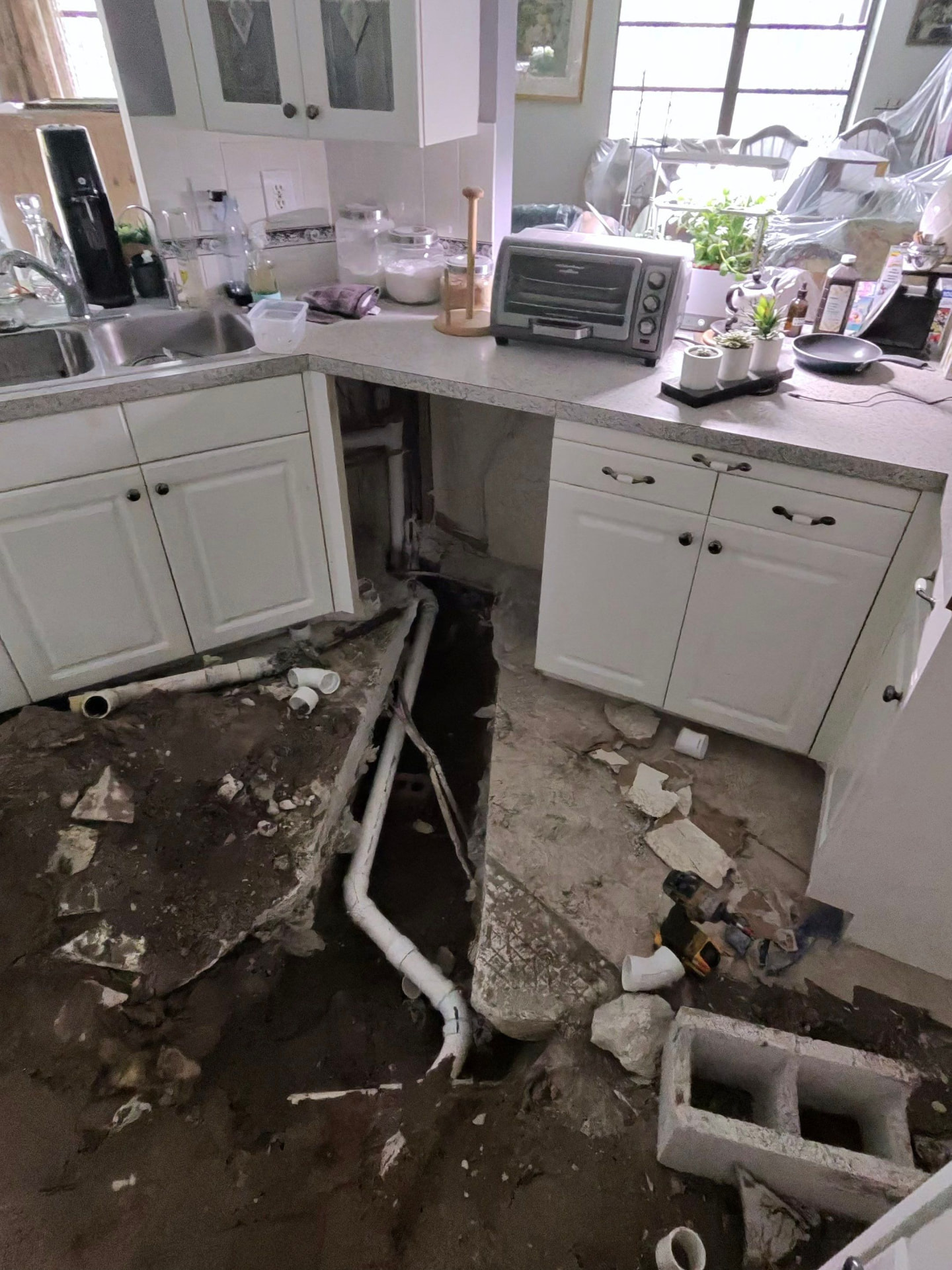
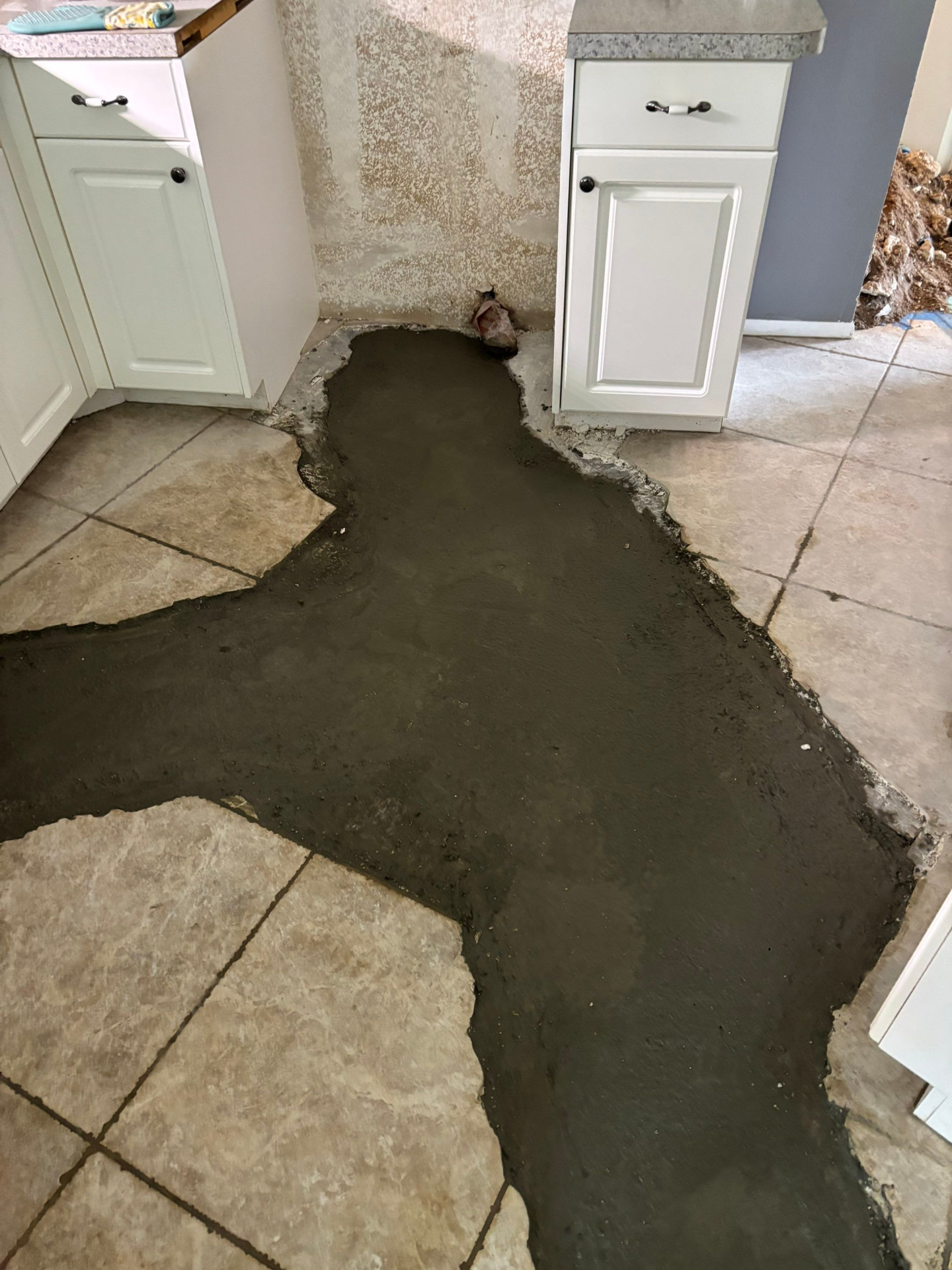
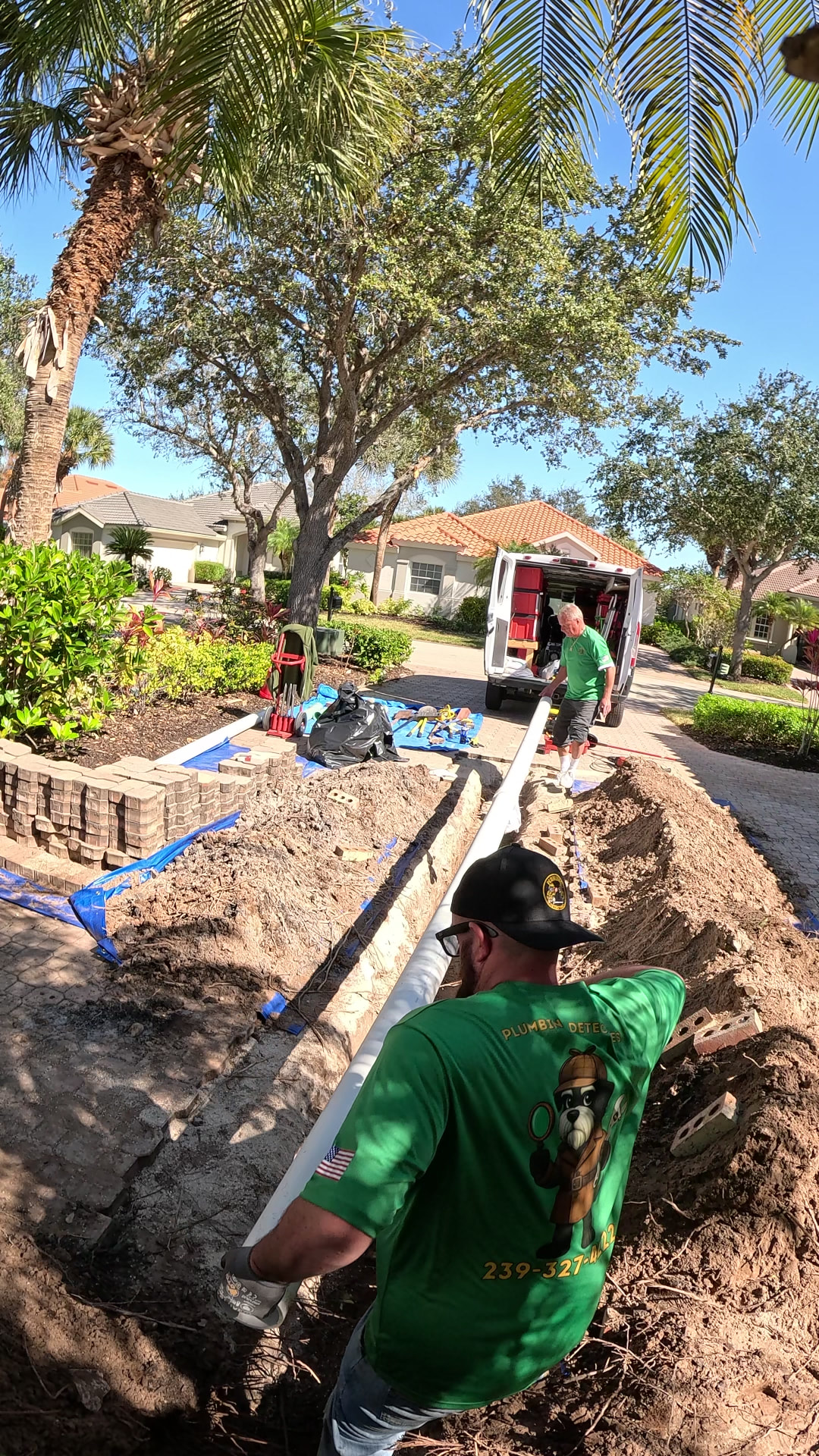
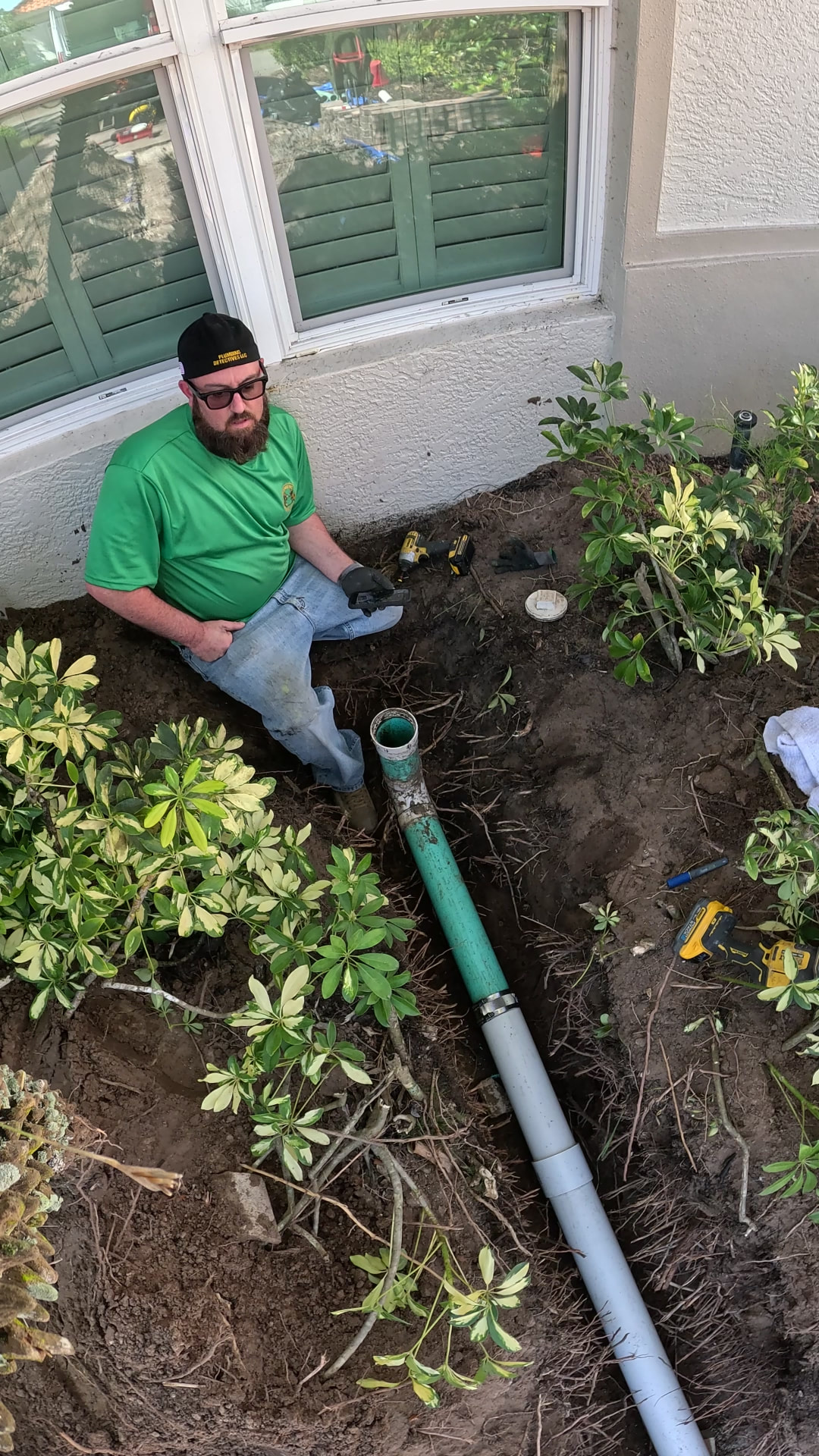
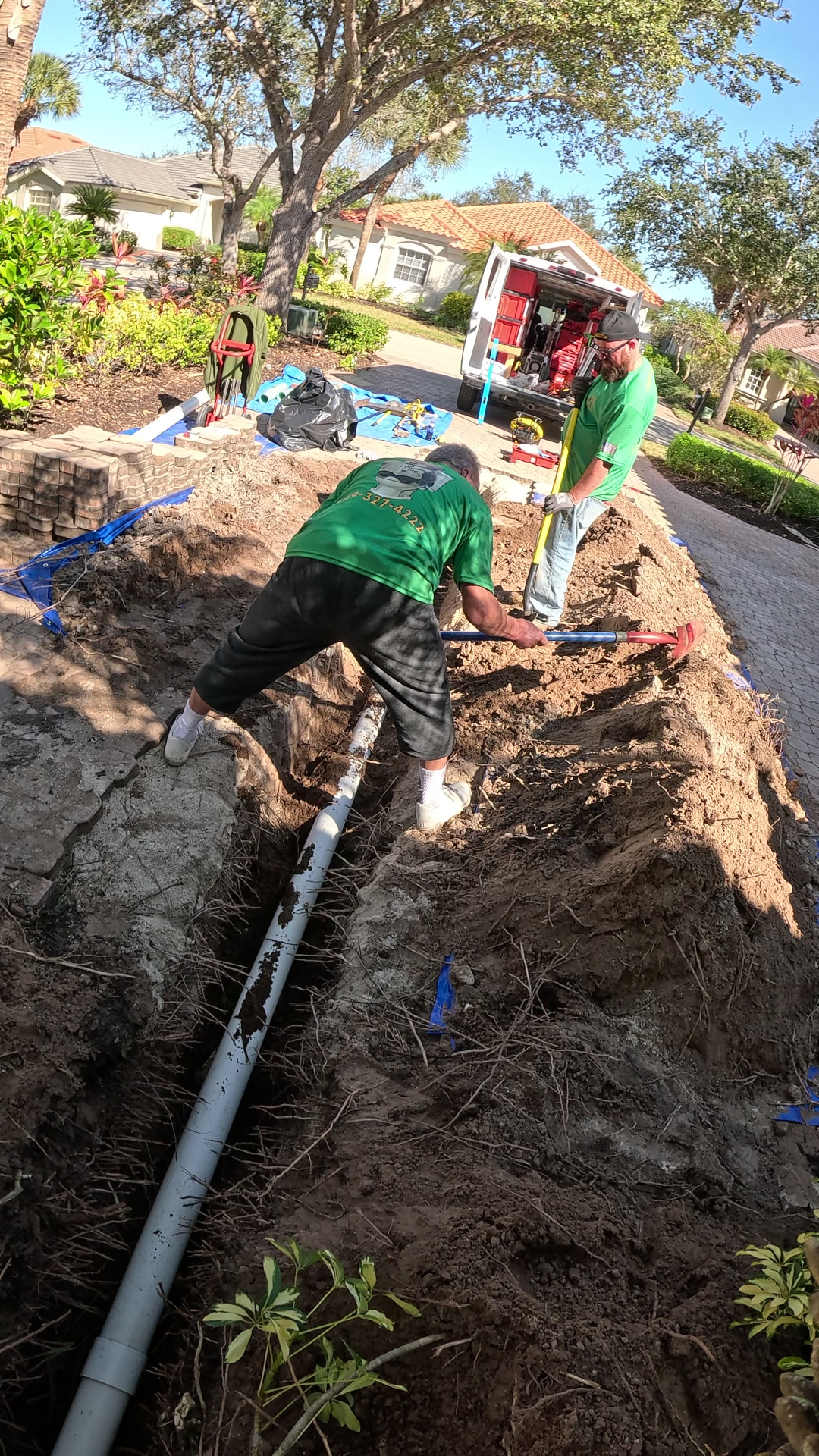
How the new pipe gets supported — the part you’ll never see but will live with for fifty years. This is where improper bedding is the single biggest reason sewer lines fail early in Venice Gardens’ sandy soil. I tamp the native sand, add bedrock, and tamp again until firm — at least 8 to 9 inches of compacted base under the pipe wherever I have the height. Where I have room, I set cinder blocks to support the pipe. Where height is tight, I set two bricks in a V under the line every six feet. More bedrock, tamp, check pitch, continue the run — and only when pitch is verified along the entire length does backfill go in. A pipe bedded this way doesn’t belly when August rains soften the ground. A pipe laid on loose sand does.
Cleanouts to code. Every replacement includes cleanouts where the Florida Plumbing Code requires them — at the junction of the building drain and building sewer, at the base of stacks, at horizontal runs over 100 feet, and at aggregate direction changes exceeding 135 degrees.
Permit and inspection. Venice Gardens is unincorporated Sarasota County — not the City of Venice. Sewer line repair and replacement is new plumbing work under the Florida Building Code, requiring a permit rather than falling under a minor-repair exemption. All permits for Venice Gardens route through Sarasota County Planning and Development Services, with the R.L. Anderson Administration Center at 4000 S. Tamiami Trail in Venice serving as the closer permit center for this neighborhood. We verify jurisdiction and pull the correct permit before work begins on every job.
Gurgling toilet? Recurring backups? Smells you can’t trace?
Call 239-388-3631. I live in this neighborhood — the camera comes first, you see everything I see, and you get a straight answer before anyone talks about opening a floor.
Venice Gardens Context
Repair Method Quick Reference — Venice Gardens Context
| Method | Best For | Not Appropriate When | Typical Regional Cost Range |
|---|---|---|---|
| Spot / Point Repair | One isolated failure in an otherwise sound line — a separated joint, a single crushed or rotted section, one root intrusion point | The camera shows failures at multiple points along the run; the "isolated" problem is actually a pattern | $800–$5,000 per national data; Florida sewer repairs average $3,430, most homeowners paying $980–$7,350 (CostWhale FL data) |
| Trenchless Relining (CIPP) | Structurally intact pipe with internal corrosion/scale that still holds its pitch | Bellies, sags, or sections out of pitch — common in this neighborhood's sandy soil after 60-plus years. Florida code (FBC-P Section 717) requires pre- and post-lining camera surveys. | $8,000–$20,000 typical Southwest Florida range; roughly $80–$250 per linear foot |
| Pipe Bursting | Structurally failed pipe on a straight run where a new pipe can be pulled through the old path | Runs with offsets, material transitions, or collapse that would deflect the bursting head | Roughly $60–$200 per linear foot nationally |
| Excavation & Replacement | Collapsed, rotted, severely bellied, or heavily obstructed cast iron — restored to new PVC at correct pitch with proper bedding and support | Rarely wrong when done correctly — the tradeoff is floor/yard access, which is why protection and documentation standards matter | $12,000–$30,000+ typical for full cast-iron-to-PVC replacement; roughly $100–$300 per linear foot |
All figures are typical published market ranges — not quotes for your home. Every Venice Gardens job is diagnosed by camera and priced section by section, in writing, before any work begins.
The Pipe's Worst Nightmare
Roots in a 60-Year-Old Neighborhood
Venice Gardens was built with mature landscaping in mind, and 60-plus years later, the trees planted alongside these homes have had six decades to grow root systems that reach exactly where they shouldn’t. Roots are a pipe’s worst nightmare — they grow with force, and they find the moisture escaping from an aging joint. On the camera, root intrusion looks like a curtain of fine hair at first — then a mat, then a mass that catches everything flowing past it.
Depending on the root and the tree, sometimes I can cut them out with my Spartan 300 machine running the claw head. But here’s my honest answer when a Venice Gardens homeowner asks “can’t you just cut the roots out again?” You can — and they’ll be back, because if roots are inside your pipe, your line is compromised. Cutting is maintenance on a failing line, not a fix. At that point the real options are: dig it out, replace the section, and cut the roots back substantially at the source — or attempt a reline, if and only if the camera confirms the pitch is still in order. The camera makes that call, not the tree.
Why August Is Different From February
Rainy Season — Why August Is Different From February in Venice Gardens
The water table under Venice Gardens commonly sits 2 to 6 feet below grade, and from June through September, the rains push it higher. Here’s what that actually means for a marginal sewer line in this neighborhood.
The ground gets soft, and that’s when settling begins. Sand that held a poorly-supported pipe in place through the dry season loses its grip when it saturates. A line that was borderline in February — a slight sag, a joint starting to separate — can shift into a full belly or a separation in August. Saturated soil is also when groundwater starts infiltrating through failing joints, adding flow to a line that’s already struggling.
This is why the smart move in Venice Gardens is a camera inspection before the heavy rains arrive, not after the backup happens during them. It’s also why proper bedding on a replacement — the tamped base, the bedrock, the block and brick support — isn’t overkill. It’s what keeps the new pipe holding its pitch through fifty more rainy seasons in this same sandy neighborhood.
Your Lateral, the County's Main, and the Gap Between
Who Owns What — Your Lateral, the County’s Main, and the Gap Between
This surprises almost every Venice Gardens homeowner: you own your sewer lateral — the pipe running from your house to the connection with the county’s main — and you’re financially responsible for it, including any portion running under the sidewalk or right-of-way. The county owns and maintains only the main itself. In this area, the transition to the county side generally begins near the property line — commonly around five feet from it — but the exact point varies by property and should be confirmed for your specific address.
Since Venice Gardens is unincorporated county, Sarasota County Public Utilities is the entity handling both the water and wastewater side here — a different arrangement than the City of Venice, which runs its own municipal sewer utility for in-city customers.
Why this distinction matters financially: a documented case in this broader area involved a South Venice home severely damaged by sewage backup and mold after a utility-side valve failure — and the utility’s liability was ultimately capped at $10,000 under its insurance policy, a fraction of the damage. The lesson isn’t that the utility is the enemy. The lesson is that your lateral is your asset to protect, your responsibility to maintain, and worth understanding before something fails. Standard homeowners policies generally treat lateral failures from wear, corrosion, or root intrusion as maintenance issues, not covered perils. Sewer backup coverage is typically a separate endorsement — ask your carrier what your policy actually covers before you need the answer.
Read This Before the Contract
Buying or Selling in Venice Gardens? Read This Before the Contract
Florida Statute 689.301 requires that before executing a contract for sale, a seller must disclose to a prospective purchaser any known defects in the property’s sanitary sewer lateral. I’m not a lawyer and this isn’t legal advice — but the statute exists, and a Venice Gardens seller who knows their lateral is failing has a legal disclosure obligation.
Here’s the practical reality every Venice Gardens buyer should hear: the standard home inspection does not typically include a sewer camera inspection. Almost none do. The four-point inspection your insurer requires looks at visible supply plumbing, the water heater, and visible leaks — but nobody puts a camera down the one pipe that costs five figures to replace when it fails. Given that every original home in this neighborhood shares the same 1956–1972 cast iron, that gap matters more here than in a neighborhood with mixed construction eras.
For sellers: a pre-listing camera scope either confirms your line is clear — a selling point you hand to buyers — or tells you about a problem while you still control how to address it. For buyers: a few hundred dollars for a camera inspection with recorded footage, before you close on a Venice Gardens home, is the cheapest insurance you will ever buy given the neighborhood’s uniform pipe age.
The Part You'll Never See
If I Could Redesign One Thing About Venice Gardens Drain Systems
For the drain side of these homes, my answer comes from what I’ve actually found in every Venice Gardens home I’ve opened up: none of them were vented properly.
These homes were plumbed before modern wet venting was in the code, and what I find instead are bathroom groups with one vent serving three fixtures. My preference, on the vast majority of the work I do, is the traditional approach: vent each fixture individually. Every fixture with its own air path gives you the best flow, the quietest drainage, and the most serviceable system. So when we’re replacing a section of a Venice Gardens home’s drain system anyway, the venting gets evaluated too. Fixing the pipe under the slab while leaving three fixtures fighting over one vent is solving half the problem.
What I Find in Venice Gardens Sewer Work
Common Mistakes I Find in Venice Gardens Sewer Work
Unsupported pipe. When I camera a Venice Gardens line another company already “fixed” and find it bellying again, I’d bet all my money on what happened: nobody supported it in this sandy soil.
No camera before the quote. A sewer proposal written from a drain-cleaning visit and a guess. In a neighborhood this uniform in age, it’s tempting for a company to price off the build year rather than the actual pipe.
The disappearing video. Camera inspections where the homeowner never receives the footage. Documented video with a distance counter is accountability. When the video conveniently doesn’t exist, ask yourself why.
Lining over a belly. Selling CIPP on a line the camera shows is out of pitch — a real risk in a neighborhood where six decades of sand movement have shifted plenty of sections. Lining doesn’t fix gravity.
Cutting roots as a business model. Coming back every year to cut the same roots out of the same compromised joint, without ever telling the homeowner the line itself is the problem.
Missing or buried cleanouts. Replacements done without code-required cleanouts, or with cleanouts buried under new landscaping.
No permit. Concealed drain pipe replaced without the Sarasota County permit and inspection the Florida Building Code requires — an easy mistake to make in Venice Gardens if a company assumes it’s City of Venice jurisdiction.
Plumbing Detectives LLC Tips
If a toilet in your Venice Gardens home gurgles when the washing machine or dishwasher runs, don’t wait for the backup to make it official. Every home here is on the same 60-plus-year-old cast iron clock, and a gurgle only moves in one direction.
Find your main cleanout — usually a capped pipe at grade near the house or along the lateral path — and confirm the cap is present and sealed. Many Venice Gardens homes from this construction era don’t have proper cleanouts, and that changes how any future service call goes.
If you haven’t had your sewer lateral camera-inspected in the past three years — or ever — schedule it before the June rains, not after. The rainy season is when this neighborhood’s soft, saturated sand turns marginal lines into failed ones.
Before you sign any sewer repair or lining proposal in Venice Gardens, ask for the recorded camera footage with the distance counter visible. If the contractor is quoting off the neighborhood’s known build year instead of your specific pipe, that’s not a diagnosis.
What the 2024 Season Did
Storm Context — What the 2024 Season Did to Venice Gardens’ Sewer Picture
I want to be straight about this section: it’s grounded in documented county records, not my personal storm-repair work in every affected home. Hurricane Milton made landfall near Siesta Key in October 2024 — the first direct hurricane landfall in Sarasota County since 1944. The Venice Gardens Water Reclamation Facility, which serves this neighborhood, experienced a power supply failure during the storm that caused a documented 126,000-gallon raw sewage spill, with a nearby lift station contributing additional spillage.
Two practical takeaways for Venice Gardens homeowners. First, saturation and surge are exactly the conditions that shift marginal, poorly-supported lines — and this neighborhood’s sandy soil and uniform pipe age make that risk higher than in a neighborhood with newer or mixed infrastructure. Second, if your home took any backup or unusual drainage behavior during or after Milton, and your drain system has never been camera-inspected since, that inspection is a reasonable next step — particularly given the county’s own documented facility failure during that storm.
The Differentiator
Why Plumbing Detectives LLC
I named the company Plumbing Detectives LLC because the work starts with figuring out what’s actually wrong — and in a neighborhood where every home shares the same pipe material and the same age, that diagnostic step matters more, not less. The differentiator isn’t the method. It’s whether anyone actually diagnosed your specific pipe before pricing it, whether you got the footage, and whether the person who opened your floor supported the new pipe properly in this neighborhood’s sandy soil.
Camera first. Documented findings. Section-by-section honesty. White glove protection of your home. Proper bedding you’ll never see but will never have to think about again.
License CFC1434139. Fully insured. We pull permits through Sarasota County Planning and Development Services. Emergency sewer service available in Venice Gardens and nearby areas — call for priority scheduling. I’m your neighbor — not a marketing line, an actual fact.
Answers
Frequently Asked Questions — Sewer Line Repair in Venice Gardens, FL
If you’ve read this far, you understand why every home in Venice Gardens shares the same sewer risk profile — and why that shared history doesn’t mean every home needs the same fix. You know what six decades of Florida water does to cast iron, why lining can’t fix a belly, and what proper pipe support actually looks like under this neighborhood’s sandy soil. If your Venice Gardens home is showing any of the signs on this page, or if you simply want to know what condition your line is actually in after six decades, call me at 239-388-3631. I live here. The camera goes in first, you see everything I see, and you get the truth before you get a price.
Plumbing Detectives LLC | Venice, FL | License CFC1434139
239-388-3631 | plumbingdetectivesfl.com