
Sewer Camera Inspection · Venice, FL
Sewer Camera Inspection in Venice, FL
Sewer Camera Inspection — $325. Optional recorded-video add-on — +$70, delivered by Google Drive within 24–48 hours, guaranteed. Total with the recorded-video add-on: $395. Licensed master plumber CFC1434139.
Call Now239-388-3631Camera log · one line, 43 feet
What the camera actually found, foot by foot
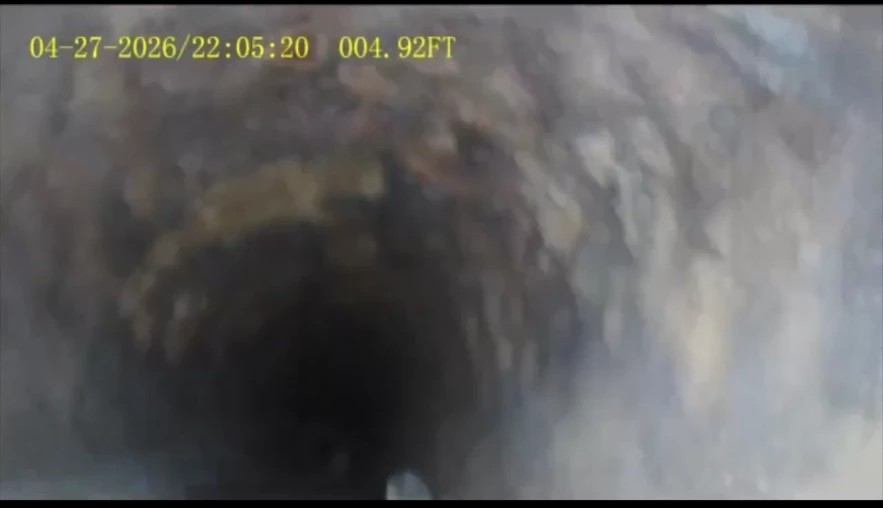
These are real stills off one inspection, with the footage counter burned into the picture. Nothing staged, nothing borrowed — this is how a failing line reads on camera from the cleanout out to the collapse, including a second belly at 37 feet.
 4 ft
4 ftScale building on the pipe wall
Four feet in and the scale is already obvious — the inside of the pipe is no longer smooth. That rough, built-up surface is what catches paper and grease and starts the backups.
Every sewer problem in Venice starts the same way: something is wrong, and nobody can see it. The pipe is under the slab, under the yard, invisible from every angle except one. A sewer camera inspection is the one honest way to know what’s actually happening inside your line — before anyone quotes you a repair, before you buy a house built in 1965, before the rainy season turns a marginal pipe into a backup.
I named the company Plumbing Detectives LLC because the diagnosis is the job. The camera is the single most important diagnostic tool I own, and this page explains exactly what a camera inspection involves, exactly what it costs, exactly what you walk away with, and why the documented footage is worth more than the inspection itself.
My name is Mike Reynolds. I’m the owner of Plumbing Detectives LLC and a licensed master plumber, license CFC1434139, based right here in Venice. I run the camera myself. Here’s how it works.
Transparent Pricing
Transparent Pricing — What It Costs, What You Get
Most companies in this market make you call for camera inspection pricing. Here’s mine, in writing:

Camera Inspection & Surface Locate
$325
I run the camera through an accessible cleanout and inspect the line. Anything the camera finds gets located and marked above ground — I use a 512 Hz locator to pinpoint problems from the surface and mark the exact spots. You’re with me the whole time: when I see something, I call you over and show you on the screen, live. We go back and forth along the run together. When we’re done, you get a written report of the findings. Everything is explained on site, face to face.
Optional Recorded-Video Add-On
+$70
Optional. Adds the full recorded video of your inspection, delivered to you by Google Drive within 24 to 48 hours. If it’s not delivered in that window, the video add-on is refunded. That’s the guarantee. Total with the recorded-video add-on: $395. Ask for the video add-on when you book — it is not included in the $325 base inspection.
Regional pricing for sewer camera inspections runs $150 to $500, and Florida-specific data puts the typical scope at $200 to $400 — so my pricing sits right in the honest middle of the market. If another company quotes you less, ask the questions that matter: Are they locating and marking the line above ground? Are they walking you through the findings on screen, in real time? Are they giving you a written report? Are they delivering the actual footage on a guaranteed timeline? My service includes documentation and a guaranteed turnaround. That’s what the price buys.
Documentation
Why the Video Is Worth More Than the Inspection
I want to explain why the video report exists as an option, because the value isn’t the upload — it’s the documentation.
Once you’re holding the recorded footage of your own sewer line, with the distance counter visible on screen, that video works for you in ways a verbal opinion never can. You can send it to another plumber for a second opinion. You can hand it to a contractor planning a renovation. You can give it to your insurance carrier. You can attach it to a real estate transaction — as a seller demonstrating a clear line, or as a buyer documenting a problem before closing. It’s a permanent, timestamped record of exactly what your pipe looked like, foot by foot, on a specific date.
Here’s the uncomfortable truth about this industry: some companies casually lose the camera video, or never record one at all. Think about why. Documented footage with a distance counter shows exactly where the problems are, exactly how severe they are — and exactly where they aren’t. It keeps the diagnosis honest and the repair proposal accountable to what’s actually on screen. A company whose footage always seems to disappear is a company whose quotes can’t be checked. Mine can. That’s the point.
The Equipment
What the Camera Actually Is — And Why the Equipment Matters
Not all sewer cameras tell the truth equally. I run a Plumber’s Vision inspection camera system, and it has three features that matter for your diagnosis:
A self-leveling head. The picture stays oriented right-side up as the camera travels, which means when the image shows water pooling along the bottom of the pipe, that’s real — the line is holding water in a low spot. A self-leveling head is how bellies show up plainly on screen instead of being explained away. This matters enormously if anyone ever proposes relining your pipe, because a liner can’t fix a belly, and the self-leveling head is what proves whether one exists.
A distance counter. The footage shows exactly how many feet in every finding sits. Combined with the locate, that turns “you have a problem somewhere” into “the separation is at 23 feet, under the hallway, marked on your floor.”
A 512 Hz locator. The camera head transmits a signal I trace from above ground. I walk the line’s path across your floor or yard and mark each problem’s exact position — inside the house, I mark with blue painter’s tape. When it’s time to price a repair, the marks mean we’re opening the floor at the problem, not exploring for it.
The Process
The Inspection, Step by Step
Access. The visit runs 25 minutes to 2 hours, and access is the variable. If there’s a cleanout on the lawn — great, we’re in and moving. But plenty of older Venice homes don’t have accessible cleanouts, which means sometimes a toilet has to be pulled, and sometimes the camera goes in from the roof through a vent stack. I’ll tell you which situation your home is before we start. (At one South Venice job, the toilet was cemented in and had to be broken just to get camera access — more on that job below.)
The run. I feed the camera through the line, watching the screen the entire way. The moment I see something — buildup, a root mat, standing water, a separation — I call you over. You see it live, on screen, as I see it. We move through the line together, and every finding gets marked above ground as we go.
The findings, explained. Buildup and scale that’s narrowing the pipe. Bellies holding water. Root intrusion at joints. Cracks, channeling, separations. Or — and this happens too — a clean, sound line, which is a result worth exactly what you paid to know it. I explain each finding in plain language, on site, and what it means for the line’s future.
The written report. Every inspection ends with a written report of the findings. If you chose the video option, the full footage lands in your Google Drive within 24 to 48 hours, guaranteed.
What happens next — only if the line needs it. If the camera found problems, I explain the honest options: monitor, spot repair, relining where the pitch supports it, or replacement where it doesn’t. The full decision tree — including why lining can’t fix a belly and how section-by-section replacement pricing works — lives on my Venice sewer line repair page. If the findings do lead to repair work, that work is permitted through the correct authority for your address — the City of Venice Building Department (941-486-2626, via the eTRAKiT portal) inside city limits, or Sarasota County Planning and Development Services for the surrounding unincorporated areas. And if the line is sound, I tell you that, and the conversation is over. The inspection is a diagnosis, not a sales funnel.
Plumbing Detectives LLC Professional Opinion
Never authorize a sewer repair, replacement, or lining job that wasn’t preceded by a camera inspection you personally watched or received on video. The camera is the diagnosis. Everything else is a guess with a price attached. And if anyone proposes lining your pipe, know this: Florida’s plumbing code now requires a video camera survey before relining begins and after it’s complete. The footage isn’t a courtesy. It’s the standard.
Documented Job
What the Camera Found — A Real Venice Inspection
The best explanation of what a camera inspection is worth is what one actually found, in a documented job that became a distributed press release in May 2026.
A 1980 South Venice slab home. The homeowner’s only symptom: a guest toilet gurgling louder and louder over the course of a week. She requested a camera inspection. The toilet was cemented in — we had to break the bowl for access. Within the first ten feet, the camera hit standing water under the daughter’s closet in the next room. Past that section, the pipe was bone dry — the water wasn’t flowing, it was pooling in a sag and seeping into the sand through pipe that had rotted from the inside out. Further along, in the kitchen run, the 4-inch trunk line had narrowed to what looked like 2-inch pipe from interior buildup. Near the end of the kitchen the camera could barely pass at all — the line had sunk so badly it was remarkable there hadn’t been a backup yet. When the floor came open, the pipe was more than half full of black, soot-like buildup, with a sagging 1/8 bend that had to be seen to be believed.
Here’s the part that matters most: the camera also showed the last fifteen feet of the run — past the master bath, out toward the septic — was still in good condition. So it stayed. Roughly three-quarters of the home’s drain system was replaced; the sound section was left alone. That’s what the camera buys you: not just finding what’s broken, but proving what isn’t, so you never pay to replace pipe that’s fine.
Every foot of that job is on video — the pre-repair inspection footage, the excavation, and the post-repair camera run through the new line. That’s the documentation standard on this page, applied to a real Venice home.
And it isn’t a one-off. Another inspection — a vacation home whose owners reported smells — found the line disconnected at the cleanout within the first five feet, a completely collapsed section under the master bedroom, and a wye fitting barely hanging on as the only thing keeping the rest of the house flowing. Same era, same material, same black buildup. Two houses that looked fine from above. Two cameras that told the truth.
Timing
When a Venice Homeowner Should Get a Camera Inspection
A gurgling toilet, slow drains, or recurring clogs. The gurgle is the most common early symptom of a failing line in this market — air pulling through the bowl because the drain system isn’t flowing right. It only gets worse. The camera tells you what’s causing it while it’s still a scheduled repair.
Before buying a home — especially one built before 1980. I’ll say this as plainly as I can, because I just lived it: I recently purchased a home in South Venice, and the standard home inspection did not include a sewer camera inspection. Almost none do. The inspector checks the roof, the panel, the visible plumbing — and nobody looks inside the one pipe whose replacement costs five figures. In my opinion, a sewer scope should be required on every older-home purchase. Until it is, a few hundred dollars for documented footage before closing is the cheapest protection available on a 1960s Venice slab home.
Before selling. Florida Statute 689.301 requires sellers to disclose known defects in the sanitary sewer lateral before a contract is executed. A pre-listing camera scope either produces documented proof of a clear line — which you hand to buyers as a selling point — or it tells you about a problem while you still control the timing and the fix. Either result beats a buyer’s plumber finding it three weeks from closing.
Before rainy season. Venice’s water table runs just 2 to 6 feet down, and the June-through-September rains push it higher. Saturated sand is when marginal lines settle, bellies deepen, and joints separate. If your lateral hasn’t been inspected in the past three years — or ever — the smart timing is before the heavy rain arrives, not during the backup.
Before any renovation that touches plumbing. Adding a bathroom, remodeling a kitchen, converting a tub to a shower — all of it drains into a line whose condition should be known before new fixtures connect to it.
Before anyone lines your pipe. Since April 2024, Section 717 of the Florida Building Code, Plumbing, requires the existing pipe to be cleaned and internally inspected by video camera before any cured-in-place relining begins — and inspected again after installation, before the code official approves it. A pre-lining camera survey isn’t optional in Florida. If a company proposes lining your Venice sewer without showing you pre-lining footage, they’re skipping a step the state requires — and possibly hiding the belly that makes lining the wrong answer.
After the 2024 storms. If your home took water during Milton or the surrounding storm season and the drain system has never been looked at since, saturation and surge are exactly the conditions that shift marginal lines. A camera run settles the question.
Ready to know what’s actually in your line?
Sewer Camera Inspection — $325. Optional recorded-video add-on — +$70, delivered by Google Drive within 24–48 hours ($395 total). Call 239-388-3631. Emergency sewer service available in Venice and nearby areas — call for priority scheduling.
Quick Reference
What the Camera Finds in Venice Homes — Quick Reference
| Finding | What It Looks Like on Screen | What It Means | Typical Next Step |
|---|---|---|---|
| Scale / buildup | Pipe walls closing in — a 4" line behaving like 2"; in severe cases, black soot-like accumulation filling half the pipe | Decades of interior corrosion and deposits restricting flow; common in 60+ year old Venice cast iron | Depends on severity: cleaning and monitoring, or replacement of the affected sections when the pipe wall itself is compromised |
| Belly / sag | Standing water that shouldn't be there — the self-leveling head shows water pooled along the bottom while pipe beyond it runs dry | The line has settled out of pitch; waste collects in the low spot until it blocks. Bellies rule out relining — a liner follows the host pipe's shape | Spot repair or sectional replacement with proper bedding and support, re-graded to correct pitch |
| Root intrusion | Fine root hairs at a joint, growing into mats and masses that catch everything passing | Roots found moisture escaping a compromised joint; the line is compromised wherever they've entered | Cutting (Spartan 300 with claw head) as maintenance; replacement of the section with roots cut back at the source, or relining only if pitch is confirmed intact |
| Separation / disconnection | A visible gap or offset at a joint — in one Venice-area inspection, the line was disconnected at the cleanout within the first five feet | Waste and water escaping into the soil; soil migrating into the line; settlement accelerating | Repair or replacement of the affected fitting/section |
| Collapse | The camera physically cannot pass | No camera passage means severely restricted or no flow — backup is a matter of time | Sectional replacement; camera continues upstream after the failed section is cleared, so the repair goes exactly as far as the damage and no further |
| Clean, sound line | Smooth walls, steady flow, consistent grade on the counter | The line is healthy — documented proof, on video if you chose the report | Nothing. Keep the footage; re-inspect in a few years or before a sale. A clean result is a result. |

Septic or City Sewer
Septic or City Sewer — The Camera Covers Both
The inspection covers your line whether it runs to a municipal main or to a septic system. Plenty of homes in this market — particularly across South Venice — remain on septic, and both of the documented inspections described on this page were septic-served homes. The pipe between your fixtures and the tank fails the same ways, from the same causes, as a lateral running to the city main.
Worth knowing about the boundary if you’re on municipal sewer: you own your lateral from the house to the connection with the main — the transition generally begins near the property line, though the exact point varies by property. The City of Venice operates its own sewer utility for in-city customers with a 24-hour emergency line at 941-486-2770; the unincorporated areas around the city are served by Sarasota County Public Utilities. The camera inspection documents your side of that boundary — the side you’re financially responsible for, and the side your insurance likely treats as a maintenance item rather than a covered peril. Also worth knowing: Venice is not part of Sarasota County’s Phillippi Creek septic-to-sewer conversion program — that program’s boundary sits well north of the city — so if you’re on septic here, no county program is converting your connection.
Plumbing Detectives LLC Tips
Buying a home in Venice? Add a sewer camera inspection to your due diligence — the standard home inspection doesn’t include one, and I say that as someone who just bought a South Venice home and watched it not happen. A few hundred dollars of documented footage before closing on a 1960s slab home is the best-value inspection in the entire transaction.
Choose the video report option if the inspection is tied to any transaction, insurance question, or second opinion. The footage — with the distance counter visible — is a timestamped record you can hand to anyone. That documentation is worth more than the inspection itself.
Locate your main cleanout before you need it. If it’s buried, missing its cap, or doesn’t exist — common in older Venice homes — that’s worth knowing on a calm Tuesday rather than during a backup. It also determines whether your camera inspection is a 25-minute cleanout job or a pulled-toilet job.
If any company proposes relining your sewer, ask to see the pre-lining camera footage first. Florida’s plumbing code requires it — and it’s also the footage that shows whether your pipe has the bellies that make lining the wrong answer.
Why Us
Why Plumbing Detectives LLC
The company is named for exactly this service. Detective work is looking at the evidence before drawing the conclusion — and in sewer work, the camera is the evidence. I run the inspections myself on a Plumber’s Vision camera system with equipment that shows the truth: a self-leveling head that proves bellies, a distance counter that pins every finding to a foot mark, and a 512 Hz locator that puts each problem’s position on your floor in blue tape. You watch the screen with me. You get the written report. You get the footage on a guaranteed timeline if you want it. And if the line is clean, you get told that, too.
Diagnosis first. Documentation always. The repair conversation only when the evidence says so.
License CFC1434139. Fully insured. Serving Venice, Venice Island, and South Venice — zip codes 34285 and 34293 — and the surrounding communities. Emergency sewer service available in Venice and nearby areas; call for priority scheduling.
Answers
Frequently Asked Questions — Sewer Camera Inspection in Venice, FL
If you’ve read this far, you now understand sewer camera inspections better than most homeowners in this market ever get them explained. You know what the equipment actually does, what the findings look like, why the documented footage is worth more than the inspection itself, why Florida code now requires camera surveys around any relining work, and what a camera found under two real Venice-area homes that looked perfectly fine from above. Whether you’re chasing a gurgle, buying a 1960s slab home, listing one, or just want to know what sixty years have done to the pipe under your floor — call me at 239-388-3631. The camera goes in, you see everything I see, and you walk away with the truth in writing.
Plumbing Detectives LLC | Venice, FL | License CFC1434139
239-388-3631 | plumbingdetectivesfl.com