
Whole House Repiping · Bradenton, FL
Whole House Repiping in Bradenton, FL
Honest assessment across a century of housing eras — from 1920s bungalows to new construction. Licensed master plumber CFC1434139. Diagnosis first, always. Call 239-388-3631.
Call Now239-388-3631The house I’m currently bidding in Bradenton was built in the 1940s. The homeowner is adding structural steel — a significant renovation — and I specifically told them to finish that work first. Once the structure is complete, I can properly anchor and support the new plumbing to something permanent. Trying to repipe before the structural work is finished doesn’t make sense.
That’s an honest answer that costs me time on the front end. But it’s the right answer for that specific home at that specific moment.
That’s how I approach every Bradenton job. The first thing I want to know when I pull up to a Bradenton address is when the house was built — and whether it’s on a private well or municipal water. Those two questions immediately start narrowing down what pipe materials I’m likely walking into and what problems I should be expecting before I knock on the door.
Bradenton is a river city with a housing stock that spans more than a century. A 1920s bungalow in the Village of the Arts and a 2020 home in Del Tierra are both in “Bradenton” — but they have almost nothing in common from a plumbing standpoint. The pipe materials are different. The water source may be different. The failure modes are different. The right approach is different. Treating them the same is the mistake.
My name is Mike Reynolds. I’m the owner of Plumbing Detectives LLC and a licensed master plumber, license CFC1434139. I’m based in Venice and registered in both City of Bradenton and Manatee County jurisdictions. Before you spend a dollar on repiping in Bradenton, here’s what I’d want you to understand.
The Local Story
What Makes Bradenton Different — A Century of Housing in One Market
No other market I serve has Bradenton’s range. The oldest residential neighborhoods — Old Manatee Historic District, the Village of the Arts, Wares Creek, Braden Castle Park — date to the 1920s and 1930s and represent some of the oldest occupied housing stock in Manatee County. The mid-century neighborhoods — Bayshore Gardens, built 1956 to 1963, Riverview Boulevard — are slab-on-grade concrete block construction from the transition era when galvanized steel was giving way to copper. The 1980s growth corridor — Braden Woods, Braden River Lakes, Peridia, the Tara-area condominiums — falls squarely in the polybutylene window. And the eastern growth edge — Del Tierra, Esplanade at the Heights, the 34211 and 34212 zip code corridor — is modern PEX construction.
That’s roughly a hundred years of residential plumbing in a single market. Every era gets a different evaluation when I walk in the door.
The second thing that sets Bradenton apart is the dual-jurisdiction permitting structure. Most homeowners with a Bradenton mailing address are actually in unincorporated Manatee County — not inside the City of Bradenton’s 14.3 square mile incorporated boundary. Bayshore Gardens, Braden River Lakes, Peridia, the Tara communities — all of these carry Bradenton mailing addresses but permit through Manatee County Building and Development Services at 1112 Manatee Ave W, not through the City of Bradenton Building Division at 101 Old Main Street. These are two completely separate permit offices with different fee structures, different review processes, and different inspection systems.
I verify jurisdiction by address before pulling any permit on every Bradenton job. Filing with the wrong office would invalidate the permit. It happens more than it should in this market.
The Material Story
What’s Actually in Your Walls — The Bradenton Pipe Material Story by Era
Every era of Bradenton construction tells a different pipe material story. Here’s how I think about it by decade.
Pre-1960 — The Village of the Arts, Wares Creek, Braden Castle Park, Old Manatee
These are the homes I walk into and immediately think about galvanized steel. Galvanized was the Florida residential standard through the 1950s and into the early 1960s. In the homes I’m currently looking at in this part of the market — I’m bidding a 1940s Bradenton home right now — the construction era tells me the pipe material before I see a single fitting.
Galvanized supply lines from this era are now 65 to 100-plus years old. The zinc coating that originally protected the steel from corrosion has been depleting for decades. What’s left is rust scale building up on the interior walls of the pipe — progressively narrowing the bore, reducing water pressure, and eventually corroding through to produce pinhole leaks or sudden wall failures. By the time a homeowner in a 1930s Village of the Arts bungalow mentions that their pressure has been declining for years, the galvanized system has been telling that story slowly for a long time.
Bayshore Gardens — documented as built 1956 to 1963 — sits in the galvanized-to-copper transition window. Real permit records pulled from Manatee County’s own BuildZoom data confirm active repipe permits being filed for Bayshore Gardens addresses right now. This isn’t speculation. It’s documented, ongoing repipe activity in a specific, dated subdivision.
1960s through the 1970s — Riverview Boulevard, Samoset, older suburban expansion
Copper supply lines became the Florida standard as galvanized gave way. Homes from the late 1960s through the 1970s are most likely copper. In Bradenton’s municipal water — both the City of Bradenton and Manatee County Utilities use chloramines as a disinfectant, documented in both utilities’ own Consumer Confidence Reports — that copper has been exposed to a chemistry that can contribute to pinhole leak development over decades. Copper in this age range is now 45 to 60 years old and in the failure window in many homes.
Under-slab copper in 1970s construction deserves specific attention. Copper supply lines from this era were frequently laid directly in or under the concrete slab without protective sleeving. Unsleeved copper in direct contact with concrete is subject to corrosion from outside the pipe as well as inside — the concrete’s mineral content, the moisture that migrates through it, and the physical abrasion of the pipe expanding and contracting with temperature changes all contribute. Pinhole leaks in unsleeved under-slab copper are one of the most common plumbing emergencies in Bradenton’s mid-century housing stock.
1978 through 1995 — Braden Woods, Braden River Lakes, Peridia, Tara condominiums
This is the polybutylene window, and these are the specifically named, build-year- confirmed Bradenton-area subdivisions that fall inside it. Braden Woods and Braden River Lakes — built 1980s through 1992 — are documented in multiple sources. Peridia started construction in 1987. The Tara Verandas condominiums date to 1989 to 1991. Any home in these communities that hasn’t been repiped may have polybutylene supply lines.
Here’s what I tell homeowners about polybutylene — the thing most people don’t realize: it usually looks perfectly fine from the outside. That’s what makes it deceptive. The failures happen from the inside out. The outside of the pipe can look almost new while the material has already started breaking down internally from chloramine exposure. Visual appearance alone should never determine whether a polybutylene repipe is necessary. The pipe needs to come out because of what it is, not because of how it looks.
Post-1995 — CPVC and PEX in the newer construction
River Club, Del Tierra, Esplanade at the Heights, and the ongoing eastern Manatee County growth corridor are CPVC and PEX-era construction. These homes are not near-term repipe candidates in the traditional sense. The conversation there is water quality, expansion tank compliance, and installation workmanship — not aging pipe materials at end of life.
Water Chemistry
Bradenton Water Chemistry — A Variable That Changes by Address
This is something I want to be honest about. Water chemistry in Bradenton is a variable I’m becoming more conscious of as I build my understanding of this market. The science is clear. The field documentation takes time.
Here’s what the research shows. Both the City of Bradenton and Manatee County Utilities use chloramines for disinfection — documented in their own Consumer Confidence Reports. Manatee County’s 2024 water quality data shows a total hardness range of 90 to 259 mg/L — roughly 5 to 15 GPG from the utility’s own figures, with independent water treatment specialists placing the effective range higher at 15 to 20 GPG in many areas, and some eastern Manatee County wells testing above 25 GPG. The sources disagree on the precise figure, and I’m not going to resolve that disagreement here with a number I can’t stand behind for every address.
What I can tell you is that all sources agree Bradenton-area water is in the hard to very hard category. And the combination of hard water and chloramine disinfection is a real factor in copper pinhole development over time.
This is also why the water treatment conversation needs to happen alongside the pipe material conversation. Always test the water first. Know what’s actually causing the damage before spending thousands of dollars replacing plumbing. The pipe material is only part of the equation. The water attacking that material is just as important. A whole-house water treatment or filtration system — matched to what’s actually in your specific water — may be one of the most important investments a Bradenton homeowner makes alongside a repipe. We’ll touch on that throughout this page.
Plumbing Detectives LLC Professional Opinion
Always test the water first. Know what’s actually causing the damage before spending thousands of dollars replacing plumbing. The pipe material is only part of the equation. The water attacking that material is just as important. And sometimes the right plumbing decision is waiting until the rest of the project is actually ready — like a home where structural work needs to be completed before the plumbing can be properly anchored. Rushing a repipe before conditions are right doesn’t serve the homeowner. Diagnosis first. Every time.
The Honest Answer
Do You Actually Need a Whole House Repipe?
This is the most important question on this page and the answer is different for every Bradenton home. Here’s the honest breakdown.
No — not right now:
A home that’s been correctly repiped with PEX or properly installed copper, documented with a permit and final inspection. Done.
One isolated pinhole leak in a copper system that otherwise passes a pressure test. Repair it, monitor it, don’t jump to replacement.
A newer home in Del Tierra or the eastern Manatee County growth corridor with PEX or CPVC and no pattern of failures. Not the repipe conversation.
A home in the middle of structural renovation where the right move is finishing the structural work first so the plumbing can be properly anchored and supported. Sequence matters.
Maybe — worth a full assessment:
Copper from the 1970s or 1980s that’s had two pinhole leaks in different locations within the past year. That’s a pattern, not isolated bad luck. A pressure test and visual inspection tells me whether it’s systemic.
A home in Braden Woods, Braden River Lakes, Peridia, or Tara-area communities where the pipe material hasn’t been confirmed. Build year puts these squarely in the polybutylene window. A 15-minute check answers the question.
An older home on well water where nobody has evaluated what the water chemistry is doing to the existing pipe material.
A home approaching an insurance renewal or listing for sale where the four-point inspection is going to ask about pipe material and condition.
Yes — a full repipe is the right answer:
Confirmed polybutylene throughout the home. Citizens Property Insurance Corporation’s underwriting Rule 206.B is a hard written rule. The national class-action settlement fund closed to new claims in 2009 — replacement is now an out-of-pocket or insurance-negotiated cost. Full replacement is the standard answer.
Galvanized supply lines confirmed in an unrepiped 1930s, 1940s, or 1950s home. At 65 to 90-plus years old in Florida’s water chemistry, the pipe is past any reasonable service life extension.
Three or more pinhole leaks in copper within a six-month window. The system is deteriorating at multiple points simultaneously.
A four-point inspection has flagged the pipe material and triggered a carrier non-renewal, coverage restriction, or premium action.
Repeated patch repairs over multiple years with no improvement to the pattern. At that point the homeowner has stopped asking “can we fix this one” and started asking “how do we stop doing this forever.” That’s the repipe conversation.
Not sure where your Bradenton home falls? Call 239-388-3631. I’ll assess the system — construction date, pipe material identification, pressure test, water source evaluation — and give you a straight answer before recommending anything.
Call Now239-388-3631Quick Reference
Pipe Material Quick Reference — Bradenton Context
| Pipe Material | Typical Lifespan | Common Failure Mode | Bradenton Context | Status |
|---|---|---|---|---|
| Galvanized Steel | 40–50 years (shorter in FL) | Internal rust scale narrows diameter over decades — pressure loss, discoloration, eventual wall failure | Pre-1960 construction: Village of the Arts, Wares Creek, Braden Castle Park, Old Manatee, early Bayshore Gardens. Build-year-confirmed repipe activity documented in Bayshore Gardens right now. | Past expected service life in all unrepiped pre-1960 homes. Replacement strongly recommended. |
| Copper (Type L) | 50–70 years | Pinhole leaks from interior water chemistry corrosion — chloramine treatment and hard water are primary drivers. Unsleeved under-slab runs are highest risk. | 1960s–1990s conventional homes throughout Bradenton. Riverview, Samoset, mid-Bayshore Gardens. Now 35–60 years old. | In the pinhole risk window. Evaluate by leak pattern and pressure test, not age alone. |
| Polybutylene (PB2110) | 25–40 years (unpredictable) | Fails from inside out — chloramine degradation makes pipe brittle internally while exterior looks normal. Acetal fittings fail suddenly with no warning. | Braden Woods, Braden River Lakes (1988–1992), Peridia (from 1987), Tara Verandas (1989–1991). Build-year-confirmed polybutylene-window subdivisions. | Active insurance liability. Citizens Rule 206.B applies. National settlement closed 2009. Full replacement standard. |
| CPVC | 50+ years when installed correctly | Brittleness with age and heat cycling. Cracks during repair attempts. Branch lines often fail before mains. | Appears in 1990s–2000s construction and repairs. River Club era. | Evaluate mains and branches separately. Better modern materials available for replacement. |
| PEX-A | 50+ years | No documented systemic failure at current installed age | Present in newer eastern Manatee County construction and in correctly done repipes. | Current repipe standard. I specify Uponor ProPEX expansion fittings, backed by Uponor's 25-year limited warranty, and document the installation date — which Citizens now asks for on four-point inspections. |
Polybutylene
The Polybutylene Problem — What Homeowners in Braden Woods and Peridia Need to Know
Polybutylene gets its own section on this page because of what the research confirms about specific Bradenton-area subdivisions. Braden Woods, Braden River Lakes, Peridia, and the Tara condominiums are build-year-verified communities inside the 1978 to 1995 polybutylene installation window. If you live in one of these communities and haven’t confirmed your pipe material, that check should happen before your next insurance renewal.
The national polybutylene class-action settlement — covering pipe and fittings manufactured by Shell, DuPont, Hoechst-Celanese and others — stopped accepting new claims in 2009. For homes built in the 1980s or early 1990s, the window for class-action recovery has closed. Replacement is now an out-of-pocket cost or an insurance-negotiated cost in the large majority of cases, not a litigation recovery. I want Bradenton homeowners to know this clearly so they’re not operating under the assumption that a class action is going to pay for this — it isn’t.
What is documented and real: Citizens Property Insurance Corporation’s underwriting Rule 206.B bars new coverage on any home over 20 years old with polybutylene piping. Since all Bradenton-area polybutylene-candidate homes are now 30 to 48 years old, essentially none qualify for new Citizens coverage with active polybutylene. Most private carriers treat it the same way. And under Florida’s Johnson v. Davis disclosure law, sellers are required to disclose known material defects — including polybutylene piping — that are not readily observable. A financed buyer whose lender requires bindable insurance cannot close on a polybutylene home through conventional financing without the pipe being addressed.
The identification is straightforward. Look under the kitchen and bathroom sinks at the supply pipe coming out of the wall. Look at the connections to the water heater. Gray flexible plastic pipe stamped PB2110 along the side is polybutylene. It takes about fifteen minutes. It answers the question definitively.
Manufactured Housing
Mobile Home Repiping in Bradenton — A Distinct Market
Bradenton and Manatee County have one of the largest documented concentrations of mobile and manufactured home parks in Southwest Florida — 80 to 128 parks tracked across the county, with a significant concentration along the 14th Street West and Cortez Road West corridor in ZIP 34207. Named parks documented in Manatee County’s own GIS inventory include Aloha Estates, Bayshore Windmill Village, Braden Castle Mobile Home Park, Bradenton Tropical Palms, Capital Trailer Court, Casa Loma, Chateau Village, Fair Lane Acres, Floridana, Kingston, K&K, and Royal Garden Estates, among dozens of others.
I want to be straightforward about my personal experience in Bradenton’s mobile home parks — I don’t have enough firsthand work in this specific market to make claims I can’t support. What the research documents is consistent with what I see in manufactured housing markets generally: parks with confirmed 1980s build dates are the strongest polybutylene candidates, while parks with 1950s and 1960s roots are more likely early copper or galvanized.
A manufactured home repipe is structurally different from a site-built home repipe regardless of the city. Access comes from underneath through the belly wrap rather than through an attic. The supply runs are typically accessible through the chassis framing rather than buried behind finished walls. The job profile — and the cost — is different. Florida regional sources place mobile home repiping at approximately $2,000 to $7,500 depending on size, compared to the broader $4,500 to $10,500 range for site-built homes. I quote manufactured home jobs after assessing the specific home’s configuration, not from a general estimate.
Funding Source
The Lasting Manatee Program — A Funding Source Nobody Is Talking About
Manatee County received $252.7 million in HUD Community Development Block Grant — Disaster Recovery funding following Hurricanes Debby, Helene, and Milton, administered locally as the Lasting Manatee program. Within that, the Home Recovery Program allocates $75.5 million specifically for repair, rebuilding, or elevation of storm-damaged owner-occupied primary residences — with up to $250,000 available for repairs and up to $450,000 for reconstruction or elevation. Assistance is structured as a five-year forgivable loan contingent on the home remaining the owner’s primary residence. The county pays screened contractors directly.
Applications for the Home Recovery Program were slated to launch on May 1, 2026. That timeline may have shifted — I’m not going to tell a Bradenton homeowner it’s definitely available when I can’t verify current status in real time. What I can tell you is that this program exists, it’s substantial, it’s specific to Manatee County, and plumbing repair tied to storm damage would plausibly fall within its general home-repair scope.
If your Bradenton home sustained storm damage from Helene, Debby, or Milton and you’re the primary owner-occupant, the Lasting Manatee program is worth researching directly at lastingmanatee.org before paying out of pocket for major plumbing work. Becoming a county-screened contractor under this program is also something I’m tracking as a pathway for qualifying storm-damage repipe work.
No competitor in this market is writing about this program. That’s worth noting.
Storm History
Five Storms, One Market — What Bradenton Has Been Through
Bradenton and Manatee County have been part of 26 federal flood-related disaster declarations. The five most recent named storms each produced documented, specific damage here.
Hurricane Ian caused $72 million in documented residential damage across Manatee County with 173 structures sustaining major damage. Hurricane Idalia brought 4 to 6 feet of surge to coastal areas with water intrusion to structures. Hurricane Debby dropped an estimated $57 million in home damage from rainfall flooding. Hurricane Helene strained the City of Bradenton’s water treatment system severely enough that the city asked all residents to conserve water — storm surge had, in the city’s own words, “severely strained” treatment operations. And Hurricane Milton caused more than $351 million in property damage in unincorporated Manatee County alone, destroyed 70 residential properties, caused major damage to 3,480 more, and produced a documented water main break in east Bradenton between 9th Ave E and 26th Ave E.
I want to be honest about my own experience. Most of my work to date has been east of I-75. I’m not going to speak from personal field experience about storm-related plumbing consequences in coastal Bradenton neighborhoods where I haven’t been working. What I can say is that the documented damage scale across five consecutive storm seasons is real, and that storm-recovery plumbing repairs done under emergency conditions are not always the same quality as standard permitted work. If your home had significant water intrusion and plumbing repairs were done on an emergency basis, having those repairs evaluated by a licensed plumber before the next insurance renewal is a reasonable step.
Step by Step
What a Correct Repipe Looks Like in a Bradenton Home
Before the details, here’s the timeline at a glance: I can usually get out for the initial assessment within a day or two of your call, depending on the schedule. Once you approve the written quote, most Bradenton repipes get on the calendar within a week or two — sooner when the situation is urgent, like an active leak, a four-point inspection deadline, or an insurance renewal date. The repipe itself takes two days for most standard single-story slab homes, with water restored by the end of each day.
Assessment and written estimate. Before I quote anything I want to know the construction date, the water source, the pipe material, the maintenance and repair history, and the access situation. In a 1940s Bradenton home that’s mid-renovation, I also want to know when the structural work will be done — because the repipe needs to anchor to something permanent. That context determines the scope, the routing, and the price. Written flat-price estimate before any work begins. No changes after the job starts without a call to you first. Once the quote is approved, we get you on the schedule — and urgent situations move to the front of it.
Permit jurisdiction. City of Bradenton properties permit through the City of Bradenton Building Division at 101 Old Main Street — phone 941-932-9414, email permitting@bradentonfl.gov. Residential plumbing permit fee: $100. Over-the-counter same-day processing available for residential work.
Manatee County properties — which describes most Bradenton-mailing-address homes — permit through Manatee County Building and Development Services at 1112 Manatee Ave W — phone 941-748-4501, email permitting@mymanatee.org. Manatee County operates a Residential Plumbing Express track for straightforward residential repipe work, with permit fees documented in real county records at $52 to $104 for interior water-supply repipes. Video inspection documentation is part of the County’s final inspection process under this track. We verify jurisdiction before pulling any permit and coordinate all inspections.
Historic district overlay. If your home is in the Village of the Arts, Old Manatee, or the Cortez Fishing Village area, a Certificate of Appropriateness may be required from the relevant architectural review body for any exterior-visible work. Interior-only repipes are generally exempt from this process, but any exterior penetrations or relocations — a moved hose bib, a new exterior water service line — may trigger review. We confirm this for any historically designated address before scheduling.
The overhead repipe. The standard method for Bradenton’s slab-on-grade concrete block homes. Existing supply lines abandoned in place. New PEX-A routed through the attic and down through wall cavities to each fixture. I specify PEX-A with Uponor ProPEX expansion fittings — the pipe end is expanded, the fitting is inserted, and the tubing’s shape memory contracts it tight around the fitting. It’s a connection that improves over time as the material relaxes into full contact, backed by Uponor’s 25-year limited warranty, and the installation date gets documented — which matters now that Citizens asks for PEX installation dates on four-point inspections. At every fixture — every sink, toilet, shower valve, tub, dishwasher, washing machine, ice maker — the supply terminates in a pre-fabricated copper stub-out secured to wood blocking fastened to the stud. Solid anchor at every connection. Not floating.
Quality quarter-turn angle stops. At every fixture. Not the contractor-grade push-pull round-stem compression stops that seize in hard water and snap in emergencies. Brass body, metal handle, single 90-degree turn. Every job.
Pressure test. 100 psi for 15 minutes before any wall closes. Every connection verified. No exceptions.
Rough-in inspection, drywall patching, final walkthrough. All part of the scope. Complete documentation provided.
Design Philosophy
If I Could Redesign One Thing
I’d stop putting pressurized water supply lines under concrete slabs wherever possible. Drain lines belong under the slab — gravity gives no choice. Drainage has to flow downhill and in a slab-on-grade home that means under the concrete. Water supply lines don’t have that constraint. They run under pressure and they can go anywhere that keeps them accessible.
Once a pressurized water line is buried in concrete, every future leak becomes more invasive, more expensive, and harder on the homeowner. Cutting a slab means leak detection equipment, saw work, dust, demolition, concrete patch — all for a repair that would have been a wall-access job if the pipe had been routed overhead.
This matters specifically in Bradenton’s mid-century housing stock — Bayshore Gardens, the 1960s and 1970s Riverview homes, the older neighborhoods near the river — where unsleeved copper under slab is common and slab leaks are a realistic and recurring service category. The overhead repipe doesn’t just replace the pipe. It permanently solves the access problem that made every prior repair more expensive.
If contractors started thinking about the next homeowner instead of simply getting through the inspection, we’d save homeowners thousands of dollars over the life of the house.
Bradenton-Specific Data
What It Costs — Bradenton-Specific Data
Bradenton has more locally sourced repipe cost data than almost any other market in this system, because multiple cost-estimator sites have specifically researched this city.
Plumber-Cost.com Bradenton-specific: whole-house repipe $3,000 to $15,000-plus; PEX repipe $1,500 to $8,000; copper repipe $5,000 to $15,000-plus.
Bradenton Plumbing Services: full home copper repipe $8,000 to $15,000; full home PEX repipe $4,000 to $8,000.
ProMatcher Bradenton-specific cost report: repiping a 1,500 square foot home with PEX, $4,044 to $5,228 — midpoint approximately $4,637. This is a Bradenton-specific data point from a local cost-research source, not a regional average.
Best Plumber USA Southwest Florida: 1,800 to 2,500 square foot PEX-A repipe $6,500 to $10,500.
Synthesizing these sources: a realistic planning range for a Bradenton 1,500 to 2,500 square foot single-story slab home is approximately $4,500 to $10,500 for PEX-A and $6,000 to $14,000 for copper. The ProMatcher Bradenton-specific data point sitting at approximately $4,637 for a 1,500 square foot PEX repipe suggests the lower end of the range may be more realistic for smaller Bradenton homes than the regional SW Florida averages imply.
Mobile home repiping: approximately $2,000 to $7,500 for Florida mobile homes based on regional data — meaningfully lower than site-built homes due to the belly-access method and typically smaller footprint.
All figures are typical market ranges — not guaranteed quotes for your home. Every job gets a written flat-price assessment after the on-site evaluation.
Insurance & Resale
The Insurance and Resale Reality in Bradenton
The insurance situation in Bradenton carries more weight than in many markets because of two compounding factors: the pipe material risk in the older housing stock and the post-storm insurance environment.
For polybutylene: Citizens Rule 206.B applies uniformly across Florida including Manatee County. Every Bradenton-area home with polybutylene that’s over 20 years old is outside Citizens’ insurable age window. Most private carriers treat it as an automatic decline for new business. The Guadiana v. State Farm case established that most carriers now include explicit polybutylene exclusions barring even pipe replacement coverage after a sudden failure — meaning the homeowner may have to pay for both the water damage and the pipe replacement out of pocket.
For galvanized: More variable by carrier, but increasingly consequential. Florida insurance advisors describe galvanized pipe as a high-risk material that triggers premium increases, deductible additions, or coverage restrictions in the current market.
For the broader Bradenton insurance environment: Manatee County has been part of 26 federal flood disaster declarations and has accumulated $634.6 million in cumulative NFIP claims since 1978. The Sarasota County average homeowners insurance premium for comparable dwellings reflects how significantly post-storm market conditions have hardened in this region. In a market where carriers are scrutinizing homes more carefully than ever, plumbing condition is a real underwriting variable — not just a footnote on the four-point inspection.
As of March 2025, Citizens began requiring the date of installation for PEX piping on four-point inspection forms — reflecting growing carrier scrutiny of PEX age and fitting type, not just legacy galvanized and polybutylene. This means the documentation trail from a new repipe matters more than ever. Retain the permit, the final inspection approval, the contractor’s invoice specifying the pipe material and fitting type, and photographs.
What I Find in the Field
Common Mistakes I Find in Bradenton Homes
The workmanship problems I see in Bradenton aren’t unique to this city — they’re the same pattern I see across Florida. But in a market with this range of housing ages, the consequences of poor workmanship compound differently depending on the era of the home.
Companies running too fast with inexperienced crews. Bradenton has no shortage of plumbing companies. Some are running twenty trucks with guys who have been plumbing six months to a year. No real trade schooling. No mentorship. Just enough training to get through the job and move to the next. The work that comes out of that model has consistent problems — poor pipe support, wrong transition fittings, connections that hold water for two years and then fail. It’s not the company name on the side of the truck that determines the quality. It’s who’s actually in your attic.
Wrong transition fittings between pipe types. Where copper meets galvanized, where PEX meets copper, where CPVC meets anything — the fitting has to be right for both materials. Improvised transitions that hold water initially create restriction zones and corrosion points that fail later. I find these consistently in homes that have had multiple repair visits over the years.
No proper pipe support. PEX requires support at required intervals. Galvanized and copper require proper hangers at directional changes. Pipe that’s inadequately supported vibrates, sags, and creates stress at every fitting it connects to. In a 1960s Bradenton home with a history of pinhole leaks, I sometimes find that water hammer from inadequately supported pipe has been a contributing factor for years.
Stub-outs not anchored to blocking. Every fixture connection needs to be secured to wood blocking fastened to the stud. Without that anchor, the stub-out moves with every valve operation. Over time that movement stresses the connection. I find floating stub-outs in homes throughout this market.
Contractor-grade push-pull angle stops left in place. The round-stem white-handled compression valves that seize in hard water and snap when needed in an emergency. Every repipe I do replaces them with quality quarter-turn angle stops with brass bodies and metal handles.
Repiping without evaluating the water. In a market with documented water hardness variability and dual-utility chloramine disinfection, installing pipe material without understanding the specific water chemistry at that address is specifying for an average that may not match the reality. I want to know what the water is doing before I decide what goes in the wall.
No pressure test before walls close. A repipe with unknown integrity at every connection. The first evidence of a failed fitting in a closed wall is water damage. 100 psi for 15 minutes. Every job. No exceptions.
Plumbing Detectives LLC Tips
If your Bradenton home was built between 1978 and 1995 and you’re in Braden Woods, Braden River Lakes, Peridia, or the Tara area — check the pipe material before the next insurance renewal. Look under the sinks and at the water heater connections. Gray flexible plastic stamped PB2110 is polybutylene. The national class action is closed. The Citizens rule applies. This is your responsibility to address, not someone else’s.
If you have a 1940s, 1950s, or early 1960s Bradenton home and your water pressure has been declining gradually for years, that’s almost certainly galvanized supply lines narrowing from internal corrosion — not the utility, not the water heater. Put a gauge on the street meter. If street pressure is fine and fixture pressure is low, the problem is inside the pipe between the meter and the fixtures.
If your Bradenton home sustained storm damage from Helene, Debby, or Milton and you’re the primary owner-occupant, research the Lasting Manatee Home Recovery Program at lastingmanatee.org before paying out of pocket for major repair work. This is $75.5 million in HUD-funded storm recovery money specific to Manatee County. Applications launched in 2026. Confirm current status directly with the county.
Know which permit office applies to your address before any plumbing work starts. City of Bradenton properties permit through the City Building Division at 101 Old Main Street. Most properties with Bradenton mailing addresses — including Bayshore Gardens, Braden River Lakes, Peridia, and the Tara area — are actually unincorporated Manatee County and permit through County Development Services at 1112 Manatee Ave W. Filing with the wrong office invalidates the permit.
How I Work
Diagnosis First — In Every Bradenton Home, Regardless of Age
The 1940s Bradenton home I’m currently bidding taught me something worth sharing. The homeowner was ready to move forward. I told them to wait — not because something was wrong with the decision to repipe, but because the structural work that’s currently underway needs to finish first so the new plumbing has something permanent to anchor to.
That’s a diagnosis-first answer that costs time. It’s also the right answer for that home in that moment.
In Bradenton’s market, where a 1928 bungalow in the Village of the Arts and a 2022 home in Del Tierra can be a mile apart, the diagnostic process is the job. The construction date, the water source, the pipe material, the repair history, the renovation status, the water chemistry situation — all of it shapes what the right answer is. I don’t arrive with a recommendation already written. I arrive with questions.
When the assessment is done I’ll tell you whether you need a repipe, a partial repair, a water quality evaluation, or — sometimes — to wait until conditions are right for the work to be done properly. That’s what diagnosis first actually means.
The Standard
Why Plumbing Detectives LLC
I named the company Plumbing Detectives LLC because figuring out what’s actually wrong comes before recommending anything. In Bradenton — where the housing stock spans a century, the permit jurisdiction depends on an invisible city limit line, the water chemistry varies by address, and five consecutive hurricane seasons have left their mark — the detective work is the job.
License CFC1434139. Fully insured. Registered in both City of Bradenton and Manatee County permit jurisdictions.
Documented Work
Repipe Work, Photographed on the Job
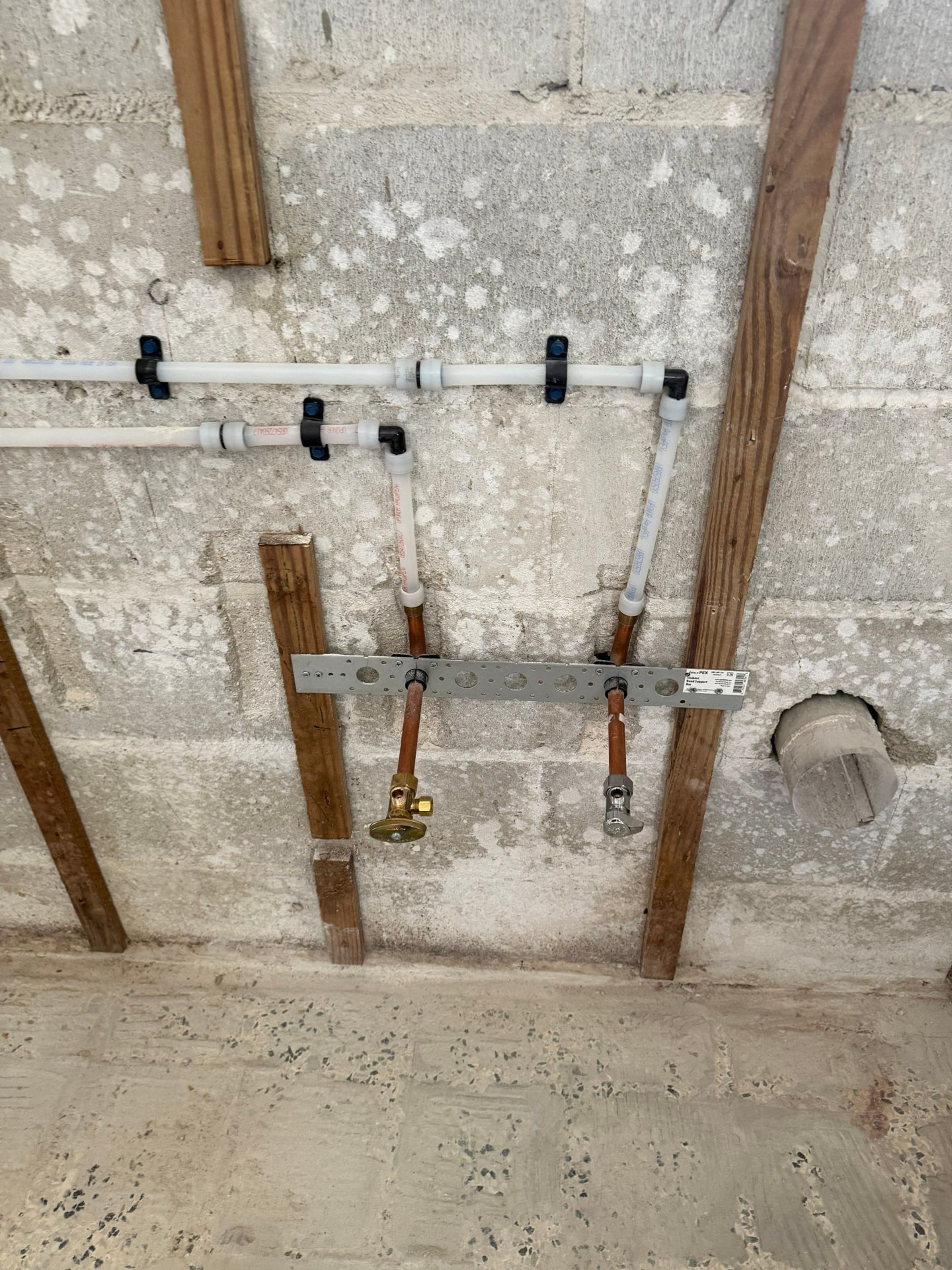
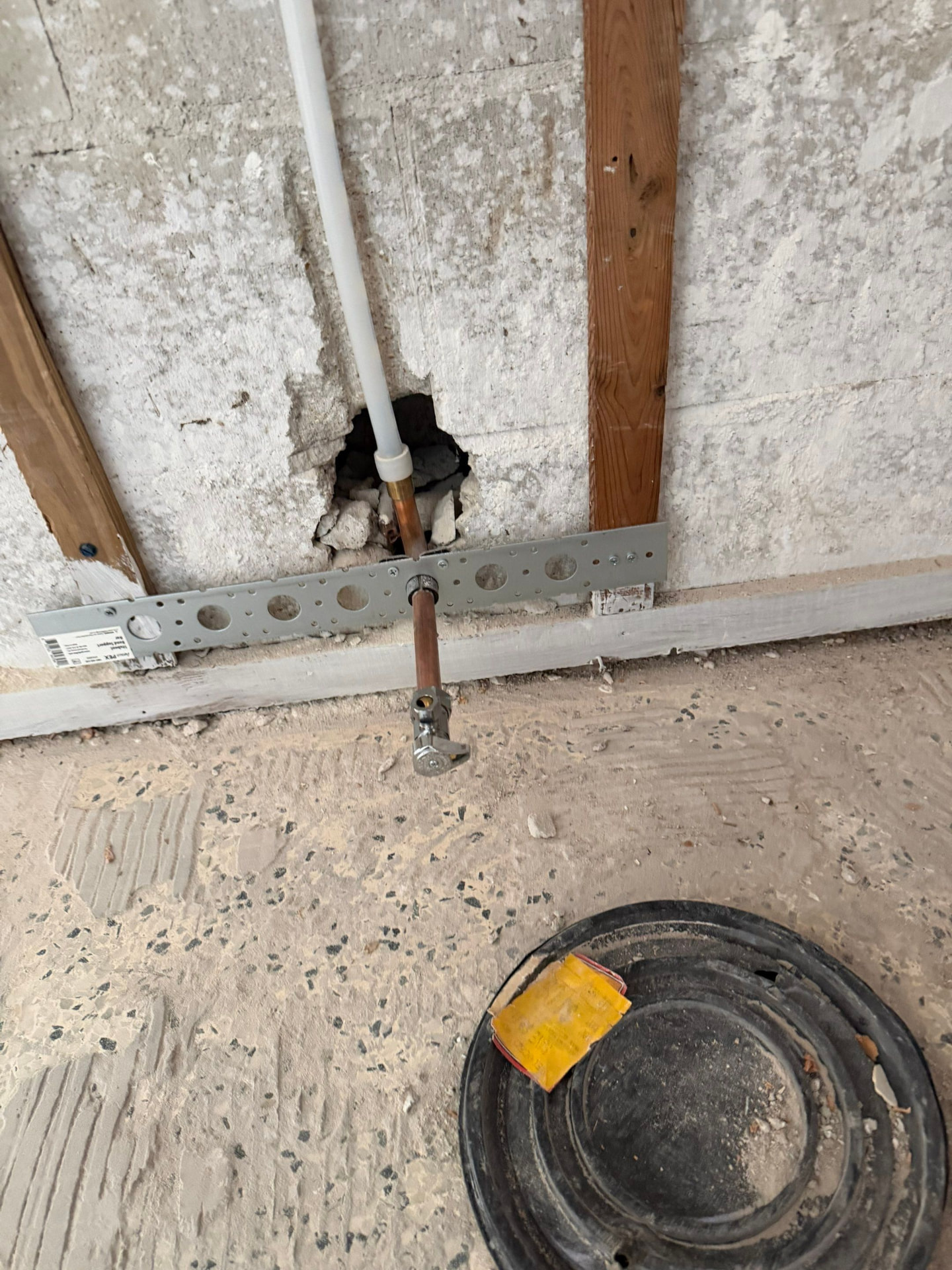
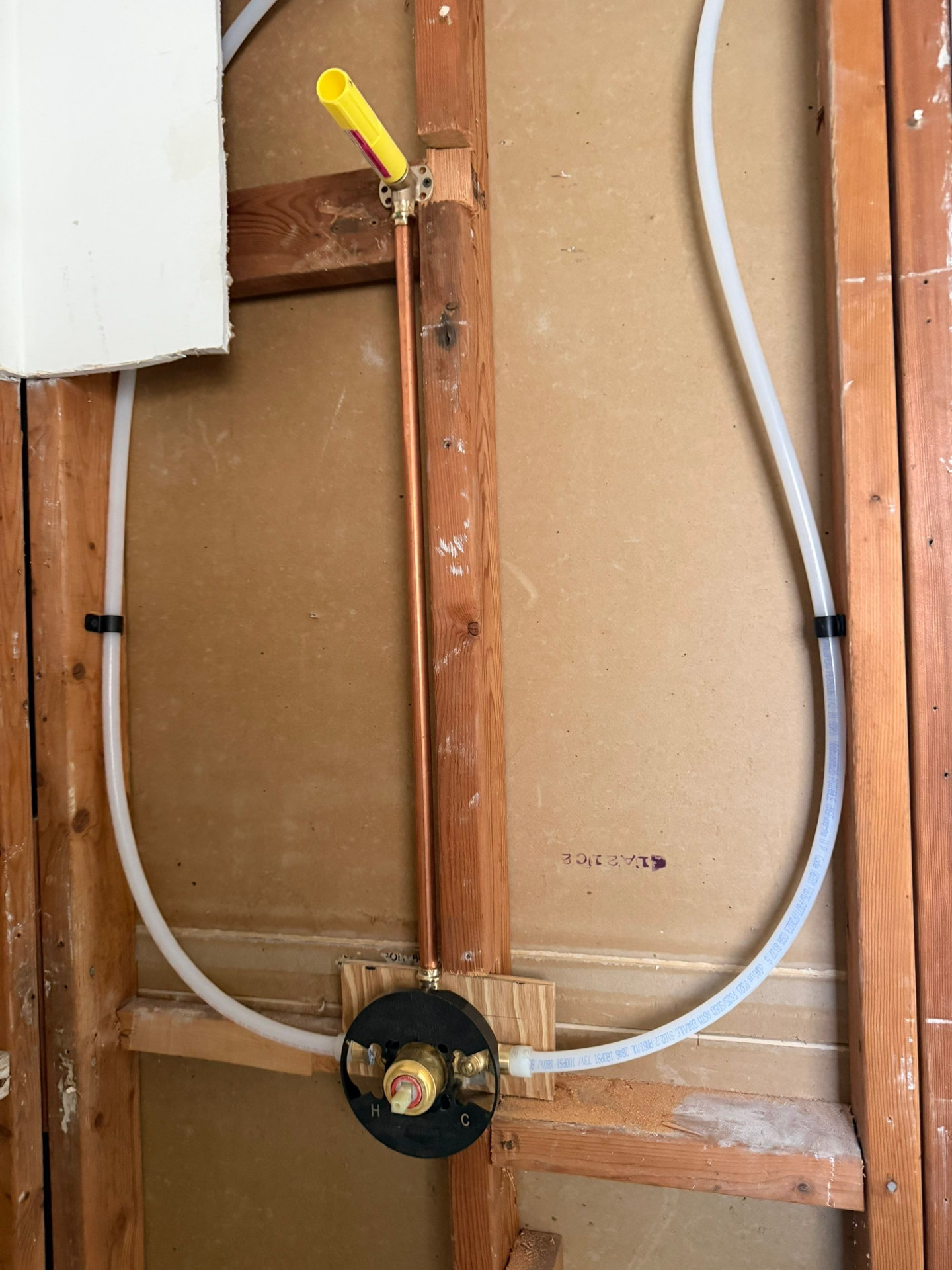
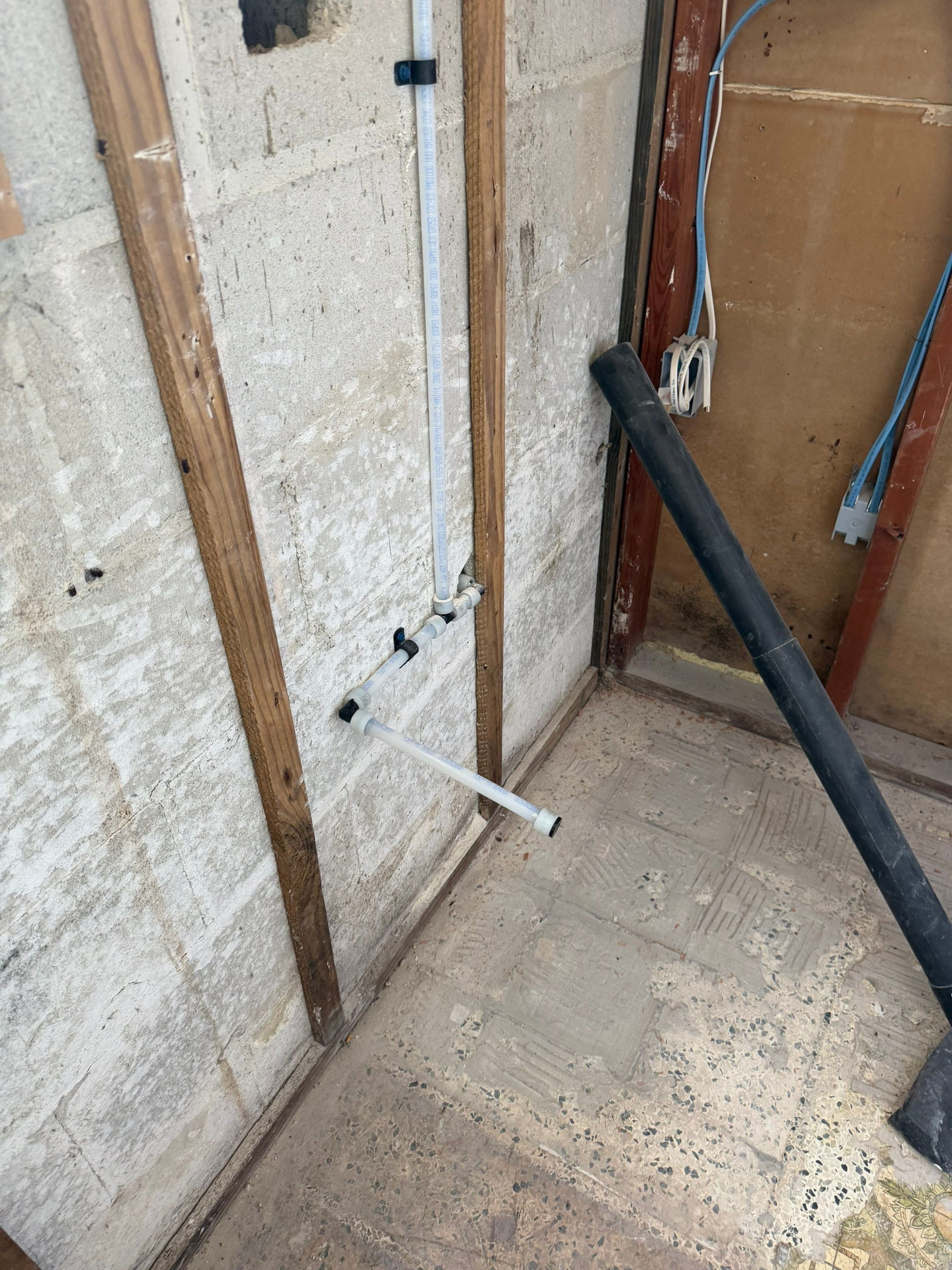
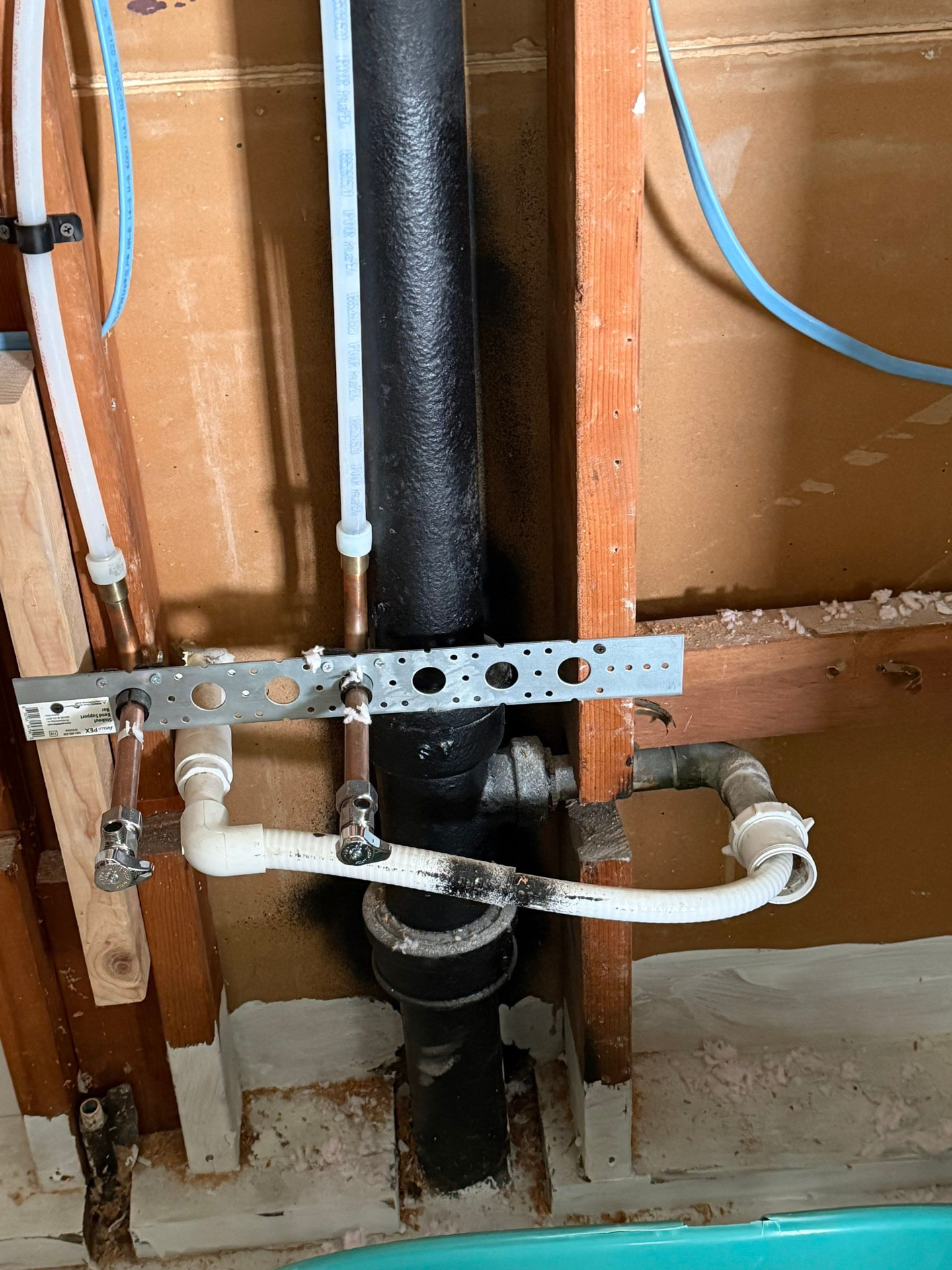
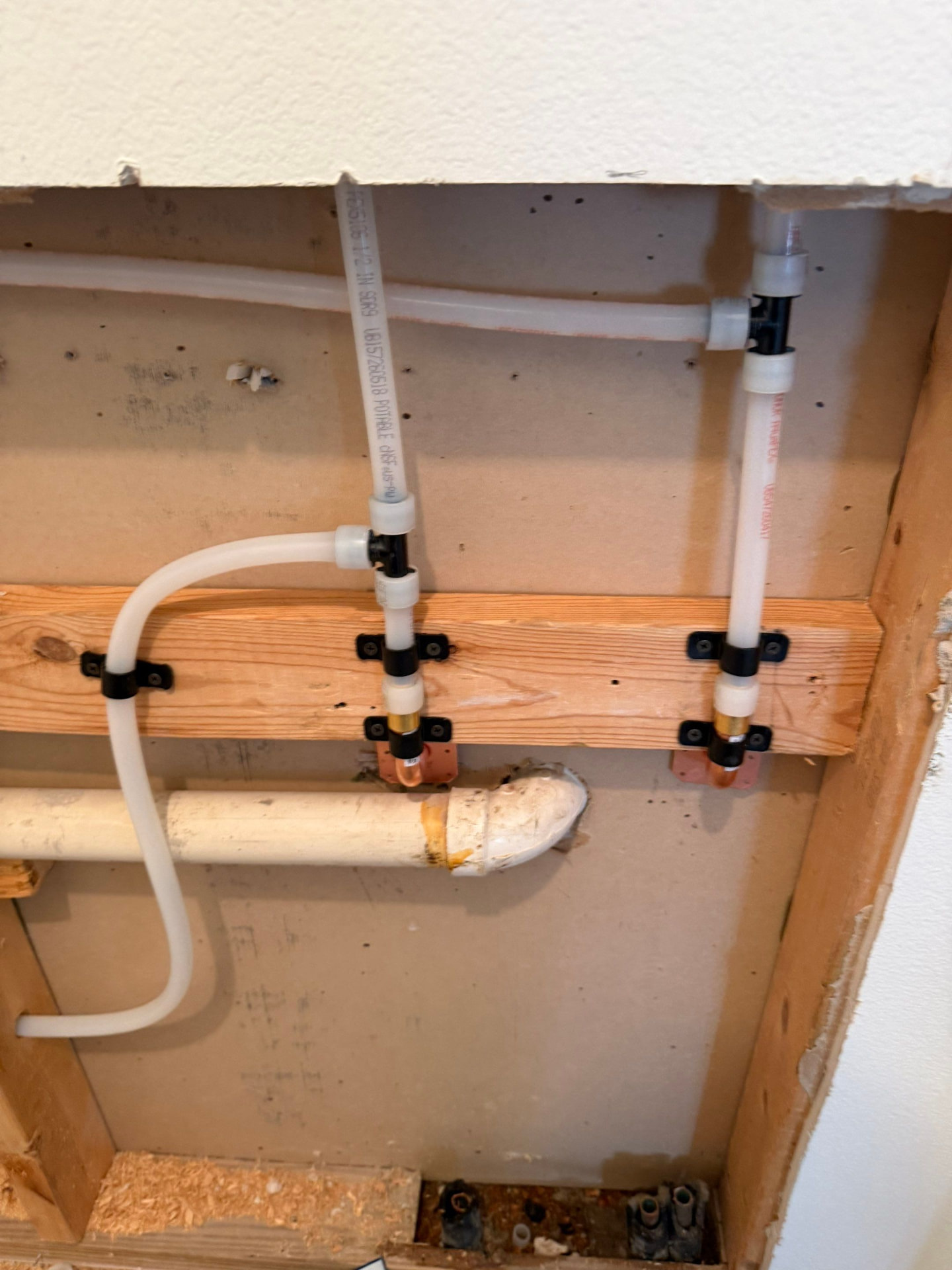
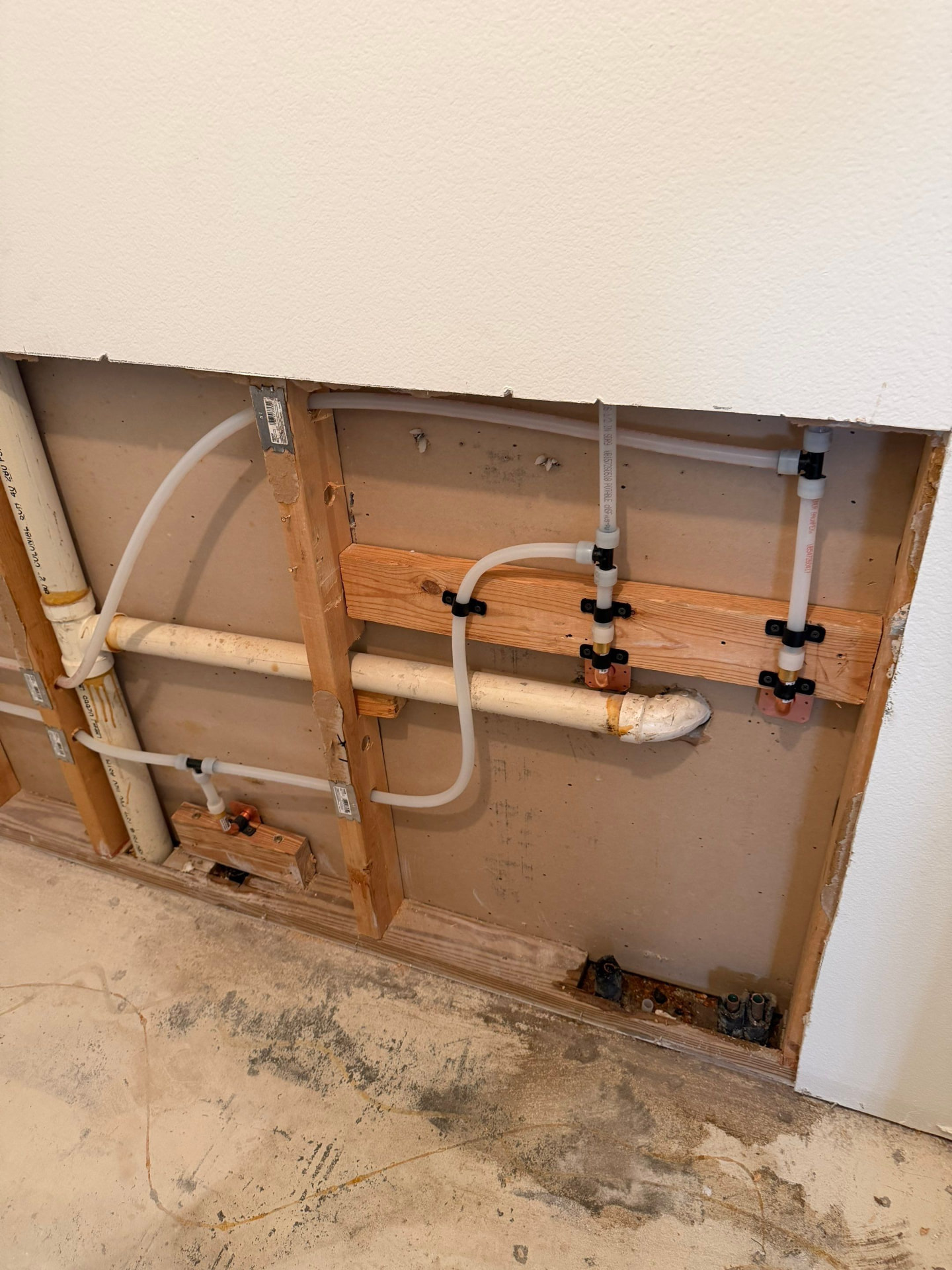
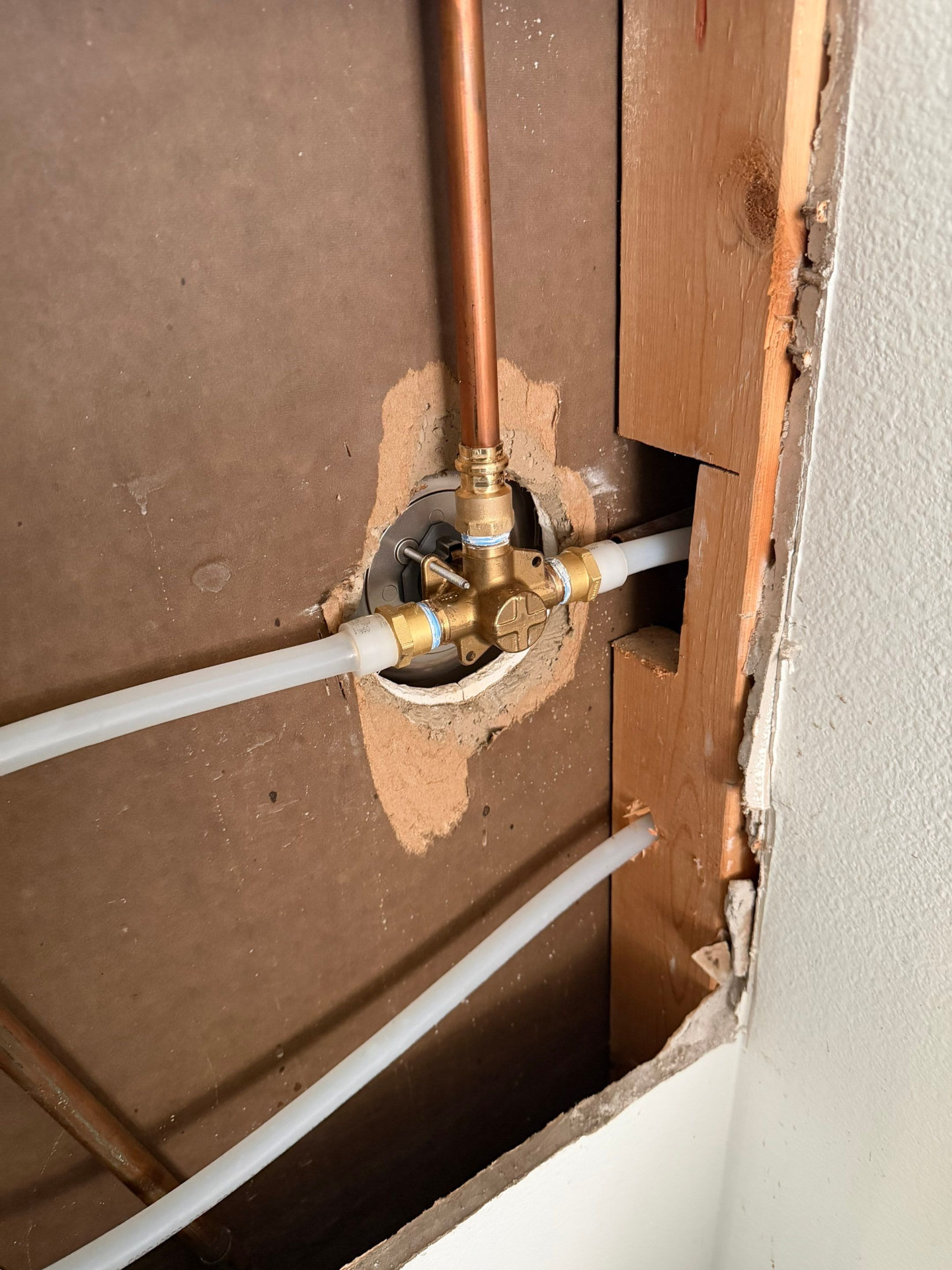
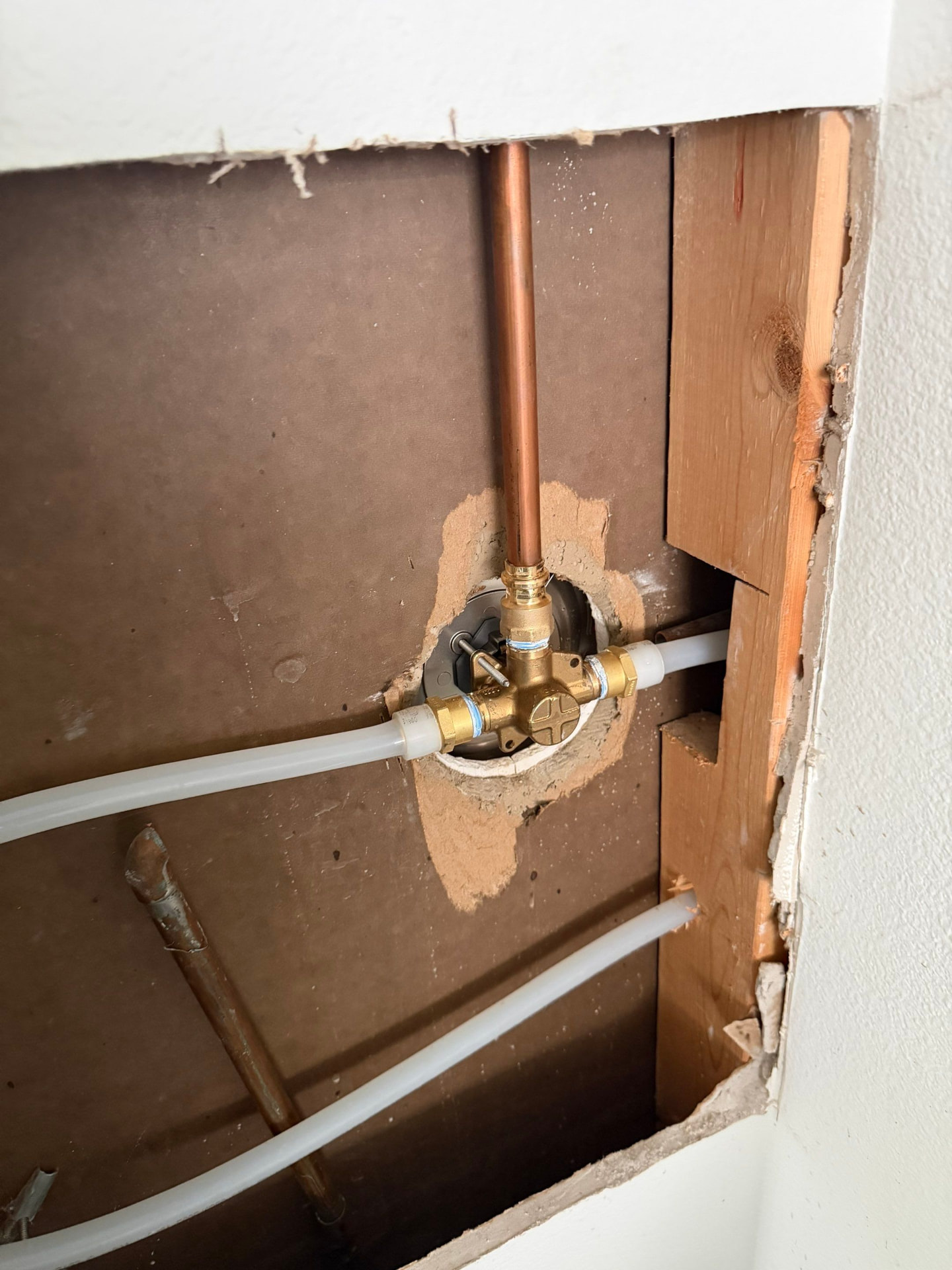
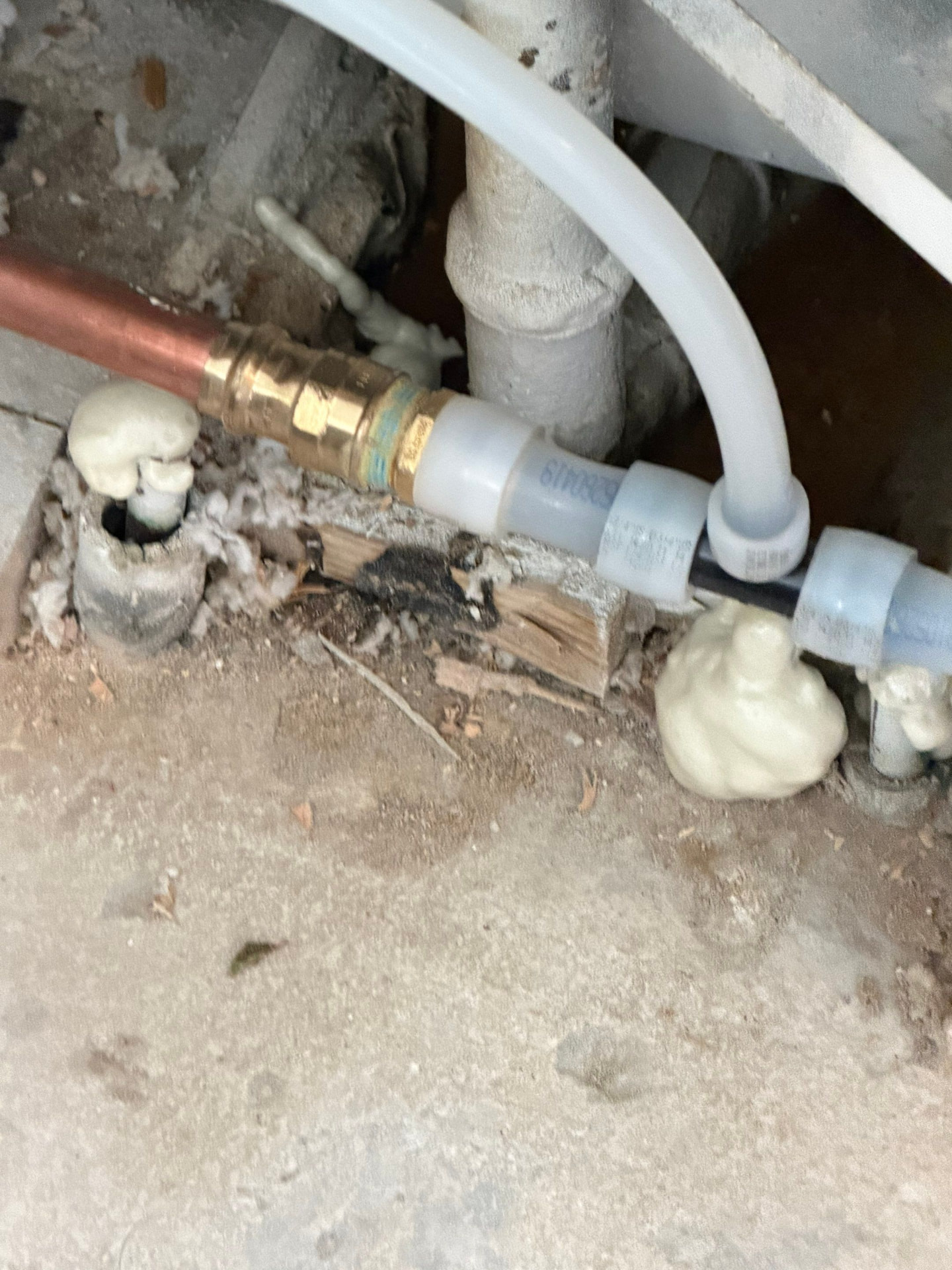
Photos from repipe work performed by Plumbing Detectives LLC. Every Bradenton job is documented from rough-in through inspection.
Answers
Frequently Asked Questions — Whole House Repiping in Bradenton, FL
If you’ve read this far, you now understand whole-house repiping in Bradenton better than most homeowners in this market ever get it explained. You know what the different housing eras mean for pipe materials. You know which specific subdivisions are inside the polybutylene window. You know the difference between the City of Bradenton and Manatee County permit offices — and why it matters. You know about the Lasting Manatee program. And you know that sometimes the right plumbing decision is waiting until the rest of the project is ready. If your Bradenton home needs an honest assessment — regardless of its age, its water source, or what the last plumber told you — call me at 239-388-3631. I’ll come out, look at the whole system, and tell you exactly what I find before recommending anything.
Plumbing Detectives LLC | Venice, FL | License CFC1434139
239-388-3631 | plumbingdetectivesfl.com