
Water Heater Installation · Venice Gardens, FL
Water Heater Installation in Venice Gardens, FL
Home turf. One of Southwest Florida’s most precisely documented older neighborhoods. Diagnosis first, always. Licensed master plumber CFC1434139.
Call Now239-388-3631I’ll be straightforward about something unusual on this page: I live in Venice Gardens. My home is off of Shamrock Drive, inside the same four boundary roads — Center Road, US-41, Briarwood Road, Bal Harbour Drive — that define this neighborhood. I drive these streets. I know which side of Shamrock Boulevard the community pool is on. I know the Lowe’s at US-41 and Shamrock wasn’t part of the original plat. And I know, from living here and from working in homes throughout this neighborhood, exactly what the plumbing situation looks like inside the concrete block ranch homes that Venice Gardens, Inc. built between 1956 and 1972.
That’s not marketing language. Sarasota County’s own 2005 neighborhood plan documents the average year of home construction in Venice Gardens as 1969. Thirty-four separate plats were recorded between 1956 and 1972. The entire neighborhood was built by one developer, in one era, with the pipe materials that were standard in Florida residential construction during those specific years — galvanized steel supply lines and cast iron drain lines. No newer pockets. No mixed eras. A single, coherent 16-year build window that now puts virtually every original home in Venice Gardens somewhere between 50 and 70 years old.
That’s not a problem on its own. These are good homes, well-built concrete block construction on slab foundations, in a community where 87 percent of residents own rather than rent and many have lived here for decades. But 50 to 70 years is past the expected service life of galvanized supply piping. It’s past the expected service life of cast iron drain lines. And the hard water that comes out of these taps — treated at a county facility that literally bears this neighborhood’s name, the Venice Gardens Water Treatment Plant at 1350 Indian Hills Blvd — hasn’t stopped working on those pipes since the day they were installed.
My name is Mike Reynolds. I’m the owner of Plumbing Detectives LLC and a licensed master plumber, license CFC1434139. This is home turf. Let me tell you what I see here.
Market Context
What Makes Venice Gardens Different From Every Other Market I Serve
Every other market I write about has some variation in its housing stock — a historic core surrounded by mid-century development, newer gated communities alongside aging ranch homes, a manufactured home corridor adjacent to new construction. Venice Gardens doesn’t have that variation. The neighborhood was built by a single developer across 34 plats in a 16-year window and then it was done. The last plat was recorded in 1972. There has been essentially no new residential subdivision construction within the neighborhood since then.
What that means practically is that there’s no “newer section” of Venice Gardens with different plumbing to compare against. Every original home on Gardenia Road, every home on Glen Oak Road, every home on Pomelo Drive, Gondola Drive, Garden Road, Sandlewood Drive, Bob O Link Drive — all of them were built in the same era, with the same pipe materials, under the same construction standards. The plumbing risk profile is remarkably uniform across the entire neighborhood.
The second thing that makes Venice Gardens distinct is the water source. Sarasota County draws from ten wells located directly on the Venice Gardens site — right here in this neighborhood — feeding the Venice Gardens Water Treatment Plant, which uses reverse osmosis treatment. This isn’t a coincidence of naming. The neighborhood’s water comes from under the neighborhood itself, drawn from the intermediate and Floridan aquifers, treated on site, and distributed to the homes within it. The raw source water starts around 1,120 mg/L hardness. After county treatment it comes out at roughly 120 to 125 mg/L — meaningfully softened, but still in the moderately hard range. Independent measurements for the immediate Venice area show 11.6 to 18 grains per gallon depending on the source and season. The water has been depositing mineral scale inside Venice Gardens’ pipes and water heaters for as long as the homes have been standing.
Third, this is an overwhelmingly owner-occupied, long-tenure community. Sarasota County’s neighborhood plan documented 87.6 percent owner-occupied. Multiple current sources put it at 83 percent. The median age is in the mid-to-upper 50s. A significant share of residents are retirees who have been in the same home for years or decades. What that tells me plumbingwise is that many of these homes have not been through an investor-driven renovation cycle where the plumbing gets updated. Original pipes from the 1960s, in homes where the same family has lived since the 1980s, with no particular reason to open the walls — that’s the scenario where the condition of the original galvanized supply lines becomes genuinely important.
Home Age
The 1956-1972 Build Era — What’s Behind the Walls in Venice Gardens
The homes in Venice Gardens were built during a specific and well-defined period in Florida residential plumbing history. Understanding what that means today is the most important thing a Venice Gardens homeowner can know about their plumbing.
Galvanized steel supply lines. Galvanized steel was the standard residential water supply material in Florida from the 1930s through the late 1960s and into the early 1970s. It’s a steel pipe coated in zinc, and the zinc coating is what protects the steel from corrosion. Over time — in Florida’s water chemistry especially — that zinc coating breaks down from the inside. Rust builds up on the interior walls of the pipe. The internal diameter narrows. Water pressure drops, slowly and steadily, in a way that homeowners adapt to over years without realizing the cause. Eventually the corrosion reaches the pipe wall itself and the pipe fails.
One of the most common things I find in Venice Gardens is a homeowner who mentions that their water pressure has been declining for years and they assumed it was the water heater or the city water supply. It’s almost never either. It’s the galvanized supply lines, corroding from the inside, narrowing their effective diameter with each passing year. A pressure gauge on the street meter shows full supply pressure at the main. The pressure drop is happening between the main and the fixture — inside the galvanized pipe.
Sarasota-area plumbing companies have been documenting this pattern specifically. One regional repipe specialist states directly that galvanized pipes installed before the 1970s in Sarasota-area homes are “near total failure.” Another states that homes from the 1950s to 1970s are “failing across whole neighborhoods.” That language applies precisely to Venice Gardens, where the average build year is 1969 and the entire plat sequence falls within that failure window.
The insurance dimension is real and current. Florida insurance carriers have been canceling policies and declining renewals on homes with active galvanized piping. A Sarasota repipe specialist notes explicitly that “many Florida insurance companies are cancelling policies when galvanized pipes are present.” For Venice Gardens homeowners planning to sell, refinance, or renew their homeowner’s insurance, the galvanized supply situation in an original home is not just a plumbing question.
Cast iron drain lines. The homes built during the Venice Gardens plat sequence — 1956 through 1972 — predate the mid-1970s regional transition from cast iron to PVC for drain-waste-vent systems. That means virtually every original Venice Gardens home has cast iron drain lines running under the slab. Cast iron is durable pipe and it was the right choice for the era. It also corrodes from the inside over decades. The interior of the pipe develops a rough, corroded surface that catches debris and toilet paper, causing recurring slow drains and eventually backups. At the joints, corrosion weakens the connections. In extreme cases the bottom of the pipe corrodes through entirely, producing a slab leak from the drain side rather than the supply side.
One of the most common things I see when I run a camera through a drain line in a Venice Gardens home is exactly the interior deterioration that fifty-plus years of Florida water chemistry produces. The outside of the pipe may look intact. The inside tells a different story.
If you’re in an original Venice Gardens home and you haven’t had a plumber evaluate your supply lines and under-slab drains, that conversation is overdue given the neighborhood’s build era. Call 239-388-3631 and I can tell you what you actually have.
Water Quality
What the Venice Gardens Water Treatment Plant Does — And What It Doesn’t Do
There’s something genuinely unusual about the water serving Venice Gardens that most homeowners here don’t know: the water comes from under the neighborhood itself. Sarasota County operates ten groundwater wells on the Venice Gardens site, feeding the Venice Gardens Water Treatment Plant at 1350 Indian Hills Blvd, which uses a reverse osmosis treatment process to soften and treat the water before distribution.
The raw groundwater coming out of those wells starts at approximately 1,120 mg/L hardness — extremely high by any standard, driven by the calcium and magnesium-rich limestone geology of the Floridan Aquifer. The treatment process reduces that dramatically. What comes out of your tap is roughly 120 to 125 mg/L after county softening — still classifiable as moderately hard, but far better than the untreated source.
Here’s the honest version of what that means for your water heater. Even at 120 to 125 mg/L — roughly 7 to 9 grains per gallon after treatment — the water is still hard enough to deposit mineral scale inside a water heater tank over time. Every gallon of water that enters the tank heats up, and the minerals fall out of solution and settle at the bottom. Year after year, that layer of calcium and magnesium scale builds up. It insulates the bottom of the tank from the heating element or burner. The unit works harder. The efficiency drops. The tank lining takes more thermal stress than it was designed for.
In a Venice Gardens home where the water has been running through the same pipes for 50 or 60 years, the scale accumulation in the water heater adds to the mineral deposits already narrowing the galvanized supply lines. They’re part of the same problem. Hard water, aging pipe materials, and deferred maintenance compound each other in ways that are difficult to untangle once they’ve been running for decades.
The county’s own Consumer Confidence Report acknowledges seasonal taste and odor variations in the water supply and the treatments used to address them. These are cosmetic issues, not health concerns. What matters for plumbing is the ongoing mineral load, and the Venice Gardens Treatment Plant is doing a good job with a very hard source — but “good job” in this context still means moderately hard water at the tap.
Installation Quality
Why Most Water Heater Installations in Venice Gardens Miss the Same Things
In a neighborhood of homes built between 1956 and 1972, water heater replacements happen constantly. Many of these homes have had two or three water heaters over the decades. What I often find when I look at the connections on those replacement units is that the installation shortcut that creates the most long-term damage was repeated each time — because nobody caught it and nobody explained why it was a problem.
Every tank water heater ships from the factory with galvanized steel nipples at the hot and cold ports. In a Venice Gardens home with galvanized or copper supply lines, those nipples are the connection point between the tank and the home’s plumbing. When a plumber threads the existing copper supply line directly onto those galvanized nipples with no transition fitting in between, they’ve created a classic case of galvanic corrosion at the most important connection point in the installation.
The mechanism is straightforward once you understand it. Copper and galvanized steel are dissimilar metals. When they make physical contact in the presence of water — which conducts electrical current — the more reactive metal begins to dissolve. In this case that’s the zinc coating on the galvanized nipple. It dissolves into the water, atom by atom, silently and invisibly inside the threaded joint. No external rust. No visible sign. Just the zinc coating gradually disappearing, leaving bare steel exposed to the same corrosive process.
This is happening faster in Venice Gardens’ water than it would in a softer water market. Hard water is a more effective electrolyte than soft water, meaning it conducts the tiny currents that drive galvanic corrosion more efficiently. A connection that might take ten years to fail in soft water fails sooner in this water chemistry.
The correct installation uses brass as a transition fitting. Brass sits between copper and galvanized on the electrochemical scale and reduces the corrosive potential between them by roughly 86 percent. Here’s exactly what a correct installation looks like in a Venice Gardens copper-plumbed home — and most original Venice Gardens homes that haven’t been repiped do have copper supply lines, since copper became the standard as galvanized gave way in the late 1960s and early 1970s.
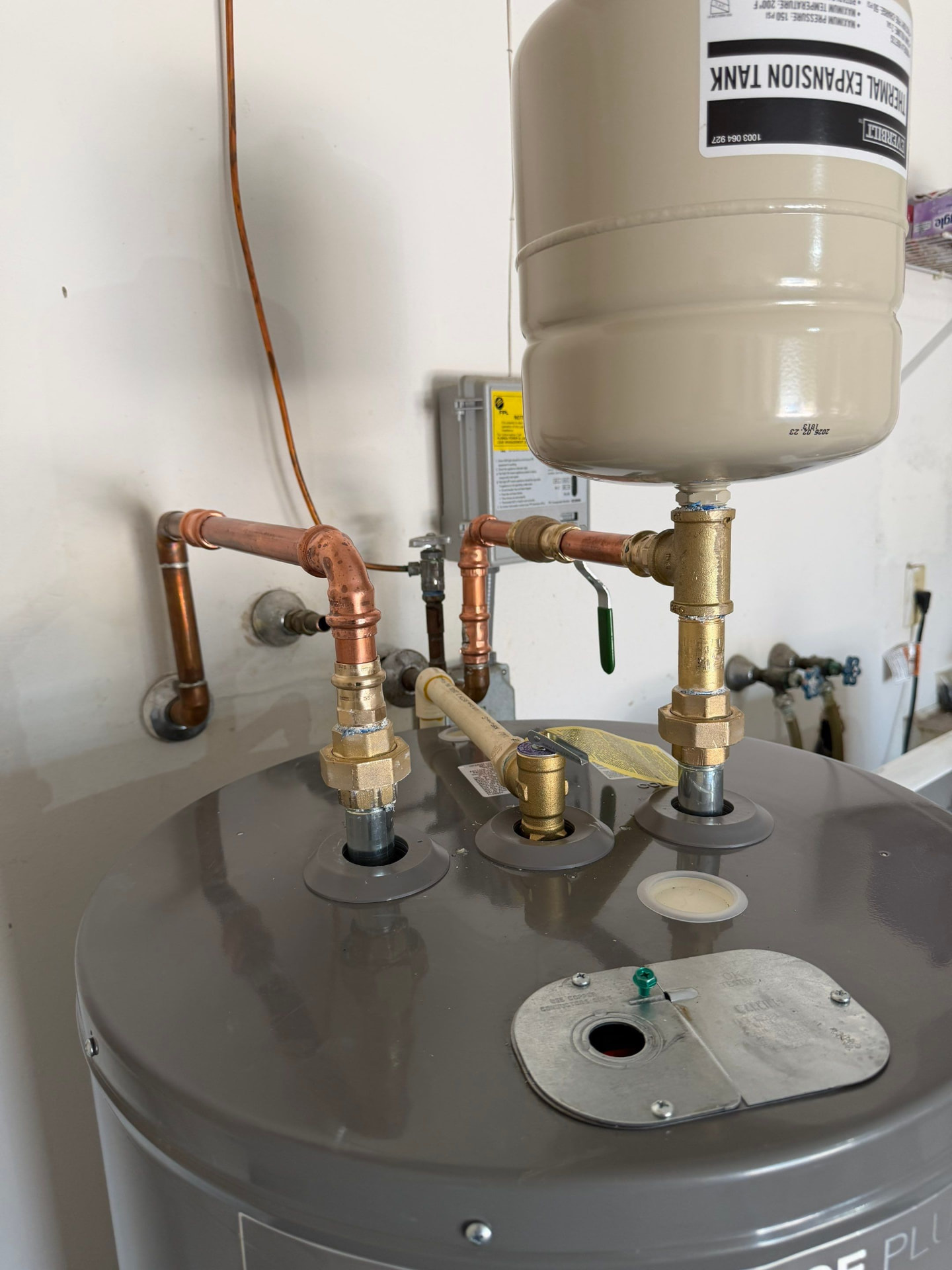
Cold side: A brass female union threads directly onto the galvanized cold nipple. A brass nipple runs into the other side of the union. A brass tee threads onto that nipple — the expansion tank connects off the top of the tee, and a copper male adapter transitions out of the side port to copper pipe, which runs to a ball valve and the cold supply. The galvanized nipple never contacts copper.
Hot side: A brass female union threads onto the galvanized hot nipple. A copper male adapter threads into the other side of the union. Copper pipe continues from there.
Unions on both sides, not couplings. A union disconnects with a wrench. A coupling means cutting pipe. In a Venice Gardens home where the next water heater replacement may be another decade away, building in a union on both the hot and cold sides is the professional standard — not a premium option.
Plumbing Detectives LLC Professional Opinion
In Venice Gardens specifically, I’d look at the connection fittings on any water heater before recommending replacement. A tank that’s “failing” in a home with original galvanized supply lines may actually be showing the consequences of a decades-old installation shortcut rather than equipment failure. Replacing the tank without correcting the connection fittings means the new unit starts its life with the same problem. I’ve seen this happen — a homeowner replaces a water heater in a Venice Gardens home, gets another ten years out of it, replaces it again, and nobody ever addressed the galvanic corrosion at the nipples across either installation.
Expansion Tank
The Expansion Tank — Why Every Venice Gardens Water Heater Replacement Needs One
Venice Gardens is served by Sarasota County Public Utilities on a closed plumbing system — meaning there’s a backflow prevention device on the service line between the meter and the home that prevents water from flowing back toward the municipal supply. This is standard for county water customers and it creates a specific requirement for water heater installation.
When water heats up it expands. In a closed system, that expanded water has nowhere to go unless there’s an expansion tank on the cold supply line to absorb it. Without one, the pressure from every heat cycle pushes against every fitting, every valve, and every connection in the home’s plumbing. Over time this stresses components in ways that aren’t immediately visible. The most common symptom I encounter is a temperature and pressure relief valve that’s been dripping. The homeowner has the valve replaced. The new valve does the same thing. The cycle repeats.
In most cases I’ve encountered in Venice Gardens, the dripping T&P valve isn’t a sign of a failing water heater. It’s a sign of a closed plumbing system without an expansion tank. The valve is doing exactly what it was designed to do — relieving excess pressure. The pressure exists because there’s no expansion tank to absorb the thermal expansion.
Florida Building Code requires an expansion tank on water heater replacements in closed plumbing systems, which describes every Venice Gardens home on county water. It’s not an optional add-on. It’s part of a correct installation.
Anode Rod
The Anode Rod — The Maintenance Item Nobody in Venice Gardens Knows About
Most Venice Gardens homeowners I’ve spoken with have never heard of an anode rod. It’s one of the most important components in a water heater and the one most consistently neglected across this neighborhood.
Here’s a simple way to think about it. Inside the water heater tank is a metal rod suspended in the water. Because of its electrochemical properties, it attracts the corrosive attack of the water to itself — it corrodes so the steel tank walls don’t have to. It’s called a sacrificial anode rod because that’s literally what it does: it sacrifices itself to protect the tank. When the rod is consumed, the tank walls become the next target.
In Venice Gardens’ water — moderately hard even after county treatment, with the seasonal and mineral characteristics of Floridan Aquifer groundwater — a standard magnesium anode rod depletes faster than it would in softer water markets. A rod that might last five to seven years in a softer water environment may need attention in three to four years here.
One of the most common situations I encounter in Venice Gardens is a homeowner whose hot water has developed a slightly metallic quality or a faint sulfur odor. In most cases this is the anode rod reacting with sulfates in the county water — a well-documented phenomenon in the Sarasota area that gets misidentified as a water quality problem when it’s actually an anode rod problem. A rod swap at $50 to $100 in parts frequently resolves it entirely. The homeowner who was considering a water filtration system doesn’t need one.
We offer a Corro-Protec powered titanium anode rod upgrade on every installation. Unlike a sacrificial rod, it uses a small impressed electrical current — less than three dollars per year in electricity — to actively repel corrosion from the tank walls rather than absorbing it. It never depletes. The manufacturer backs it with a 20-year warranty. For a Venice Gardens home where the water heater is going to be working against moderately hard water for its entire service life, this is one of the most practical long-term protection investments available at the time of installation.
Common Problems
Mistakes I Commonly Find on Water Heater Installations in Venice Gardens
These are the installation problems I find most often in Venice Gardens homes — and in a neighborhood where the average home has had two or three water heater replacements over the decades, these errors tend to have been compounded across multiple service calls.
Copper directly on galvanized nipples. No brass transition fittings. The most common installation error in this market, described in detail above. In Venice Gardens’ water chemistry it runs faster than in softer markets. I find it across the neighborhood on original galvanized homes and on copper-plumbed homes alike where the nipple transition wasn’t done correctly.
Missing expansion tank on a county water connection. Every Venice Gardens home on Sarasota County Public Utilities is on a closed system. The expansion tank is required. Replacement water heaters installed without one put the T&P valve in the position of relieving system pressure with every heat cycle — a function the valve can perform but was never designed to perform continuously.
No unions on hot and cold sides. Couplings instead of unions on one or both sides. The next replacement requires cutting pipe. In a concrete block Venice Gardens home where the utility space may be tight and the copper lines have been in place since the 1970s, cutting pipe during a water heater replacement adds unnecessary disruption. Unions on both sides cost almost nothing more and prevent that entirely.
Partial repipe of galvanized supply lines. I’ve found Venice Gardens homes where a plumber replaced the visible galvanized sections — above the slab, in the utility room, under the sinks — but left the sections running under the slab untouched. The homeowner was told the repipe was complete. It wasn’t. The sections under the slab are still galvanized, still corroding, and still restricting flow. Regional plumbing experts specifically call out partial galvanized repipes as a problem: if the under-slab sections remain, the insurance issue persists, resale complications remain, and the underlying problem hasn’t been solved.
Ignoring the under-slab drain condition while addressing the supply side. In a Venice Gardens home where I’m discussing a galvanized supply line repipe, I’m also looking at the cast iron drain lines under the slab. These are the same age. They’ve been through the same water. Addressing the supply system and not evaluating the drain system is doing half the job.
Plumbing Detectives LLC Tips
If you’re selling a Venice Gardens home and the buyer’s inspector identifies galvanized supply lines, understand what the options are before accepting a price reduction. A whole-home repipe in a Venice Gardens-sized home is a real project but it’s a documented, permitted improvement that resolves the insurance issue, the pressure issue, and the buyer’s concern in one job. Knowing the scope and cost of a repipe gives you negotiating context that a vague “galvanized pipes exist” disclosure doesn’t.
Wastewater
The Wastewater Side — Venice Gardens WRF and What Happened During Hurricane Milton
Venice Gardens isn’t just named on the water supply side — the neighborhood has its own Water Reclamation Facility as well, at 375 Venice East Blvd. This is the wastewater treatment plant that serves unincorporated south Sarasota County including Venice Gardens. The county broke ground in May 2025 on an Advanced Wastewater Treatment conversion and capacity expansion — doubling the facility from 3 million gallons per day to 6 million gallons per day, with construction targeted for completion in 2027 to 2028.
This matters for Venice Gardens homeowners for one specific reason: during Hurricane Milton in October 2024, a power supply failure at this facility caused a 126,000-gallon raw sewage spill. A nearby lift station associated with the facility contributed additional spillage. The county has since documented the event and is investing in infrastructure upgrades that are meant to prevent a recurrence.
I include this not to alarm anyone but because Venice Gardens homeowners who were on the sewer system during Milton — which is the large majority of the neighborhood — may have experienced backflow risk during that event that they weren’t fully aware of. Backflow prevention at the individual home level, particularly for homes with main drains close to grade in the lowest sections of the neighborhood, is worth understanding. If you’re uncertain whether your home has any backflow protection on the drain side, that’s a question worth asking during a plumbing evaluation.
Maintenance
Annual Maintenance — What It Actually Prevents in a Venice Gardens Home
Annual water heater maintenance in any Southwest Florida market is worthwhile. In Venice Gardens specifically — moderately hard water, homes averaging 50 to 70 years old, a population that has often lived in the same home for decades without the plumbing being touched — it’s one of the most effective ways to protect an infrastructure that’s already under age-related and water-quality stress.
Annual maintenance on a Venice Gardens water heater means: flushing the mineral sediment from the bottom of the tank, which in this water accumulates meaningfully over a year and insulates the heating element from the water it’s supposed to be heating. Inspecting and replacing the anode rod when it’s significantly depleted — in Venice Gardens’ water, this may be more frequent than the manufacturer’s documentation suggests. Testing the T&P relief valve to confirm it opens and reseats correctly. Checking the connection fittings at the top of the unit for early signs of galvanic corrosion or weeping. Verifying the expansion tank is properly pressurized.
For seasonal residents — a meaningful share of Venice Gardens has a snowbird component — a pre-departure check before leaving and a return inspection after coming back covers the specific risks of extended vacancy. Sediment compacts harder in an idle tank. The anode rod continues reacting with standing water. Nobody is there to notice a weeping fitting or a slowly corroding connection. Coming back in November and finding the water heater failed in August is a more expensive problem than a spring check would have been.
Diagnosis First
Diagnosis First — In the Neighborhood I Live In
When I’m called to a water heater in Venice Gardens, I’m not coming in cold. I know the build era. I know the typical pipe materials in an original home. I know what the county water chemistry looks like because it’s the same water I’m on. And I know, from looking at homes throughout this neighborhood, what the most common installation shortcuts look like and what they do to equipment over time.
That context doesn’t change my process — I still evaluate the specific unit, the specific connections, the specific maintenance history, and the specific conditions before I recommend anything. But it means I’m starting from a more informed baseline than I would be in a market I don’t live in.
What I’m looking for when I assess a Venice Gardens water heater: How old is the unit and has it ever been maintained? What do the connection fittings look like at the top of the tank — are there brass transitions? Is there an expansion tank? What’s the T&P valve condition — has it been replaced, and was anything else addressed when it was? What’s the anode rod condition if I can access it? Is there any evidence of galvanic corrosion at the nipple connections?
Those answers tell me whether you need a new water heater or whether a service call with the right attention to the installation details will extend what you have for several more years. I’ll tell you which one honestly before I touch anything.
If you’re in Venice Gardens and you want to know what shape your water heater and plumbing are actually in — not a sales pitch, just an honest look — call me at 239-388-3631. I’m in the neighborhood.
Options
Water Heater Options for Venice Gardens Homes
When replacement is the right call, the decision about what to install depends on the home’s current setup and how it’s being used.
Tank water heaters are the right choice for most Venice Gardens homes. We install Bradford White and Rheem — brands I trust in Florida’s climate. Available in natural gas, propane, and electric configurations. For most Venice Gardens homes already on natural gas, a 40 or 50 gallon tank unit is the standard replacement. Electric units work well where gas isn’t in the home or where the homeowner prefers not to add a gas line.
One note for Venice Gardens specifically: if the supply lines in the home are still original galvanized, the conversation about a new water heater often opens a broader conversation about whether a whole-home repipe should be done at the same time. Installing a new water heater on galvanized supply lines that are near the end of their service life is doing work twice. I’ll tell you what I see and give you a frank assessment of whether the two projects belong together.
Tankless water heaters make sense for seasonal Venice Gardens homeowners who are gone for extended periods. No point paying to maintain a tank of hot water through six months of vacancy. For more on tankless-specific considerations, see our tankless water heater page.
Warning Signs
Signs Your Venice Gardens Water Heater Needs Attention
These are the specific signs I’d want Venice Gardens homeowners to call about rather than wait on.
Water pressure has been declining gradually for years. In an original Venice Gardens home this is almost always the galvanized supply lines narrowing from internal corrosion — not the water heater, not the county water supply. Call for an evaluation before replacing the wrong thing.
Water has a rusty or orange tint from the hot tap, especially first thing in the morning or after a faucet hasn’t been used for a while. Could be galvanized pipe corrosion in the supply lines, or internal tank corrosion from a depleted anode rod. Either way it’s worth determining which one before deciding on a course of action.
Hot water smells faintly of sulfur or has changed quality. In Venice Gardens this is almost always the anode rod reacting with sulfates in the county water. A rod swap is typically the fix — not a filtration system.
The T&P relief valve is dripping and has been replaced before without improvement. Missing expansion tank on a closed system. The valve replacement didn’t address the cause.
The unit is more than 10 years old with no maintenance history in Venice Gardens’ water. I’d want to evaluate the anode rod, sediment accumulation, and connection quality before it becomes an emergency.
Moisture, staining, or dampness at the base of the unit or at the connections on top. Don’t wait on either of these. Water damage in a concrete block home compounds in ways that aren’t always immediately visible.
You’re getting recurring slow drains or backups. This is the cast iron drain system under the slab, not the water heater — but it’s a related conversation about a home’s original infrastructure, and it’s worth addressing.
Plumbing Detectives LLC Tips
If you’ve lived in your Venice Gardens home for more than 10 years and haven’t had the supply lines evaluated, ask a plumber to look at the visible galvanized sections — under sinks, in the utility room, anywhere the pipe is exposed. The condition of the visible sections tells you a great deal about what the under-slab sections are likely doing. If what’s visible is heavily corroded, what’s buried is likely worse.
If your Venice Gardens home still has the original cast iron under-slab drain lines and you’ve been getting recurring slow drains or backups, a camera inspection is the right starting point before any repair decision. A camera tells you exactly what the inside of the pipe looks like and what the best remediation option is — whether that’s trenchless pipe lining, a targeted repair, or a more comprehensive solution.
Venice Gardens is on county sewer, not septic. But if you’re on the fringe of the neighborhood or in a parcel that’s less clearly defined, verify your sewer status with the county before making any assumptions. A handful of edge parcels may still have legacy septic connections that don’t match the surrounding block. Sarasota County can confirm by address.
Our Approach
Why Plumbing Detectives
I named the company Plumbing Detectives because too many homeowners get sold expensive repairs and replacements before anyone figures out what’s actually wrong. In Venice Gardens specifically — a neighborhood I live in, with homes I know, on water I’m connected to — that philosophy isn’t just a brand position. It’s personal.
My job is to diagnose the problem first, explain it in plain English, and let you make an informed decision about what to do next. That’s how plumbing should work. Diagnosis first. Explanation second. Action third.
License CFC1434139. Fully insured.
Permitting
Professional Installation Done Right
Venice Gardens is unincorporated Sarasota County. Permits run through Sarasota County Planning and Development Services — not the City of Venice building department. The county’s South County permit center is the R.L. Anderson Administration Center at 4000 S. Tamiami Trail, Venice, FL 34293. If permits or inspections are required for your project, we explain what’s involved before work begins.
Documented Work
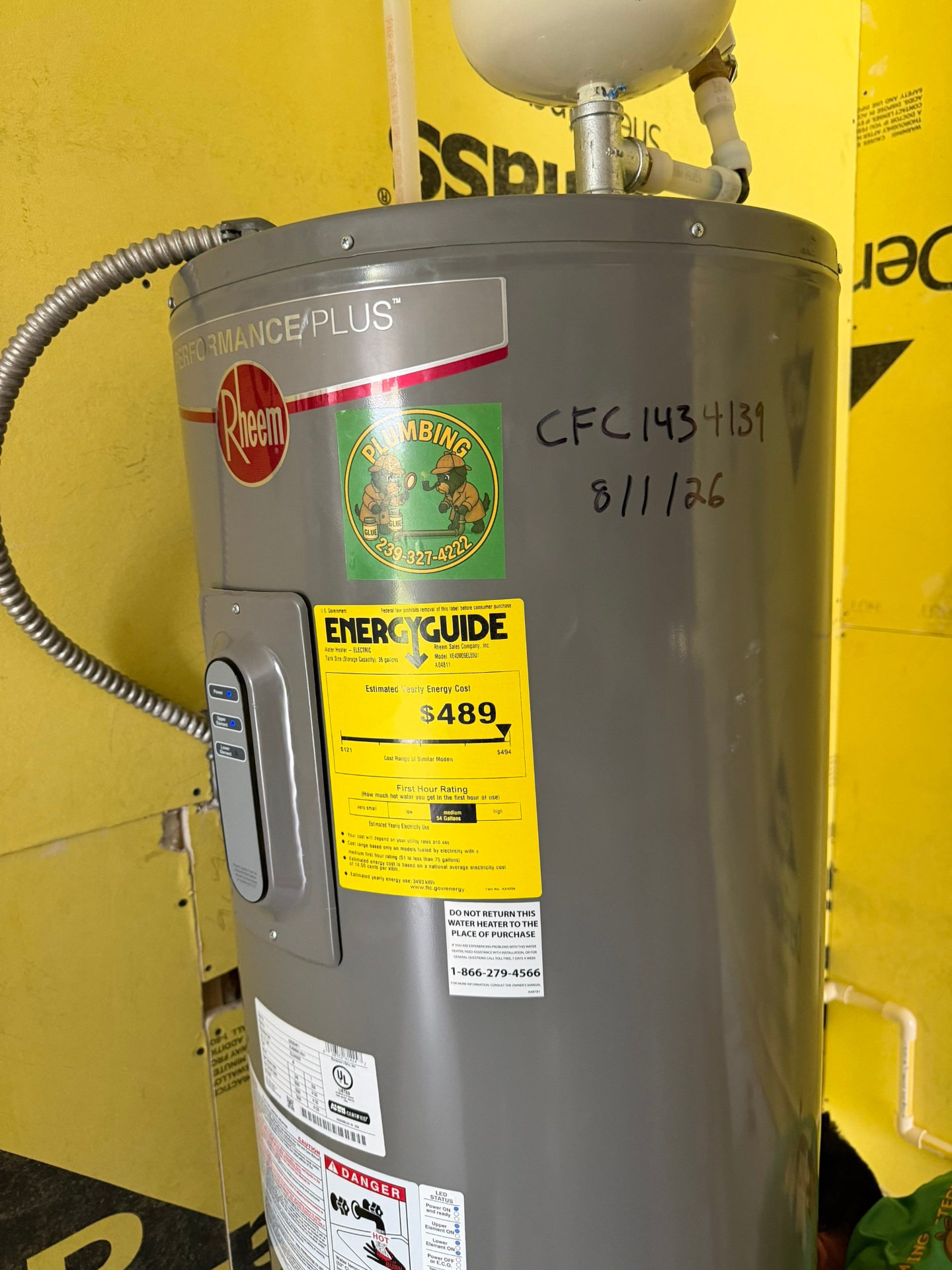
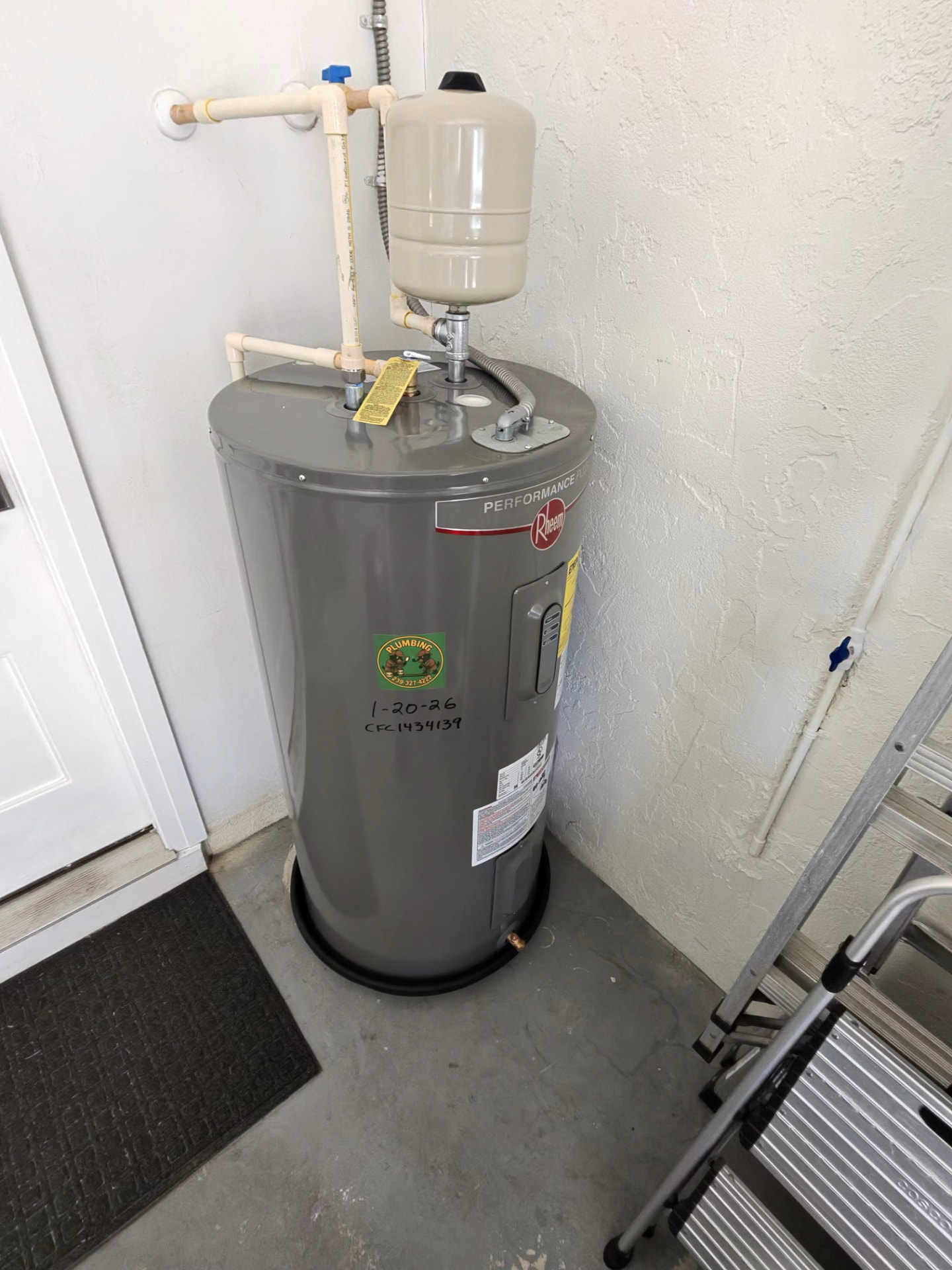
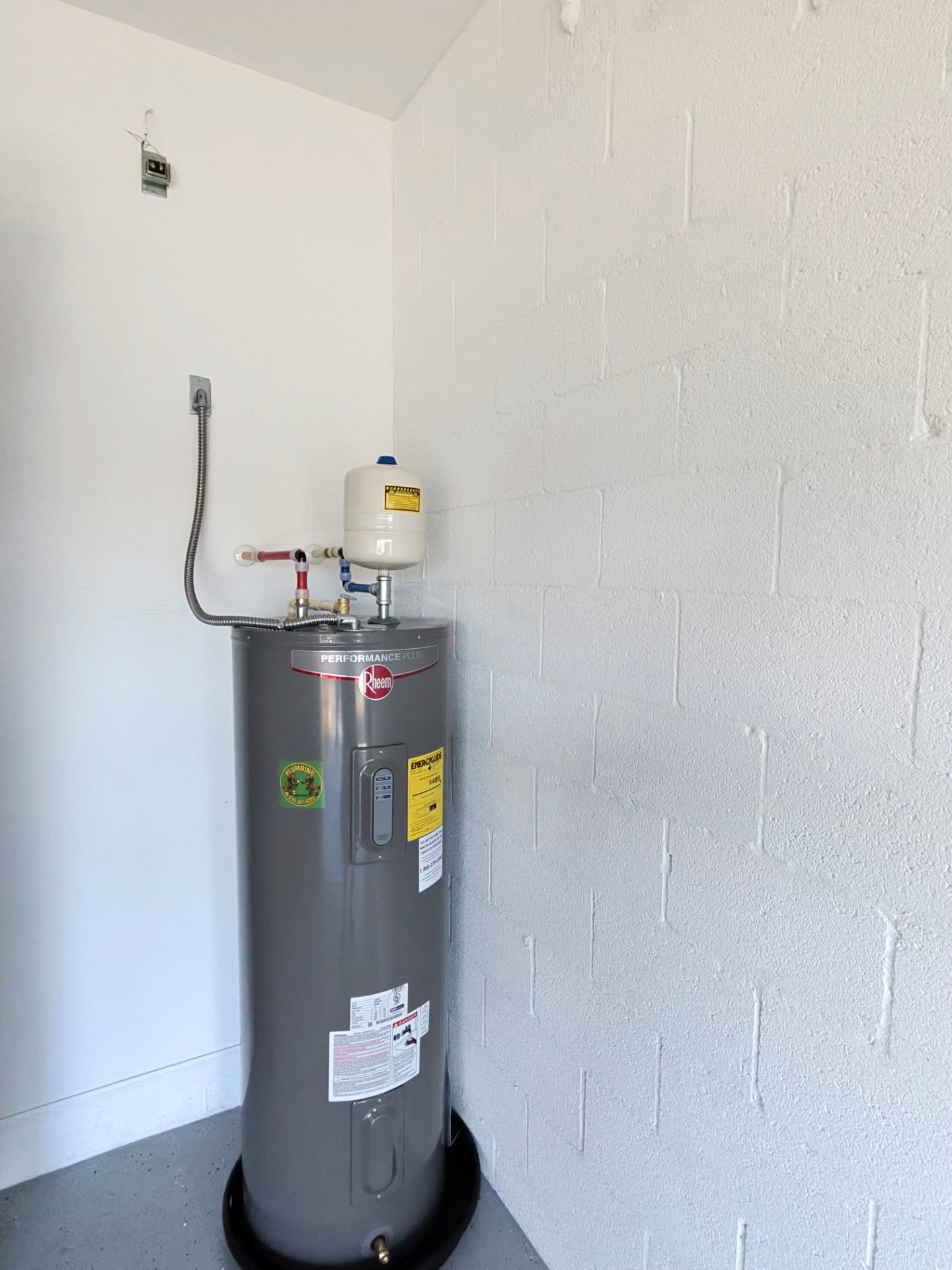
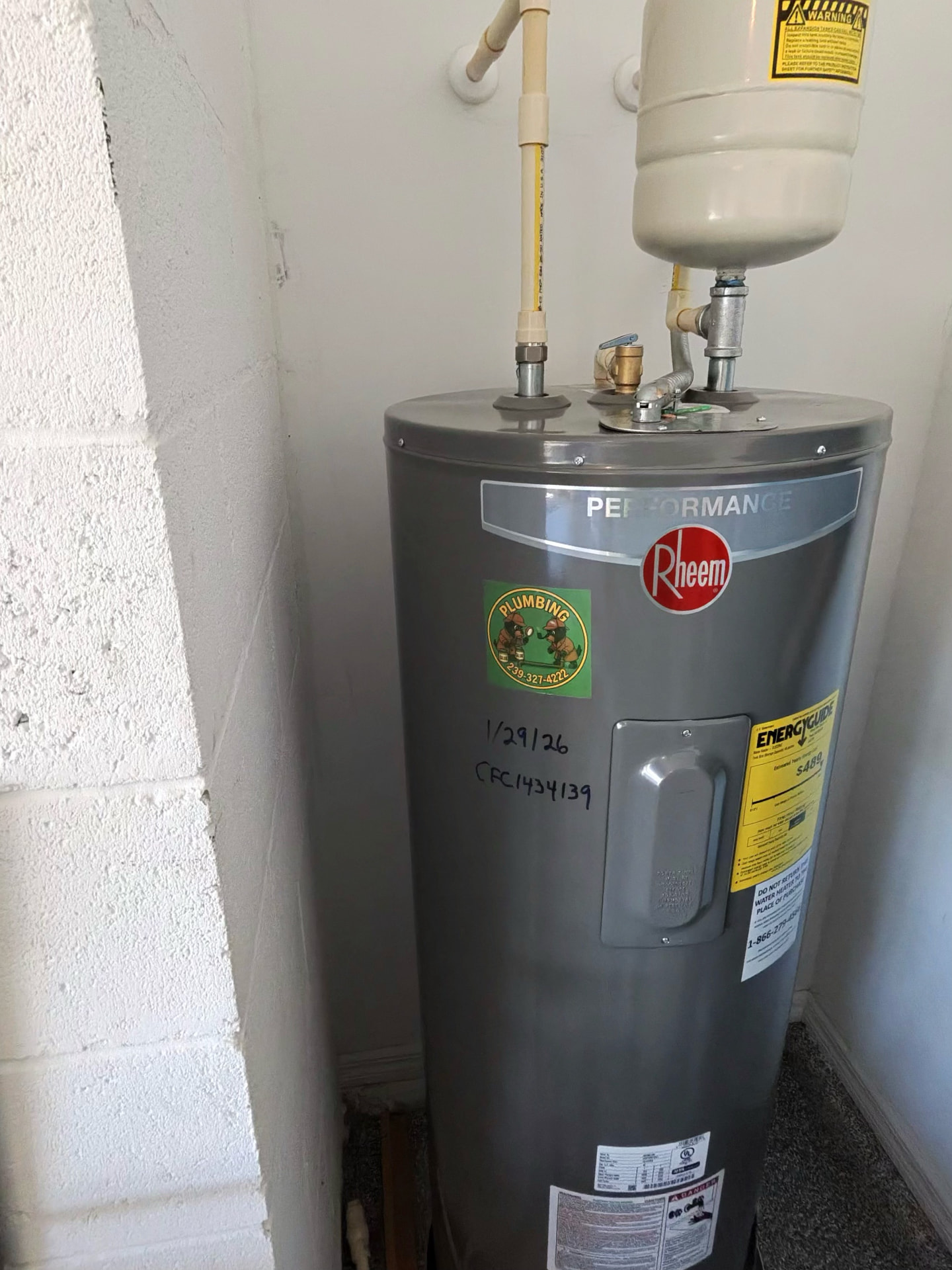
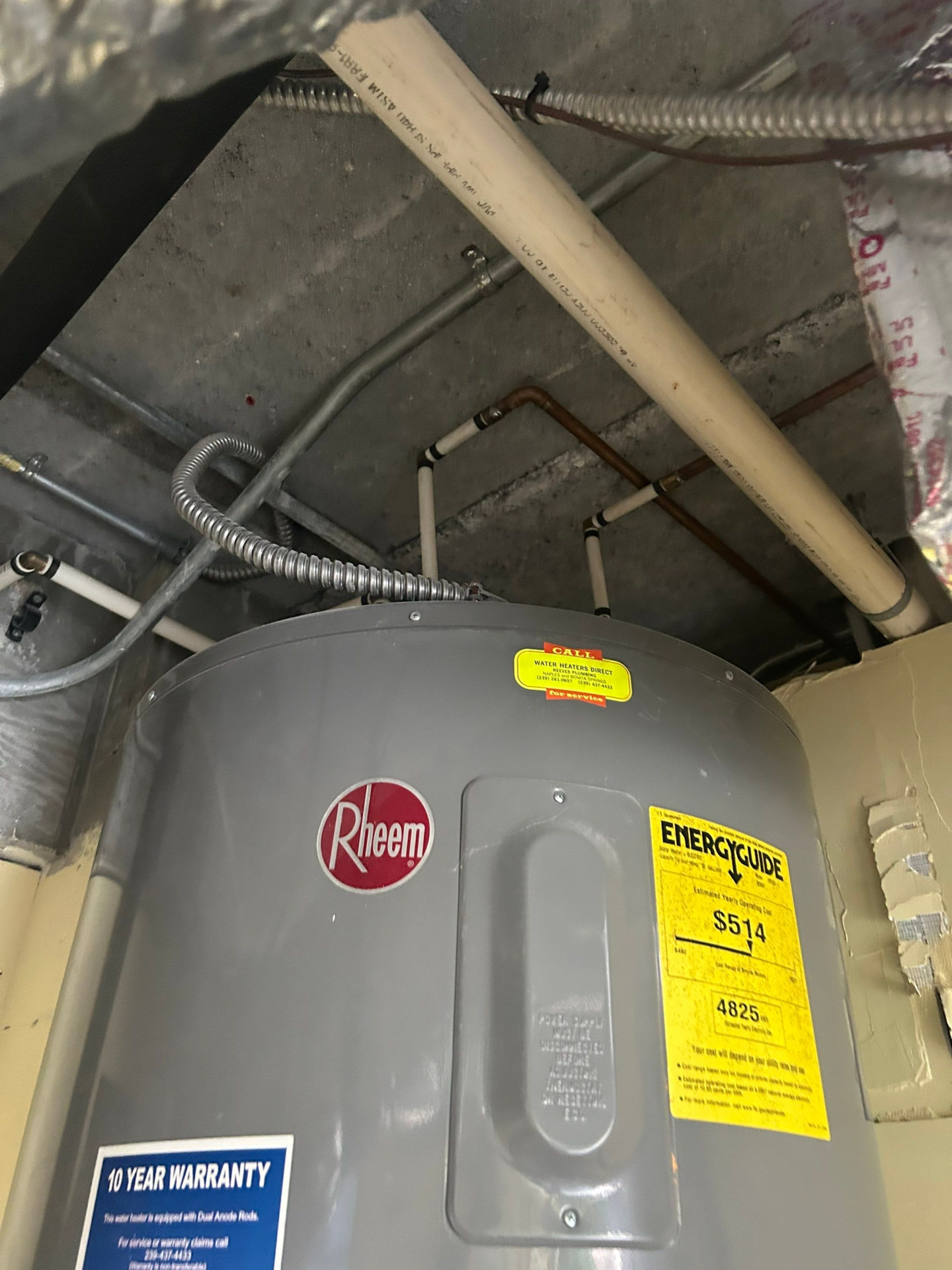
Water Heater Installs, Photographed on the Job
Answers
Frequently Asked Questions — Water Heater Installation in Venice Gardens, FL
If you’ve read this far, you now know more about water heaters in Venice Gardens than most homeowners in this neighborhood — and you understand why the 1956-1972 build era, the county water chemistry, the galvanized pipe situation, and the installation details all matter before any recommendation gets made. If your water heater is showing any of the signs on this page, or if you’d simply like to know what shape your plumbing is actually in, call me at 239-388-3631. I’ll come out, look at the whole system, and tell you exactly what I find. No pressure. No guessing. I’m your neighbor.
Plumbing Detectives LLC | Venice, FL | License CFC1434139
239-388-3631 | plumbingdetectivesfl.com