
Water Heater Installation · Nokomis, FL
Water Heater Installation in Nokomis, FL
Diagnosis first, always. We explain what’s wrong before we recommend anything. Licensed master plumber CFC1434139.
Call Now239-388-3631Nokomis doesn’t get as much attention as Venice to the south or Sarasota to the north, but I work here regularly and I’ll tell you something most plumbers won’t — it’s one of the more complicated markets in Sarasota County to work in. You’ve got some of the oldest housing stock in the region sitting two streets away from brand-new construction. You’ve got homes on municipal water next to homes on private wells, sometimes on the same block. You’ve got cast iron sewer systems in their 50th year aging out at the same time the copper supply lines in those same homes are starting to pinhole. And you’ve got a significant portion of the population that’s seasonal — home for five or six months, gone the rest of the year — which creates a very specific set of problems that most homeowners don’t anticipate.
When someone in Nokomis calls me about a water heater, I don’t start with what unit to sell them. I start by understanding what kind of house I’m walking into, where it sits relative to US-41, how old the plumbing infrastructure is, and what the water source looks like. That context determines whether the water heater itself is the problem, or whether there’s something else going on that a new tank won’t fix.
My name is Mike Reynolds. I’m the owner of Plumbing Detectives LLC and a licensed master plumber, license CFC1434139. I’m based in Venice and I serve the Nokomis area regularly. This is what I’d tell you if I were standing in your utility room.
Market Context
Why Nokomis Is Different From Other Markets
The single most useful thing I can tell you about plumbing in Nokomis is that where your home sits relative to US-41 — the Tamiami Trail that runs north-south through the middle of the community — tells me more about what plumbing problems you’re likely to have than almost anything else.
West of US-41, toward Casey Key, the Intracoastal, Dona Bay, Sorrento Shores and Sorrento South, Bay Point, and the canal communities, you’re looking at older homes with waterfront exposure, municipal water and sewer, higher flood-zone risk, and salt air corrosion that’s more aggressive than what you’d find just a few miles inland. Many of these homes were built in the 1960s through 1980s. Cast iron drain lines. Copper supply lines now entering their 40s and 50s. Water heaters sitting in garages open to Gulf-coastal air.
East of US-41, out toward Mission Valley, Sorrento Woods, Sorrento Ranches, and the larger-lot rural pockets toward I-75, the picture is different. Larger properties, more homes on private wells, more homes still on septic systems. The plumbing issues here often involve water quality from the well, sulfur odor, iron staining, and the specific challenges of septic systems in sandy Florida soil. A water heater on a well water system has different maintenance requirements than one on municipal water — the mineral content and bacterial load in well water affects anode rod chemistry in ways that city water doesn’t.
One of the most common things I see in Nokomis that I don’t see as often anywhere else is what I call the twin failure pattern. In the older Sorrento East, Venetian Gardens, Bay Point, Nokomis Heights, and Springhill Park neighborhoods, the cast iron drain lines installed in the 1960s and 1970s are now at or past the end of their expected service life. Those same homes have copper supply lines that were installed in the same era and are now in the age range where pinhole leaks begin. A homeowner calls me about a water heater and while I’m there I can see the evidence of slow drain problems and wet spots in the walls that haven’t been diagnosed yet. The water heater gets replaced but two years later something else fails that I could have pointed to on the first visit. I’d rather tell you what I see while I’m there than let you find it the hard way.
Water Quality
What Nokomis Water Does to a Water Heater
Water hardness is one of those things homeowners notice at the fixtures — the white scale on the showerhead, the spots on the glassware, the film that builds up in the toilet bowl — but don’t always connect to what’s happening inside their water heater.
Sarasota County water is hard. The distribution system delivers water that tests between 15 and 25 grains per gallon depending on the area and the season. The county’s own reporting shows raw source water coming in around 1,120 mg/L before treatment — some of the hardest source water in the state — softened to roughly 120 to 125 mg/L before distribution. That treated water is significantly better than the raw source, but it’s still hard enough to create real problems inside a water heater over time.
Here’s the mechanism. Dissolved calcium and magnesium enter your water heater with every gallon. When that water heats up, the minerals fall out of solution and settle to the bottom of the tank as a chalky, white sediment layer. This is the same material as the scale on your showerhead — just accumulating where you can’t see it. Year after year, that layer builds up. An inch of mineral sediment at the bottom of a water heater tank acts as insulation between the heating element or burner and the water above it. The heater has to work harder and run longer to achieve the same result. Energy efficiency drops. The bottom of the tank gets hotter than it was designed to be. The tank lining degrades faster than the warranty assumed.
One of the most common things I see on service calls in the 34275 zip code is a water heater making noise — a low rumbling or popping during heat cycles. Homeowners often live with this noise for years. What they’re hearing is water trapped underneath a crust of compacted sediment boiling and pushing through. It’s not a safety emergency in the immediate sense, but it is the sound of a water heater working significantly harder than it should be and accumulating damage with every cycle. An annual flush is all it takes to prevent this from starting.
For homes east of US-41 on private wells, the water quality situation is different and in some ways more challenging. Well water in eastern Sarasota County frequently contains elevated iron and manganese, hydrogen sulfide (the source of the rotten egg odor), and variable bacterial loads depending on the well’s condition and depth. These contaminants affect the water heater differently than the hardness issues on municipal water. Iron deposits inside the tank accelerate corrosion. Sulfide chemistry reacts with the magnesium anode rod in ways that both deplete the rod faster and produce the rotten egg odor in the hot water. If you’re on well water and your hot water smells but your cold water is borderline, that’s a conversation about your anode rod and potentially your well water chemistry — not necessarily a new water heater.
Plumbing Detectives LLC Pro Tip
If your hot water smells like rotten eggs in Nokomis and you’re on municipal water, it’s almost always the magnesium anode rod reacting with sulfates in the water supply. I’ve been called to homes in Sorrento East where the homeowner had already spent several hundred dollars on filtration equipment that did nothing. A rod swap at $50 to $100 in parts fixed the smell the same day. Call before you buy filtration equipment.
Home Age
How the Age of Your Home Determines What I’m Looking For
Nokomis has two very distinct housing waves and they require completely different starting points.
The first wave — 1960s through early 1990s. This covers Sorrento East, Sorrento South, Sorrento Shores, Bay Point, Venetian Gardens, Nokomis Heights, Springhill Park, Waterside Acres, Laurel Villa, Laurel Grove, Mission Valley, Channel Acres, Dona Bay Shores, Tierra Sonada, and similar neighborhoods. These homes typically have cast iron drain-waste-vent systems that are now 40 to 60 years old, copper supply lines that were installed in the same era, and in any home built between 1978 and 1995 specifically — a real risk of polybutylene pipe.
The second wave — 2015 through today. Toscana Isles, Cielo, Vicenza, Aria, Palmero, Bellacina by Casey Key, Willow Chase, Legacy Groves, Magnolia Bay, Cassata Lakes, Vistera of Venice, Tiburon, Venice Woodlands, Talon Preserve on Palmer Ranch. These communities have modern CPVC or PEX supply lines, newer water heaters, and a completely different set of concerns — mostly around whether the builder’s installation was done correctly, whether the unit is properly sized for the home, and warranty boundary questions between builder responsibility and homeowner responsibility.
Let me talk about the older homes specifically because that’s where the most important plumbing decisions are happening right now.
Cast iron drainage in a 50-plus year old Nokomis home is not a question of if it will fail but when. Cast iron was the standard drain material through the 1970s and remained common into the early 1980s. In Florida’s humid sandy soil, the exterior of buried cast iron corrodes from acid produced by soil bacteria. Simultaneously, the interior of cast iron scale, develops rust tubercles that restrict flow, and eventually sections crack or separate at joints from ground settlement in Florida’s sandy soil. I’ve found cast iron in Sorrento East homes that looks acceptable from the exterior but shows significant interior deterioration when I run a camera through it. A water heater replacement in a home with failing cast iron is a short-term investment if the drain system isn’t addressed.
Copper supply lines in this same housing era are now in the age range where pinhole leaks become a pattern rather than an isolated event. I’ve been called to homes in Venetian Gardens and Bay Point where the homeowner had patched two or three pinhole leaks over the past few years and was about to patch another one. That’s the threshold where a conversation about repiping makes more financial sense than ongoing repairs. I’ll tell you where you are on that curve when I look at the system.
And then there’s polybutylene. If your home was built between 1978 and 1995 — which covers a significant portion of Nokomis’s first-wave housing stock, including Sorrento Inlet, Sorrento Park, Curry Cove, Laurel Pines, Laurel Woodlands, Laurel Woods, Blackburn Bay and Shores, Wedgewood Commons, and Tierra Sonada — you may have polybutylene pipe in your walls and you may not know it. Polybutylene is a gray flexible plastic pipe stamped PB2110 that was widely installed across Florida during that period. It was cheap, fast to install, and looked perfectly fine. The problem is that it reacts poorly with the chlorine and chloramine compounds in treated municipal water. The inside of the pipe becomes brittle over time, and the fittings — especially the acetal fittings at connections — are prone to sudden failure with no visible warning. Many insurance carriers no longer cover homes with active polybutylene, and some have canceled policies or declined renewals when they discover it during inspections. If you don’t know what’s in your walls, it’s worth finding out.
If your home was built between 1978 and 1995 and you don’t know what pipe material is in your walls, I can tell you in about 15 minutes by checking a few access points. It’s worth knowing before your insurance company asks. Call 239-388-3631.
Coastal & Seasonal
Salt Air and Seasonal Vacancy — The Two Things That Age a Water Heater Faster in Nokomis
If your home is on Casey Key, in The Inlets, in Sorrento South, in Blackburn Bay or Shores, in Bay Point, or in any canal-front or waterfront community west of US-41, salt air corrosion is a real operational factor that shortens the service life of exposed plumbing components — and water heaters are particularly vulnerable.
I’m not talking about surface rust on the outside jacket of the tank. I’m talking about what happens to the temperature and pressure relief valve over years of salt-air exposure. The valve body corrodes. The seat degrades. The valve starts to weep intermittently even when system pressure is normal. I’m talking about what happens to the anode rod access fitting — if it’s carbon steel and it’s been exposed to coastal air for fifteen years, extracting it to inspect or replace the rod becomes a job in itself because the fitting has bonded to the tank threads. I’m talking about the metal fittings at the top of the heater and the gas valve on gas-fired units. These components weren’t designed for indefinite coastal exposure. A unit that delivers 14 years of reliable service in an inland utility closet may be showing real deterioration at 9 or 10 years in a Nokomis waterfront garage.
One of the most common things I see in the waterfront neighborhoods along the Intracoastal and on Casey Key is water heater components that are years older looking than the age sticker on the unit suggests. The coastal environment does real work on these machines and most homeowners don’t account for it when they’re planning for replacement.
Seasonal vacancy is the other significant factor in this market. Nokomis has a high concentration of snowbird homeowners — people who are here from roughly November through April and gone the rest of the year. Southwest Florida accounts for a disproportionate share of the state’s seasonal population, and the Nokomis area reflects that concentration. What that means practically for a water heater is that the unit sits powered but idle for four to six months. During those months several things happen that most homeowners don’t think about.
Sediment that gets stirred up during normal usage cycles settles and compacts when the unit isn’t operating. A water heater that gets flushed annually before the owner leaves stays in better condition than one that sits all summer with last year’s sediment layer hardening at the bottom. More importantly, the anode rod continues its electrochemical work regardless of whether anyone is drawing hot water. The rod reacts with the standing water in the tank. In Nokomis’s hard water with elevated sulfate content, a magnesium anode rod that was partially depleted when the owners left in April may be exhausted when they return in October. The tank lining has been unprotected since sometime in July. The owners take their first shower in November and don’t know that the corrosive process has been running unchecked for three to four months.
I’ve been called to seasonal homes in Kings Gate and Sorrento East on return visits where hot water quality had noticeably degraded during the summer — slight metallic taste, slightly discolored water from the hot side. In every case it was an anode rod that had been depleted well before anyone noticed. Sometimes the unit was salvageable with a new rod and a flush. Sometimes the corrosive process had already started on the tank walls.
If you’re seasonal and you’re not having the water heater serviced before you leave and checked when you return, you’re gambling on the integrity of a tank that’s been sitting unmonitored for six months.
Plumbing Detectives LLC Pro Tip
Before you leave Nokomis for the summer: have the water heater flushed, the anode rod checked, the T&P valve tested, and the unit set to vacation mode. When you return: a brief check before you run it at full temperature confirms nothing developed during the vacancy. It’s a small investment that protects a much larger one.
Installation Quality
Why Most Water Heaters in This Market Are Installed Wrong
This is a section I include on every page I write because I think homeowners in this market deserve to understand it. It directly determines how long the equipment they’re paying for actually lasts.
Every tank water heater comes from the factory with short threaded pipe stubs — called nipples — at the hot and cold ports at the top of the tank. These nipples are made of galvanized steel, which means the steel was coated in zinc to protect it from corrosion. Standard equipment across every major manufacturer. The problem isn’t the nipples. The problem is what a lot of plumbers do next.
In a copper plumbing system, the standard shortcut is to thread a copper female fitting directly onto those galvanized nipples and call the job done. It looks correct. It holds water. It passes a visual inspection. But it creates a condition called galvanic corrosion that begins the moment water touches the joint and never stops.
Here’s what galvanic corrosion means in plain terms. Copper and galvanized steel are dissimilar metals with very different electrochemical properties. When two dissimilar metals make physical contact in the presence of water — which conducts electricity — a small electrical current flows between them. The more reactive metal in the pairing begins to dissolve, atom by atom, into the water. In a copper-to-galvanized joint, that reactive metal is the zinc coating on the galvanized nipple. The zinc dissolves silently, invisibly, inside the threaded joint. No rust stain on the outside. No drip. No smell. Just steady electrochemical dissolution at the one point where you most need a solid connection.
When the zinc is gone, the bare carbon steel underneath is exposed to the same attack — and carbon steel corrodes faster than zinc did. The nipple fails from the inside out. The water heater that was supposed to run 12 to 15 years gets replaced at seven or eight. Not because the tank was poor quality. Because the connection was wrong on day one.
The electrochemistry behind this is well documented. Copper sits at plus 73 millivolts on the electrochemical activity scale. Zinc sits at minus 927 millivolts. That’s roughly a 1,000 millivolt potential difference driving the corrosion reaction — about 20 times above the threshold where meaningful deterioration begins. Insert brass as a transition fitting and that potential drops to roughly 140 millivolts — an 86 percent reduction in the corrosive driving force. Brass doesn’t eliminate the reaction entirely, but it slows it to a rate the joint can handle for the life of the installation.
Here’s exactly what a correct installation looks like on a copper plumbing system.
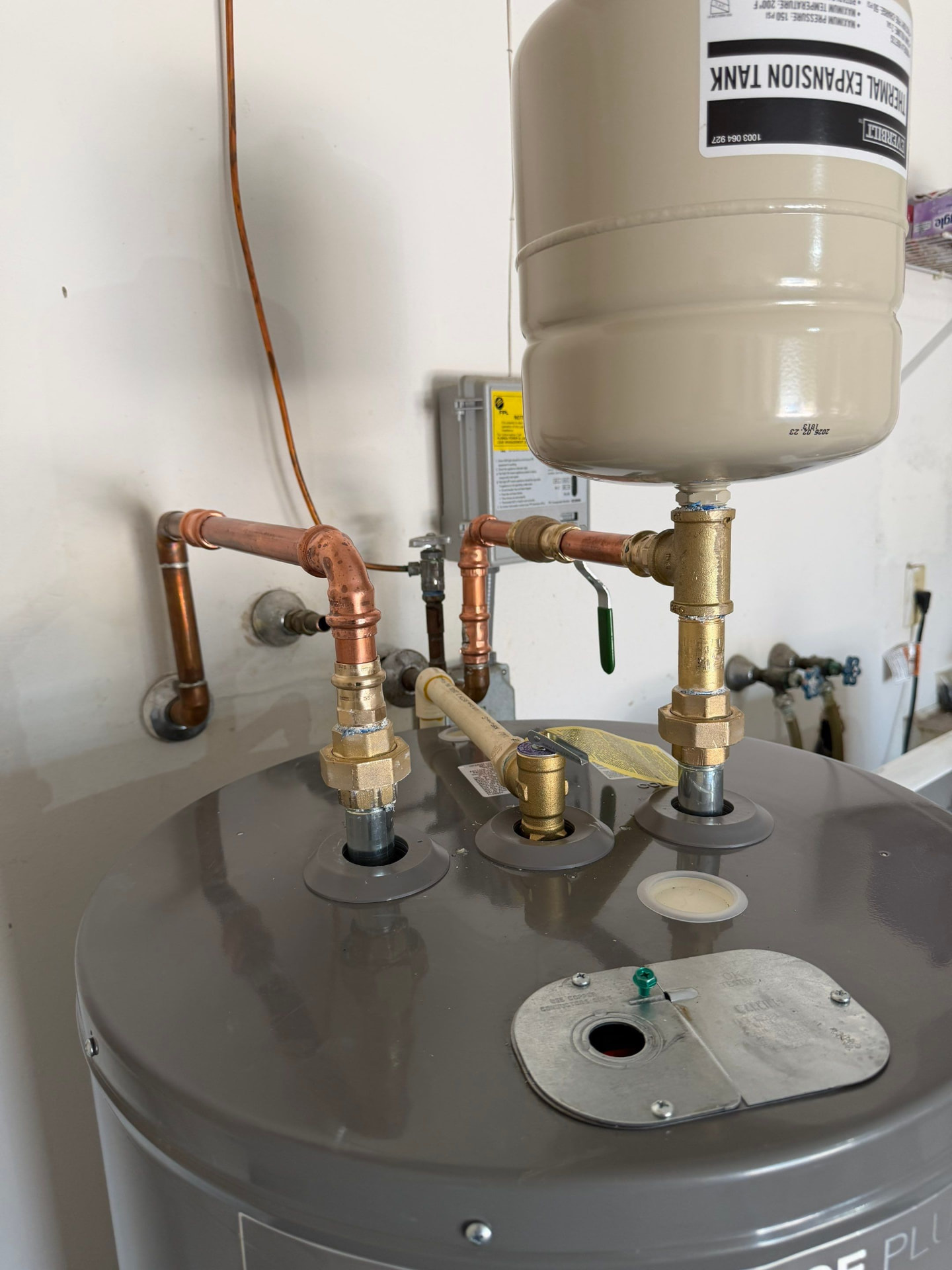
Cold side: A brass female union threads directly onto the galvanized cold nipple coming out of the top of the tank. A brass nipple runs into the other side of that union. A brass tee threads onto the brass nipple. The expansion tank connects off the top port of the tee. Out of the side port, a copper male adapter makes the transition from brass to copper pipe. From there, copper pipe connects to a ball valve shutoff and continues to the cold supply line. The galvanized nipple never sees copper directly. The full sequence is galvanized nipple — brass union — brass nipple — brass tee — copper male adapter — copper pipe. Brass throughout the transition zone.
Hot side: A brass female union threads directly onto the galvanized hot nipple. A copper male adapter threads into the other side of the union and copper pipe continues from there to the distribution system. Galvanized nipple — brass union — copper male adapter — copper pipe.
I use a union on both sides. A union is a three-piece fitting that can be disconnected with a wrench. A coupling requires cutting pipe. Ten years from now when this heater needs to be replaced, the next plumber — or me on a return visit — disconnects both unions and the new heater drops in without cutting into your copper lines. Unions cost about two dollars more than couplings. Most plumbers skip them on both sides. I use them every time.
For homes in Nokomis with CPVC supply lines — which is common in some of the older homes that were repiped at some point, as well as in certain 1980s and 1990s construction — the specific fitting types change but the principle is the same. Every transition from the galvanized tank nipple to any supply pipe material goes through the correct approved fitting for that pipe type. No improvising at the connection points.
Plumbing Detectives LLC Professional Opinion
If a plumber recommends replacing your water heater without looking at the connections on the existing unit, examining the anode rod condition, checking for sediment, or explaining why the unit actually failed — I’d ask a few more questions before signing anything. A water heater that dies at eight years in a market where they should run twelve to fifteen usually has a story. Understanding that story is the difference between fixing the problem and replacing it.
Expansion Tank
The Expansion Tank — Why It Matters in Nokomis Specifically
Almost every home in Nokomis that’s connected to Sarasota County Public Utilities has a backflow prevention device on the water service line between the meter and the house. That device does its job — it prevents contaminated household water from flowing back into the municipal supply. But it also creates what’s called a closed plumbing system, and closed systems have a specific requirement that a lot of water heater installations in this area skip.
Water expands when it heats up. In an open plumbing system, that expanded water can push back toward the street. In a closed system, it can’t. The backflow device won’t allow it. So when your water heater runs a heat cycle and the water in the tank expands, that pressure has to go somewhere. Without an expansion tank, it cycles through every fitting, every valve, and every appliance connection in your plumbing system, every time the heater runs.
Over months and years that repeated pressure cycling fatigues fittings and stresses valve seats. And it causes the temperature and pressure relief valve on the water heater to do something it was never designed to do regularly — drip or discharge to relieve excess system pressure. When that happens, most homeowners assume the relief valve is faulty and have it replaced. The new valve does the same thing. Nobody identifies what’s actually causing it.
One of the most common things I find during second-opinion calls in Nokomis is a replacement T&P valve on a water heater with no expansion tank anywhere in the system. The first valve was blamed for failing. The underlying cause was a closed system with no pressure relief cushion. The replacement valve will fail the same way.
The Florida Building Code requires an expansion tank on water heater replacements in closed plumbing systems. Nokomis is effectively 100 percent closed system for homes on Sarasota County municipal water. An expansion tank is a standard part of every correct water heater installation in this market. It’s not an optional add-on.
Anode Rod
Protecting the Tank — The Anode Rod and the Corro-Protec Upgrade
Most homeowners have never heard of an anode rod. I’m going to explain what it is because understanding it is the most important maintenance concept for a water heater in this market.
Inside every tank water heater is a metal rod suspended vertically through the top of the tank. This rod is made of a material — usually magnesium or aluminum-zinc — that is more electrochemically reactive than the steel tank walls. Because it’s more reactive, it preferentially attracts the corrosive chemical attack that water conducts against metal. It corrodes so the tank walls don’t have to. The technical term for this is cathodic protection. The common name is the sacrificial anode rod, because the rod sacrifices itself to protect the tank.
When the rod is consumed — and it will be consumed, that’s its purpose — the protection it provided ends. The tank walls become the next target. Corrosion begins on the interior steel lining. The water starts picking up rust particles, giving it a slightly metallic taste or faint orange tint from the hot side. The tank’s service life is now counting down. In Nokomis’s hard water conditions, a magnesium anode rod that might last five to seven years in softer water can be significantly depleted in three to four years. And because nobody can see it without removing it, most homeowners never know it’s gone.
The practical consequence I see regularly is water heaters in this market that were replaced at eight or nine years old — well before their rated service life — because the anode rod had been consumed years earlier and the tank had been corroding unprotected. The replacement cost is real. The cause was a fifteen-dollar rod that nobody checked.
On every installation, I offer an upgrade to the Corro-Protec powered titanium anode rod. This is a different approach to the same problem. Instead of a sacrificial rod that depletes, the Corro-Protec uses a low-level impressed electrical current — less than three dollars per year in electricity — to actively repel corrosion from the tank walls rather than absorbing it. It’s made from titanium, which doesn’t corrode and doesn’t deplete. The manufacturer backs it with a 20-year warranty. For Nokomis’s water conditions — elevated hardness, sulfate chemistry that accelerates magnesium rod depletion, seasonal vacancy periods where the anode is reacting with standing water for months — it provides a meaningful upgrade in long-term tank protection.
I’ll be honest with you about when it makes sense and when it doesn’t. If the tank is old and close to the end of its life anyway, the Corro-Protec is not the right investment. But on a new installation, or on a tank with good remaining service life, it can add years. I’ll tell you which situation you’re in before I recommend it.
Common Errors
Mistakes I Commonly Find on Water Heater Installations in Nokomis
When I’m called for a second opinion or to look at a failing water heater in Nokomis, these are the installation errors I find most often. I include this not to criticize other plumbers but because I think homeowners should know what to look for — and what to ask for when they hire someone.
Copper directly on galvanized. No brass transition. As I explained in the section above, this is the most common installation error in this market and it silently shortens the service life of the unit. I find it on handyman swaps, unpermitted installs, and on work done by companies that move fast and cut corners on the fittings.
Missing expansion tank. On a closed plumbing system — which is virtually every Nokomis home on municipal water — an expansion tank is required. Missing expansion tanks are one of the most common things I find. The homeowner usually tells me they’ve had the T&P relief valve replaced once or twice. That’s the symptom.
No union fittings. Couplings instead of unions on both hot and cold sides. Means the next heater replacement requires cutting pipe. Adds cost and inconvenience to a job that doesn’t need to be complicated.
Improper T&P discharge. The temperature and pressure relief valve on a water heater is required to have a discharge pipe that runs to within six inches of the floor or outside — so if the valve opens and dumps hot water, it goes somewhere safe and not onto whoever is standing nearby. I’ve found T&P discharge pipes that terminate in the air above the heater, point at the wall, or have been connected to a drain in ways that code doesn’t allow.
Wrong unit size. A 40-gallon heater replacing a 50-gallon in a home with two full bathrooms and four occupants because the smaller one was what was on the truck. I’ve taken calls from homeowners complaining their new water heater runs out of hot water faster than the old one. In every case it was undersized.
Incorrect venting on gas units. Gas water heaters require proper draft venting — the right diameter flue, the right slope, the right clearances. I’ve found gas heaters in Nokomis with flex vent improperly supported, undersized flue connections, and vent runs with too many elbows that restrict draft. This is a safety issue, not just a performance issue.
Plumbing Detectives LLC Pro Tip
If you’re getting a water heater replacement quote and the contractor doesn’t mention the expansion tank, ask them directly: “Will you be installing an expansion tank on this job?” Their answer tells you a lot about how they work.
Maintenance
Why Annual Maintenance Matters More in Nokomis Than in Most Markets
I’ve already said this elsewhere on this page but it’s worth stating plainly: the water heaters that reach their full service life in this market are the ones that get annual maintenance. The ones that fail early almost always have a maintenance history that amounts to nothing since installation.
Hard water, salt air in coastal neighborhoods, elevated sulfate content, and seasonal vacancy periods all compound each other. They don’t just add up — they multiply each other’s effects. A tank in a Nokomis waterfront garage with hard water, coastal air exposure, seasonal vacancy, and a five-year-old magnesium anode rod is under stress from four directions simultaneously. Neglecting annual maintenance in this context isn’t a minor oversight. It’s genuinely shortening the working life of the equipment.
Annual water heater maintenance means: flushing sediment from the bottom of the tank through the drain valve, inspecting and replacing the anode rod when it’s depleted, testing the T&P relief valve to confirm it opens and reseats correctly, checking every fitting and connection at the top of the tank for early corrosion or moisture, and verifying the expansion tank is properly charged for current system pressure.
It’s not a long visit. It’s a scheduled annual hour that gives me a chance to see the unit every year and catch anything that’s developing before it becomes a problem. The anode rod I replace during a maintenance visit is the reason the tank runs to 15 years instead of 9. The fitting I notice weeping during an annual check is the reason there’s no water damage on the floor of the garage.
We offer maintenance plans for Nokomis homeowners — including a seasonal program for snowbirds who want the unit checked before they leave in spring and confirmed on return in the fall. If this is a home you leave unoccupied for four to six months, this is the most practical service commitment you can make to your plumbing system.
Sewer Status
The Septic and Sewer Question — Why It Matters for Your Plumbing Service
Nokomis is one of the few markets in Sarasota County where I can’t assume a home’s sewer status without checking. Sarasota County’s Phillippi Creek Septic System Replacement Program has been converting septic systems to county sewer in phases for more than two decades. The result is a patchwork where a home might be on county sewer while the house next door is still on septic and scheduled for future conversion.
This matters for a water heater service call for one specific reason: if your home is on a vacuum sewer or low-pressure sewer system as part of the county’s conversion program, you have a grinder pump or vacuum valve on your property that you are responsible for maintaining. Most homeowners who’ve been converted to this type of system don’t fully understand that the pump is their equipment and their maintenance obligation. It’s separate from your water heater but it’s part of your plumbing infrastructure, and when I’m on site I’ll tell you what I see.
Beyond that, homeowners in Nokomis who are still on septic should be aware that Sarasota County’s conversion program has compliance timelines — properties in priority areas will be required to connect to county sewer or upgrade to advanced treatment systems by 2030. If you’re planning significant plumbing work including a whole-home repipe or bathroom renovation, the timing of that work relative to a required sewer connection is worth discussing.
Diagnosis First
Diagnosis First — The Only Way I Work
I want to be direct about something because I think it matters. There is money in selling water heaters. They’re high-ticket replacements and the margin is real. A lot of companies have a financial incentive to recommend replacement before they’ve fully diagnosed what’s going on. I don’t operate that way, and I’ll explain why.
In Nokomis specifically, I’ve shown up to jobs where someone else had already quoted a replacement and the existing unit didn’t need to be replaced. I’ve found a tripped thermal cutoff on an electric unit — a five-minute reset that restored full function. I’ve found a failed heating element on a tank that was otherwise in excellent condition — a two-hundred-dollar part that extended the tank’s life by another several years. I’ve found missing expansion tanks causing T&P valve weeping that was being attributed to a failing heater. I’ve found anode rod issues being misread as signs of tank failure.
None of those homes needed a new water heater at the time they were quoted one.
When I look at a water heater I want to know the full picture: unit age and maintenance history, water source, what the connections look like and whether the installation was done correctly, T&P valve condition and whether it’s been weeping and why, sediment level and history of flushing, anode rod condition. Once I have that picture I can tell you what the unit actually has left, what a service call could accomplish versus what replacement would accomplish, and what the real cost-benefit looks like.
Sometimes replacement is clearly the right answer. When the tank is deeply corroded internally, when it’s well past its service life in this market, when multiple components are failing simultaneously — I’ll say so clearly and explain why. But I won’t say so without looking first.
Not sure if your water heater actually needs replacing? I’ll come out, look at the full system, and give you an honest assessment before I recommend anything. No pressure. No upselling a replacement if a service call will do the job. Call 239-388-3631.
Options
Water Heater Options for Nokomis Homes
When replacement is the right call, the decision about what to put in depends on the home, the existing infrastructure, and the homeowner’s priorities.
Tank water heaters are the right choice for most Nokomis residential applications. We install Bradford White and Rheem — two brands I trust in Florida’s climate. Available in natural gas, propane, and electric configurations. For most homes on natural gas in the older Sorrento, Venetian Gardens, or Calusa Lakes neighborhoods, a 40 or 50 gallon gas tank unit is the straightforward replacement. Electric tank units make sense where gas isn’t already in the home or where the homeowner has a specific preference.
Tankless water heaters heat water on demand without a stored tank. They don’t run out of hot water, they’re more efficient over time, and they’re a particularly good fit for Nokomis seasonal homes that sit empty for months — you’re not paying to keep 50 gallons of water hot while the house is closed. The tradeoff is higher upfront cost and sometimes a gas line upgrade or dedicated electrical circuit to handle the instantaneous demand. I’ll be honest about what your home needs before recommending one. For more on tankless options specific to this market, take a look at our tankless water heater page.
Heat pump water heaters are the most energy-efficient electric option available. They pull heat from the surrounding air rather than generating heat directly, which makes them significantly more efficient than standard electric resistance tanks. Florida’s warm year-round ambient temperature makes them work well here. For homes converting from gas or in the newer Nokomis communities where all-electric is the preference, they’re worth a real conversation.
Warning Signs
Signs Your Nokomis Water Heater Needs Attention
These are the things I’d want Nokomis homeowners to call about rather than wait on. Earlier attention almost always costs less than deferred attention.
The unit is more than 10 years old and has never been serviced. In Nokomis’s hard water and coastal conditions, a decade-old tank with no maintenance history is an unknown quantity. It may be fine. It may not be. A diagnostic visit tells you which.
You’re running out of hot water faster than before. Sediment accumulation reduces the effective usable volume of the tank. A 50-gallon unit with several inches of sediment is functionally smaller.
Hot water smells like rotten eggs. Almost always the anode rod on municipal water. Call before spending money on filtration.
Rust-colored water from the hot tap only. Internal corrosion shedding into the supply. The tank is failing inside.
Moisture, staining, or dampness at the base or at the connections on top. Slow seam failure or weeping connection. Don’t wait on this. Slow water intrusion compounds into expensive damage fast in Florida’s humidity.
Rumbling or popping during heat cycles. Compacted sediment. Flush first and evaluate from there.
T&P relief valve dripping. Could be the valve at end of life. Could be missing expansion tank. Could be system pressure issue. I need to see the whole system.
White deposits, green staining, or any sign of moisture at the top connections. Galvanic corrosion at the fittings — the installation problem I described earlier. Even if the unit is functioning, have it checked.
Plumbing Detectives LLC Pro Tip
If you bought a Nokomis home between 1978 and 1995 and haven’t had a plumber look at the supply lines, have someone check for polybutylene pipe. It’s often in the walls and previous owners may not have disclosed it or may not have known it was there.
If your home is on a canal in Sorrento South, Bay Point, or along the Intracoastal and your water heater is in a garage — check the connections on top of the unit once a year. Salt air corrosion is visible long before it becomes a structural failure. A green tint on a fitting or white powdery deposit is an early warning sign.
If you’re a Kings Gate or Fairwinds Village resident and you’ve been in the same unit for 10 or more years without a plumbing inspection, a water heater check is a good reason to have someone look at the whole system. The 55+ communities in this area have a lot of original plumbing that’s reaching the end of its expected life.
Our Company
Why Plumbing Detectives LLC
I named the company Plumbing Detectives LLC because too many homeowners in this area have been sold expensive repairs or replacements before anyone took the time to figure out what was actually wrong. My job is to diagnose the problem first, explain it in plain English, and let you make an informed decision about what to do next. That’s how I believe plumbing should work.
I’m a licensed master plumber — not a franchise, not a call center dispatching whoever is closest. When you call Plumbing Detectives LLC, you get me or someone I’ve trained and trust, and you get a straight answer about what I find. I don’t have a quota for water heater replacements. I don’t have a commission structure that rewards me for selling the most expensive option. My reputation in this market is built on telling people what they actually need, which sometimes means telling them they don’t need a new water heater when someone else said they did.
Permitting
Professional Installation Done Right
Every installation we complete follows applicable plumbing requirements for your specific property. Nokomis is unincorporated Sarasota County — there’s no separate city building department here. All permits and inspections run through Sarasota County Planning and Development Services. If permits or inspections are required for your specific project, we’ll explain what’s involved before work begins. You’ll know what to expect before we start.
License CFC1434139. Fully insured.
Documented Work
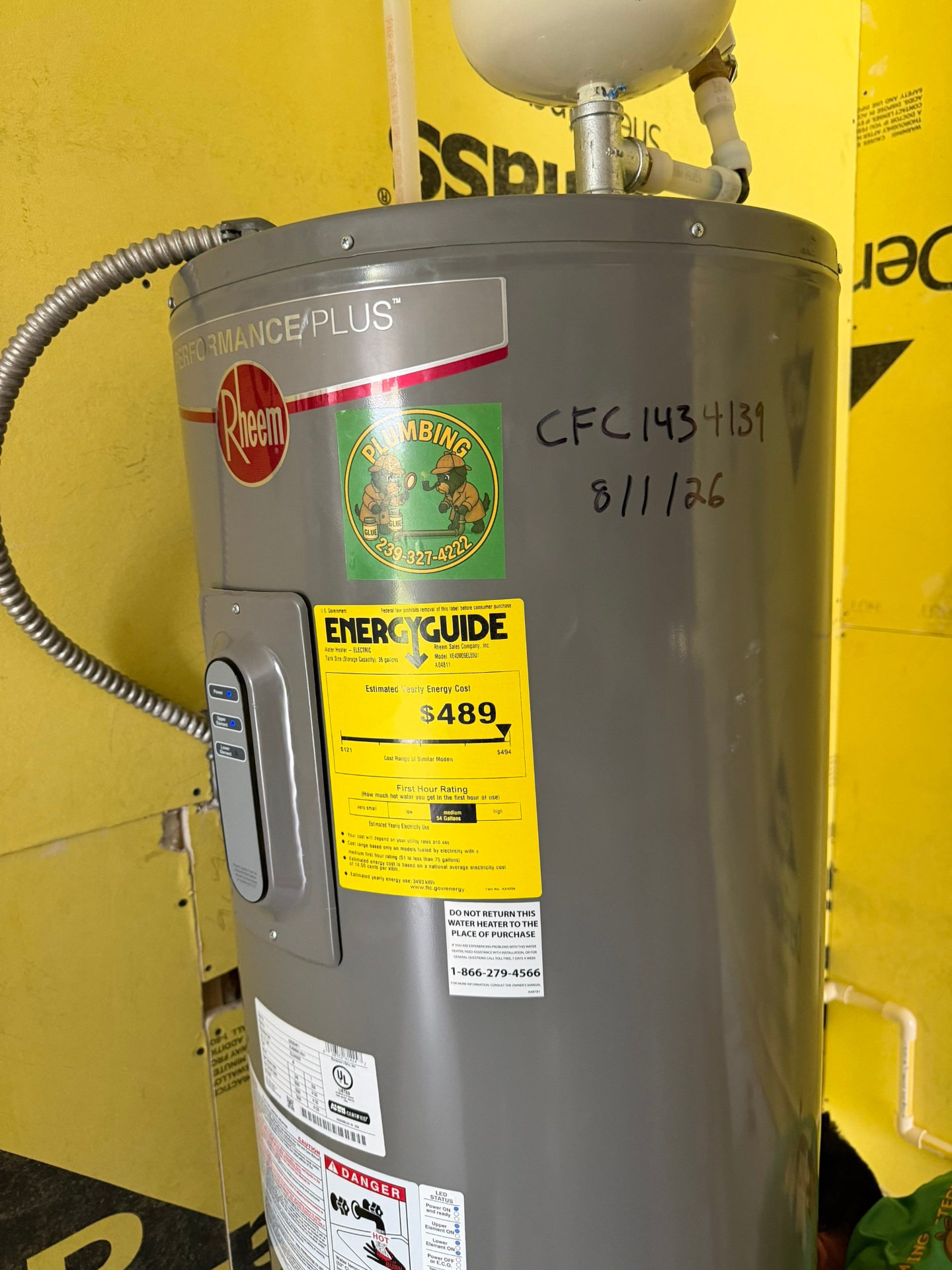
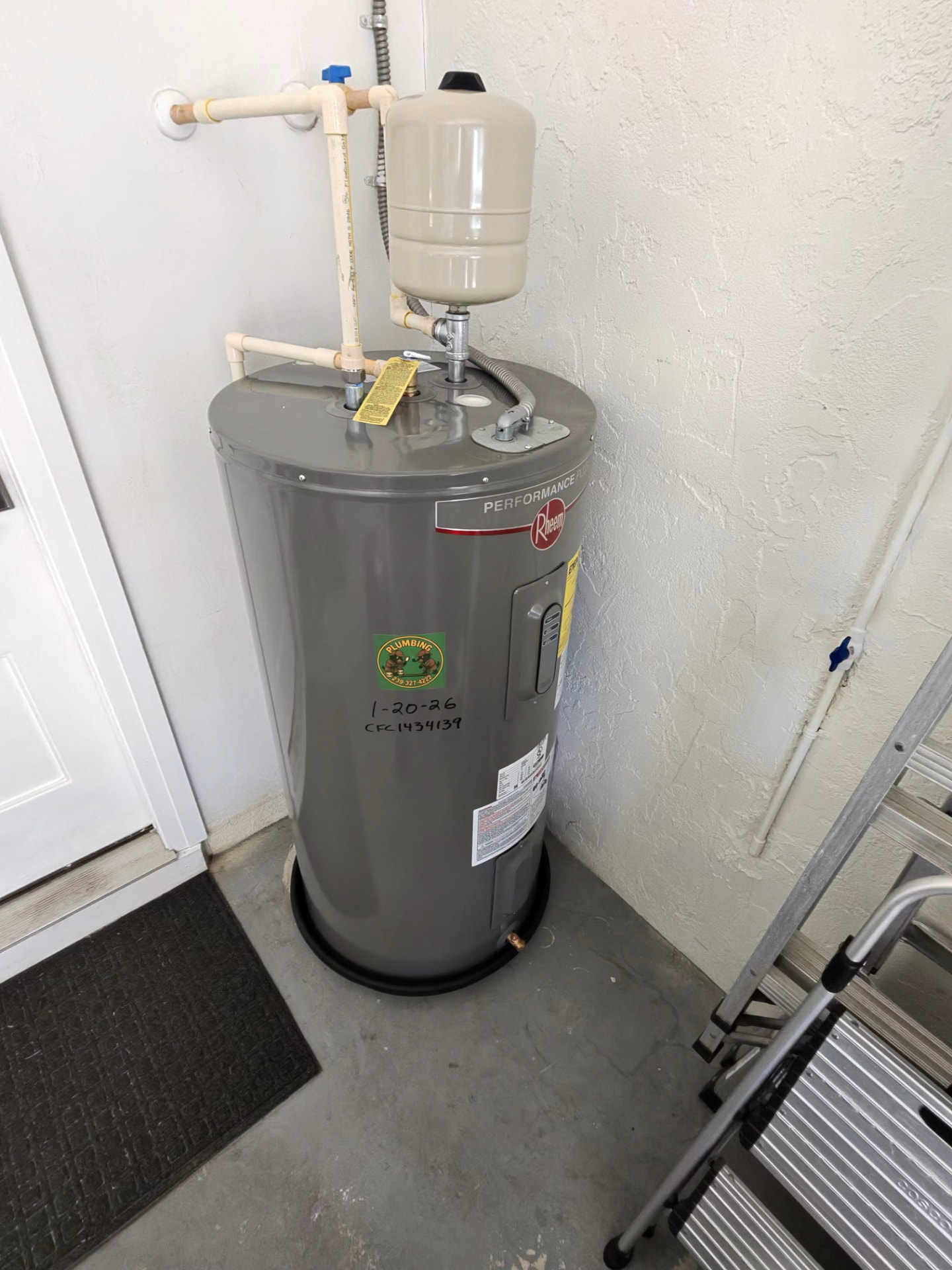
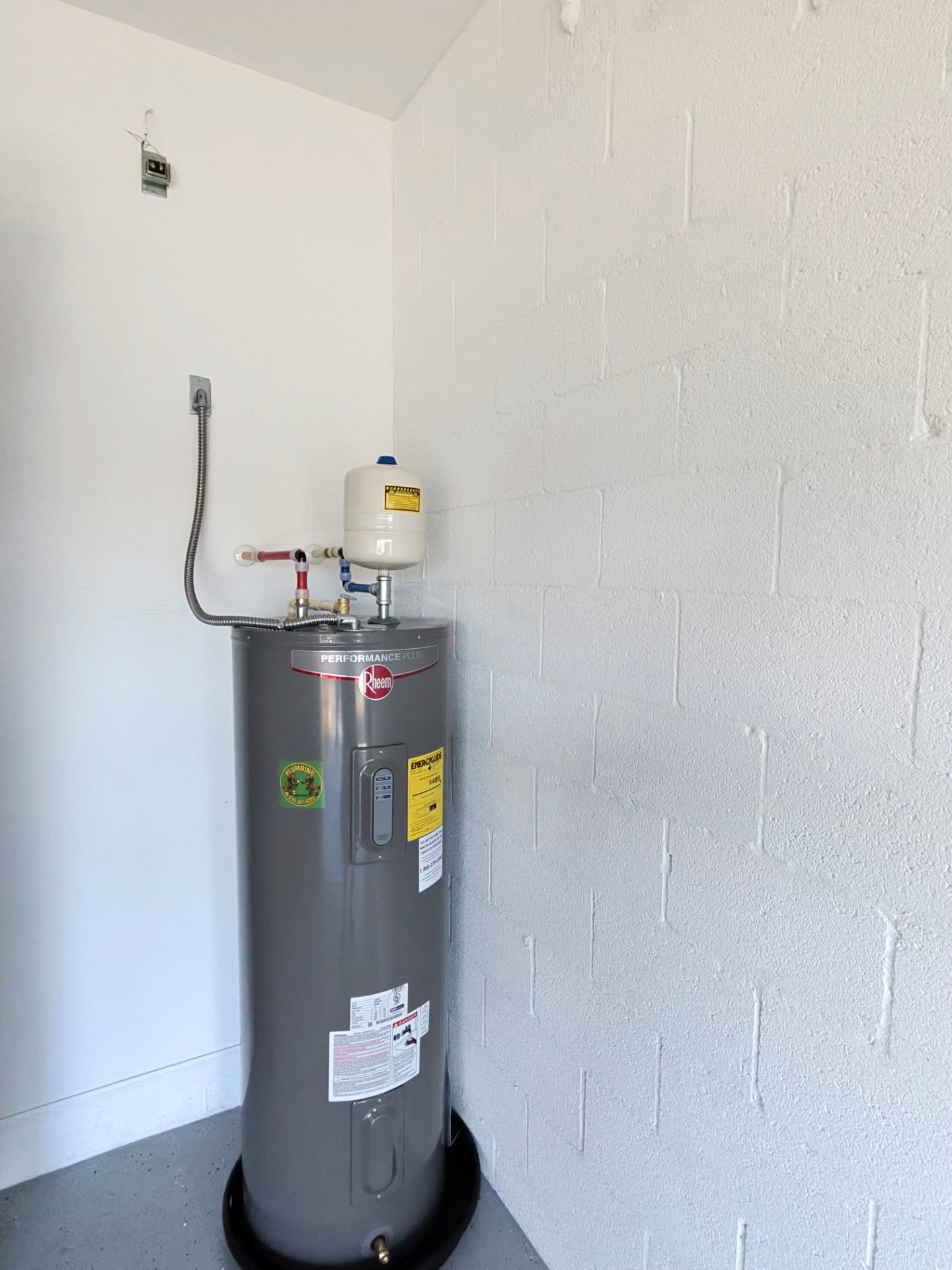
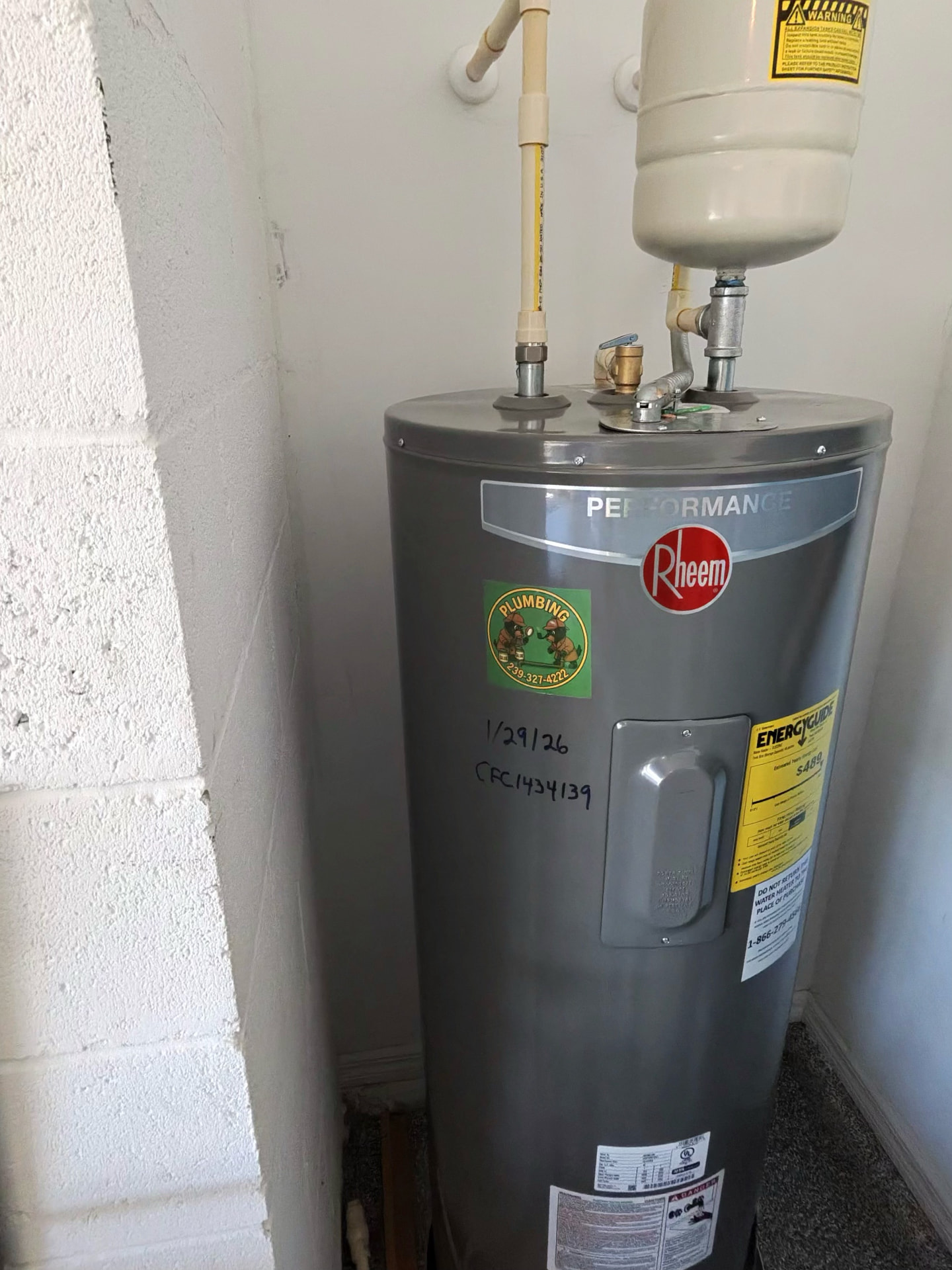
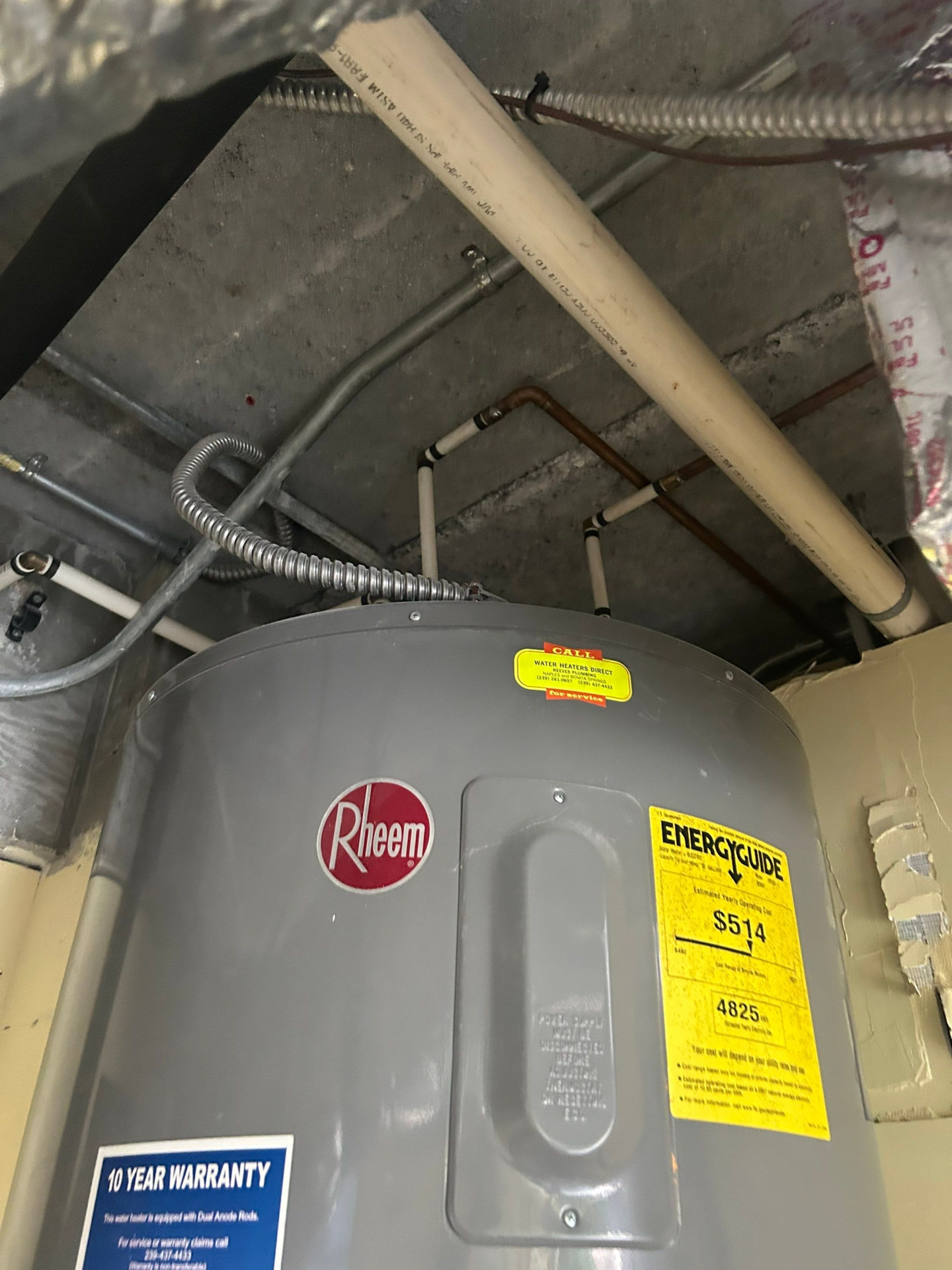
Water Heater Installs, Photographed on the Job
Answers
Frequently Asked Questions — Water Heater Installation in Nokomis, FL
If you’ve read this far, you now know more about water heaters in Nokomis than most homeowners in this market — and probably more than a few plumbers. If your water heater is showing any of the signs described above, or if you just want to know what shape yours is actually in, call me at 239-388-3631. I’ll come out, look at the whole system, and tell you exactly what I find before I recommend anything. No pressure. No guessing. Just a straight answer from a licensed master plumber who works in this market.
Plumbing Detectives LLC | Venice, FL | License CFC1434139
239-388-3631 | plumbingdetectivesfl.com