
Water Heater Installation · Englewood, FL
Water Heater Installation in Englewood, FL
A community split across two counties — Sarasota and Charlotte — with an Englewood Water District treatment story most people get wrong. Manufactured homes, post-Ian repairs, and housing stock at or past its service window. Diagnosis first, always. Licensed master plumber CFC1434139.
Call Now239-388-3631Englewood doesn’t have a city government, and it doesn’t have a single water utility, either. What it has is a community split across two counties — Sarasota to the north and east, Charlotte to the south and west — an Englewood Water District system with a water treatment story most people get wrong, and a housing stock old enough that a large share of it is at or past the typical service window for whatever supply material it was originally built with.
I was recently doing a water heater installation in an Englewood home when the rest of the plumbing told me something the water heater alone didn’t. The copper supply lines feeding the tank were heavily corroded — the kind of green oxidation you’d expect on an old outdoor fixture, not indoor supply piping. The hose bib on the side of the house was seized solid. The water heater was one part of that story. The rest of the system was telling me something too.
My name is Mike Reynolds. I’m the owner of Plumbing Detectives LLC and a licensed master plumber, license CFC1434139. I’m based in Venice and registered in both Sarasota and Charlotte Counties. Here’s what I’d tell you about your water heater before I recommend anything.
Market Context
What Makes Englewood Different — Two Counties, One Market
The county line running through Englewood matters for permitting on every job, including a straightforward water heater swap. If your home falls in the Sarasota County portion — generally the 34223 zip code covering the Dearborn Street core and the older Lemon Bay neighborhoods — permits run through Sarasota County Planning and Development Services, with trade permits on a sliding scale of $50 to $500 depending on scope, per fee schedule Resolution 2021-107. If your home is in the Charlotte County portion — Rotonda West, Cape Haze, South Gulf Cove, and Englewood Beach in 34224 — permits run through Charlotte County Building Construction Services at 18400 Murdock Circle in Port Charlotte, phone 941-743-1201. Charlotte County runs a flat $90 residential plumbing permit fee, plus a state-mandated surcharge of 0.025 times the building fee (minimum $4), and a $150 pre-application fee for single-family projects. There is no unified “Englewood” permitting authority — I verify which county governs your specific parcel before pulling any permit.
The housing stock reflects the same layered history. The older Dearborn Street core and Lemon Bay waterfront neighborhoods date to the 1950s and 1960s. The 1970s were Englewood’s single largest decade of construction — over 2,100 homes — spanning the transition from galvanized to copper to the earliest years of polybutylene. The 1980s, with 567 homes, fall squarely inside the national polybutylene installation window. Rotonda West and the Cape Haze communities bring a different era of construction again. And post-Hurricane Ian rebuilds represent their own category, sometimes with modern plumbing done correctly and sometimes carrying the compromises of emergency storm recovery.
Water Chemistry
The Water Hardness Truth — Raw Source Water vs. What Reaches Your Tank
This is the single most important water-quality fact for anyone maintaining a water heater on the Englewood Water District system, and it’s a distinction most plumbers in this market get wrong.
EWD’s own Potable Water Master Plan engineering documents show the Surficial Aquifer — the district’s primary freshwater source, drawn from Wellfields 1, 2, 3, and 5 at depths of 27 to 150 feet — averages 287 mg/L hardness as calcium carbonate, a range of 176 to 365 mg/L, which converts to roughly 10.3 to 21.3 grains per gallon. That’s the raw source water, and it’s genuinely hard. But EWD runs that water through a lime softening process before it reaches your home. The district’s own Lime Softening Plant documentation states raw water entering the process runs approximately 300 mg/L, while the finished, treated water leaving the plant averages only about 78 mg/L — roughly 4.5 grains per gallon. That’s soft to moderately soft, well under the 10.5 GPG threshold that defines very hard water.
So if you’ve heard “Englewood water is 18 to 25 GPG,” that figure describes raw groundwater at the wellfields, not what’s actually entering your water heater on the EWD system. Your tank is working against meaningfully softer water than the number that gets repeated around this market.
EWD also draws from a separate brackish source — Wellfield 4 at 260 to 450 feet, reaching into the Upper Hawthorne and Floridan Aquifers, along with an RO wellfield beneath Wellfield 2 — where hardness runs dramatically higher, averaging 2,068 mg/L as calcium carbonate. That water goes through reverse osmosis treatment, which removes hardness far more aggressively than lime softening, before being blended with the lime-softened supply and disinfected. Total dissolved solids at these brackish sources are already elevated and projected to climb — Wellfield 2 currently measures 4,957 mg/L TDS, projected to reach 7,579 mg/L by 2051; Wellfield 4 currently measures 4,827 mg/L, projected to reach 14,491 mg/L by 2051. The practical takeaway for a homeowner: EWD’s treatment burden is increasing over time as source water gets more brackish, which is one more reason I check current water chemistry at the time of a job rather than relying on a general assumption.
If your property is on a private well rather than EWD service, none of this softening applies. Well water in this area draws straight from the aquifer with no treatment, and the chemistry can be very different from your EWD-served neighbor’s water.
Water Chemistry
Chloramine, Copper, and What’s Actually in EWD Water
EWD’s 2025 Consumer Confidence Report confirms the district uses chloramine — a combined chlorine-and-ammonia disinfectant — rather than free chlorine, with a detected residual averaging 2.6 ppm and ranging from 0.6 to 5.4 ppm depending on location and season. Chloramine is generally considered less aggressive toward copper than free chlorine over the short term, which is consistent with the CCR’s own tap-water sampling: 90th-percentile copper at customer taps measured 0.184 ppm, and 90th-percentile lead at 6.08 ppb — both comfortably under EPA action levels, with no lead service lines anywhere in the district. The CCR also notes elevated sodium at 43.3 ppm, attributed to saltwater intrusion and natural leaching in the aquifer.
Here’s where I want to be careful about overstating the science: sustained chloramine residuals at the higher end of EWD’s reported range — up to 5.4 ppm — are a plausible contributing factor to long-term degradation of copper and certain fitting materials over decades. That’s informed reasoning based on general water chemistry, not something EWD has published as a finding. What I can tell you with confidence, because I’ve seen it directly, is that the real-world corrosion on older Englewood copper doesn’t always match what the tap-water numbers alone would predict. Decades of exposure add up regardless of what a water report says on paper — which is exactly why I evaluate the actual condition of the pipe and connections in front of me rather than relying on water chemistry data alone.
Not sure whether your Englewood home is on EWD water or a private well, or what your specific water chemistry means for your water heater? Call 239-388-3631. I’ll evaluate the system and the water source together before recommending anything.
Manufactured Homes
Manufactured Home Water Heaters — Fourteen Parks, A Different Job
Englewood has fourteen manufactured and mobile home parks — Polynesian Village, Shady Haven, Englewood Greens, Holiday Travel Park, Oyster Creek, Alameda Isles, and others. One park in particular, Oyster Creek Mobile Home Park, has confirmed build dates of 1981 to 1985 — squarely inside the national polybutylene installation window of 1978 to 1995. That’s not proof every unit there was plumbed in polybutylene, but it’s a specific, verifiable reason to check rather than assume.
A manufactured home water heater installation is a genuinely different job than a site-built home’s utility closet swap. Access and connection configuration are often different from conventional construction, sometimes routed alongside the home’s belly-board supply system rather than through a standard interior utility space. What I frequently find in these homes is a water heater connection with improvised fittings, a missing brass transition at the tank nipples, or no expansion tank at all — often the result of a well-intentioned neighbor’s repair rather than a licensed installation. Each of those was probably a reasonable fix in the moment. Over years, they compound into the reason a unit fails at seven years instead of twelve.
Storm Exposure
Hurricane Ian — What’s Still Behind the Connections
Hurricane Ian hit this market hard, and the claims data confirms it at the county level. Per Florida Office of Insurance Regulation records, Charlotte County recorded 107,303 Ian-related insurance claims, with 88,379 closed and 14,291 closed without payment. Sarasota County recorded 80,977 claims, with 56,990 closed and 21,181 closed without payment. Since Englewood sits inside both counties’ claim territory, its housing stock is represented in both pools, though FLOIR doesn’t break claims out by Englewood zip code specifically. Statewide insured losses from Ian totaled approximately $22.24 billion.
What that means for water heaters specifically: a meaningful share of storm-recovery plumbing work in this community was done under pressure, with the goal of restoring habitability fast rather than delivering finished, permanent-quality installation work. An electric water heater that took any water intrusion during Ian has electrical components — elements, thermostat, wiring — that were exposed to conditions they weren’t designed for, and that kind of exposure doesn’t always cause an immediate failure. It can surface as a premature failure months or years later.
I’m not going to claim a documented, measured link between Ian flooding and an actual increase in water heater failure rates in this specific market — no source establishes that causally, and I won’t invent one. What I can tell you is that saltwater or floodwater intrusion around a water heater’s connections and electrical components is a legitimate reason to have the unit evaluated if it hasn’t been looked at since the storm, especially if any post-Ian plumbing work was done on an emergency basis.
Installation Standards
Why Most Water Heaters in This Market Are Installed Wrong
Every tank water heater ships from the factory with galvanized steel nipples threaded into the hot and cold ports at the top of the unit. In a home with copper supply lines — common across Englewood’s 1970s through 1990s conventional housing stock — the standard shortcut is to thread copper fittings directly onto those galvanized nipples with no transition in between. It looks complete. It holds water. And it creates galvanic corrosion that begins working on the joint from the moment water touches it.
Here’s the mechanism in plain terms. Copper and galvanized steel are dissimilar metals. When they make physical contact in the presence of water — which conducts tiny electrical currents — the more reactive metal begins to dissolve into the water. In this pairing, that’s the zinc coating on the galvanized nipple. It dissolves atom by atom, invisibly, inside the threaded joint. No rust stain. No drip. No warning. When the zinc is gone, bare steel underneath corrodes faster, and eventually the nipple fails.
The correct fix is brass as a transition fitting. Brass sits between copper and galvanized steel on the electrochemical scale and reduces the corrosive driving force by roughly 86 percent. Here’s what a correct installation looks like on a copper-plumbed Englewood home.
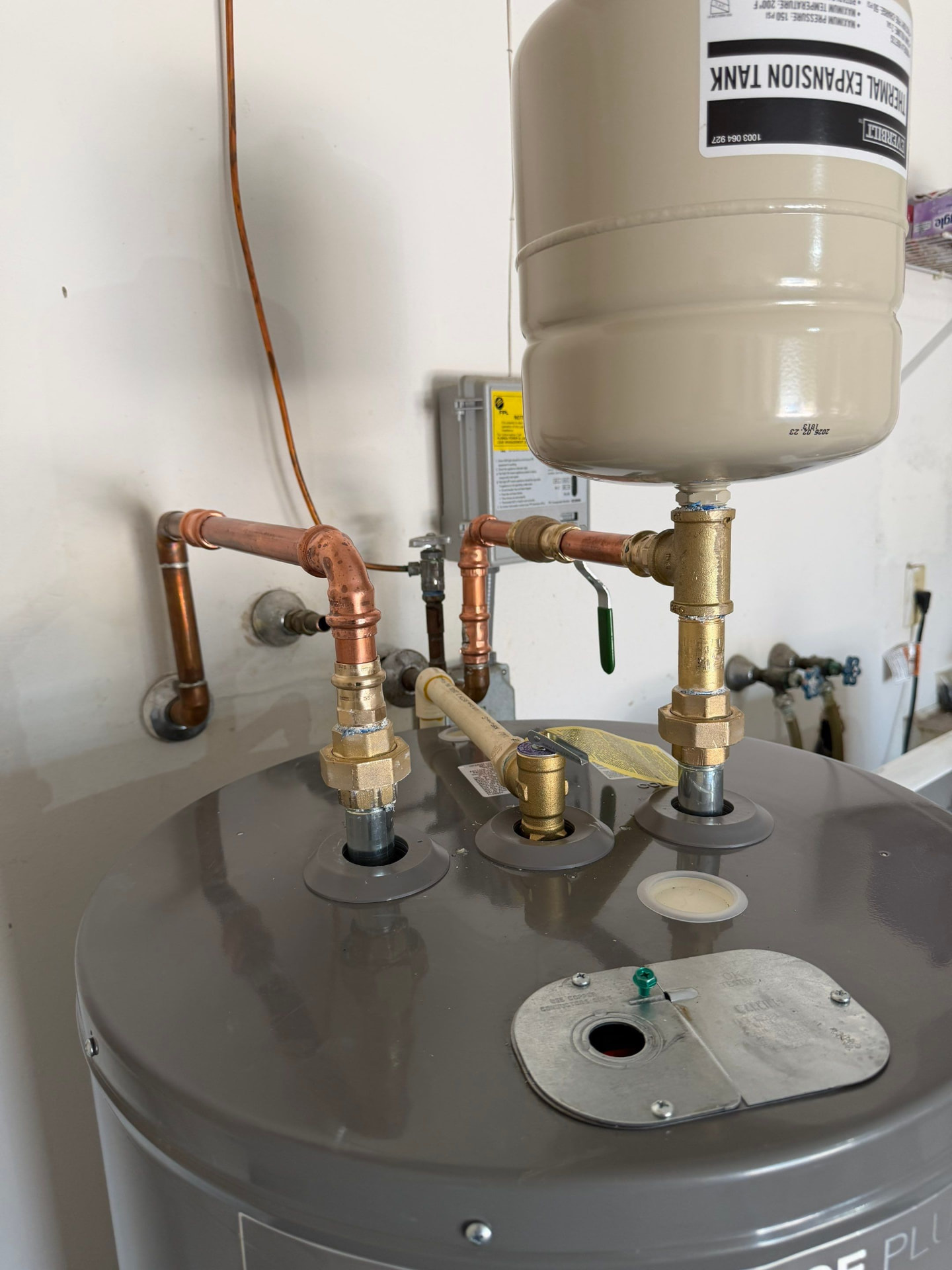
Cold side: a brass female union threads directly onto the galvanized cold nipple. A brass nipple runs into the other side of the union. A brass tee threads onto that nipple — the expansion tank connects off the top port, and a copper male adapter transitions out of the side port to copper pipe, which runs to a ball valve and the cold supply. The galvanized nipple never contacts copper directly.
Hot side: a brass female union threads onto the galvanized hot nipple. A copper male adapter threads into the union’s other side. Copper pipe continues from there.
Unions on both sides, not couplings. A union disconnects with a wrench; a coupling requires cutting pipe. In a home where the next water heater replacement may be done by a different plumber years from now, unions on both sides is the professional standard that makes that future service call cleaner.
Plumbing Detectives LLC Professional Opinion
EWD’s own data shows finished tap water is softer than most of Southwest Florida — roughly 4.5 GPG after lime softening. That’s a real advantage. But I’ve personally found heavily corroded copper connections in this market that don’t match what a soft-water report alone would predict. Decades of exposure, chloramine residuals as high as 5.4 ppm at the top of EWD’s reported range, and installation shortcuts all add up regardless of what the treated-water hardness number says. Don’t let a favorable water report substitute for an actual look at your connections.
Code Requirement
The Expansion Tank — Required and Often Missing
Homes on EWD municipal water are on a closed plumbing system — a backflow prevention device on the service line prevents water from flowing back toward the supply. In a closed system, water that heats up and expands has nowhere to go without an expansion tank to absorb it.
Without one, the pressure from every heat cycle pushes against every fitting, every valve, and every connection in the home’s plumbing. Over time this fatigues components. The most common visible symptom is a temperature and pressure relief valve that drips — not because the heater itself is failing, but because the valve is correctly relieving pressure that has nowhere else to go. Replace the valve without adding the expansion tank, and the new one does the same thing.
Florida Building Code requires an expansion tank on every water heater replacement in a closed plumbing system. I include one on every EWD-served installation. For well-water homes with their own pressure tank system, the configuration is different, and I evaluate what’s actually there before recommending anything.
Anode Rod
The Anode Rod — Different Math on EWD Water vs. a Well
Inside every tank water heater is a sacrificial anode rod — a metal rod suspended in the tank whose job is to corrode in place of the steel tank walls. It attracts the electrochemical attack to itself and buys the tank years of additional life. When it’s consumed, the protection ends and the tank walls become the target.
On EWD’s treated water — softer than most of the surrounding region at roughly 4.5 GPG — a standard magnesium anode rod may deplete somewhat more slowly than it would in a harder-water market like Sarasota or Bradenton. That’s a genuine, documented difference, and I won’t tell an Englewood homeowner on EWD water their rod situation is identical to a home on 15-plus GPG water elsewhere in the region. But “slower” doesn’t mean “never” — the chloramine residual EWD reports, up to 5.4 ppm at the high end, still interacts with the rod over time, and a decade-old tank with no maintenance history has an unknown rod condition regardless of the favorable water report.
On a private well, the math changes entirely. Well water in this part of Florida can carry iron and sulfide compounds that accelerate anode rod depletion significantly faster than treated EWD water. If your Englewood property is on a well and the anode rod has never been checked, that’s a real risk, not a theoretical one.
We offer a Corro-Protec powered titanium anode rod upgrade on every installation. Rather than depleting, it uses a small impressed electrical current — less than three dollars per year in electricity — to actively repel corrosion from the tank walls. It never degrades and carries a 20-year warranty. For a well-water Englewood home specifically, this is a meaningfully practical upgrade. For an EWD-served home, I’ll tell you honestly whether it’s worth it for your specific situation rather than defaulting to a blanket recommendation.
Common Mistakes
Mistakes I Commonly Find on Water Heater Installations in Englewood
Copper directly on galvanized nipples. No brass transition. The most common installation error I find across this market, running faster than the district’s treated-water hardness numbers alone would suggest given the real-world corrosion I’ve personally observed on Englewood copper.
Missing expansion tank on EWD-served homes. Every closed municipal water system requires one. I find it missing most often on older installations and in manufactured homes where the connection was made by someone without a full plumbing background.
No unions on the hot and cold connections. Couplings instead. Means the next replacement requires cutting into supply lines rather than a clean wrench disconnection.
Anode rod protection specified without evaluating the actual water source. Recommending the same rod strategy for an EWD-served home and a well-water home ignores a real, documented difference in water chemistry between the two.
Improper T&P discharge routing. The discharge pipe needs to terminate within six inches of the floor or to an approved exterior point. I’ve found discharge pipes in Englewood homes — including some post-Ian emergency repairs — terminated in ways that don’t meet that standard. This is a safety issue.
Water heater connections done during post-Ian emergency repairs that were never revisited. Fast repairs to restore habitability aren’t always the same as permanent-quality installations. If nobody’s gone back to check the work since the storm, that’s worth doing.
Plumbing Detectives LLC Tips
If you’re not sure whether your Englewood water heater is on EWD municipal water or a private well, check your utility bill. If you don’t have a monthly water bill, you’re on a well, and the anode rod and water quality conversation changes accordingly.
If you own a manufactured home in Oyster Creek or one of Englewood’s other older parks and don’t know your water heater’s installation history, a straightforward evaluation — expansion tank, brass transitions, anode rod condition — is worth doing proactively rather than after a failure.
The hose bib on the side of your home is often the first external fitting to show real corrosion in an older Englewood property. If it’s seized or can’t shut off reliably, that’s an early indicator of what the rest of your metal plumbing, including your water heater connections, may be dealing with.
If your water heater had any water intrusion during Hurricane Ian and hasn’t been evaluated since, don’t assume it’s fine just because it’s still running. Electrical component damage from flooding doesn’t always show up immediately.
Equipment Options
Water Heater Options for Englewood Homes
Tank water heaters are the right choice for most Englewood applications, both conventional site-built homes and manufactured housing. We install Bradford White and Rheem — brands I trust in Florida’s climate — in gas, propane, and electric configurations. For manufactured homes, unit sizing and connection type are evaluated for that specific construction rather than assumed from a general spec sheet.
Tankless water heaters heat water on demand with no stored tank. They’re a strong fit for Englewood’s seasonal population — no cost maintaining a tank of hot water through months of vacancy. For well-water Englewood homes specifically, incoming water quality matters for a tankless unit’s heat exchanger, and I’ll discuss upstream treatment honestly before recommending one. For EWD-served homes, the softer treated water — roughly 4.5 GPG — is genuinely less of a concern for tankless performance than it would be in a harder-water market.
Heat pump water heaters are the most energy-efficient electric option and perform well in Florida’s year-round warm climate. For homeowners converting from gas or focused on long-term operating cost, they’re worth a conversation.
Warning Signs
Signs Your Englewood Water Heater Needs Attention
The unit is more than 10 years old with no documented maintenance. Even on EWD’s relatively soft treated water, a decade with no flush or rod check is an unknown quantity.
Water has a rust or orange tint from the hot tap. Could be internal tank corrosion from a depleted anode rod, or — if you’re on a well — iron in the source water working through the system.
Hot water smells like sulfur. On a private well, this is typically hydrogen sulfide reacting with the anode rod. On EWD water, it’s less common given the treated water quality, but still possible depending on the rod’s condition — worth a check either way.
The T&P valve is dripping and has been replaced before without improvement. Almost always a missing expansion tank, not a valve problem.
Moisture, staining, or dampness at the base of the unit or at the connections on top. Don’t wait on this, especially in a home with any history of storm-related water intrusion.
You notice green or white corrosion at the fittings on top of the tank. Visual sign of galvanic corrosion at connections that weren’t done with brass transitions.
Your home had water intrusion during Hurricane Ian and the water heater hasn’t been evaluated since.
Our Approach
Why Plumbing Detectives LLC
I named the company Plumbing Detectives LLC because figuring out what’s actually wrong comes before recommending anything. In Englewood — where the permitting jurisdiction depends on an invisible county line, the water hardness story is more nuanced than what most homeowners have heard, manufactured home plumbing is its own discipline, and post-Ian repair work is mixed in with original construction — that diagnostic step isn’t optional. It’s the job.
License CFC1434139. Fully insured. Registered and permitted in both Sarasota County and Charlotte County.
Permitting
Professional Installation Done Right
Englewood splits across two permit authorities. Sarasota County properties — generally the 34223 zip code — permit through Sarasota County Planning and Development Services on a sliding fee scale from $50 to $500. Charlotte County properties — Rotonda West, Cape Haze, South Gulf Cove, Englewood Beach in 34224 — permit through Charlotte County Building Construction Services at 18400 Murdock Circle, Port Charlotte, phone 941-743-1201, at a flat $90 fee plus applicable surcharges. We verify jurisdiction for every job before pulling a permit.
Documented Work
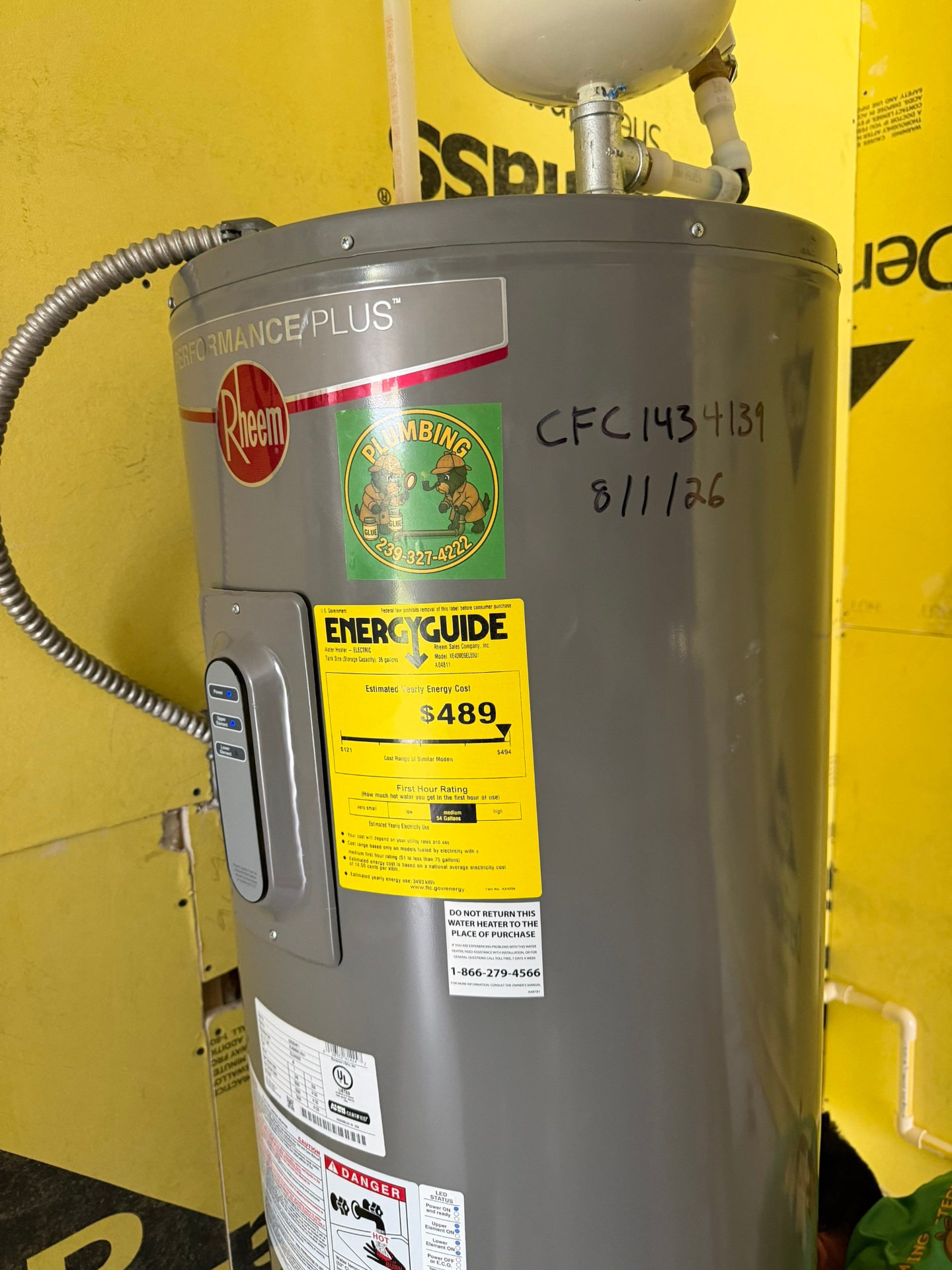
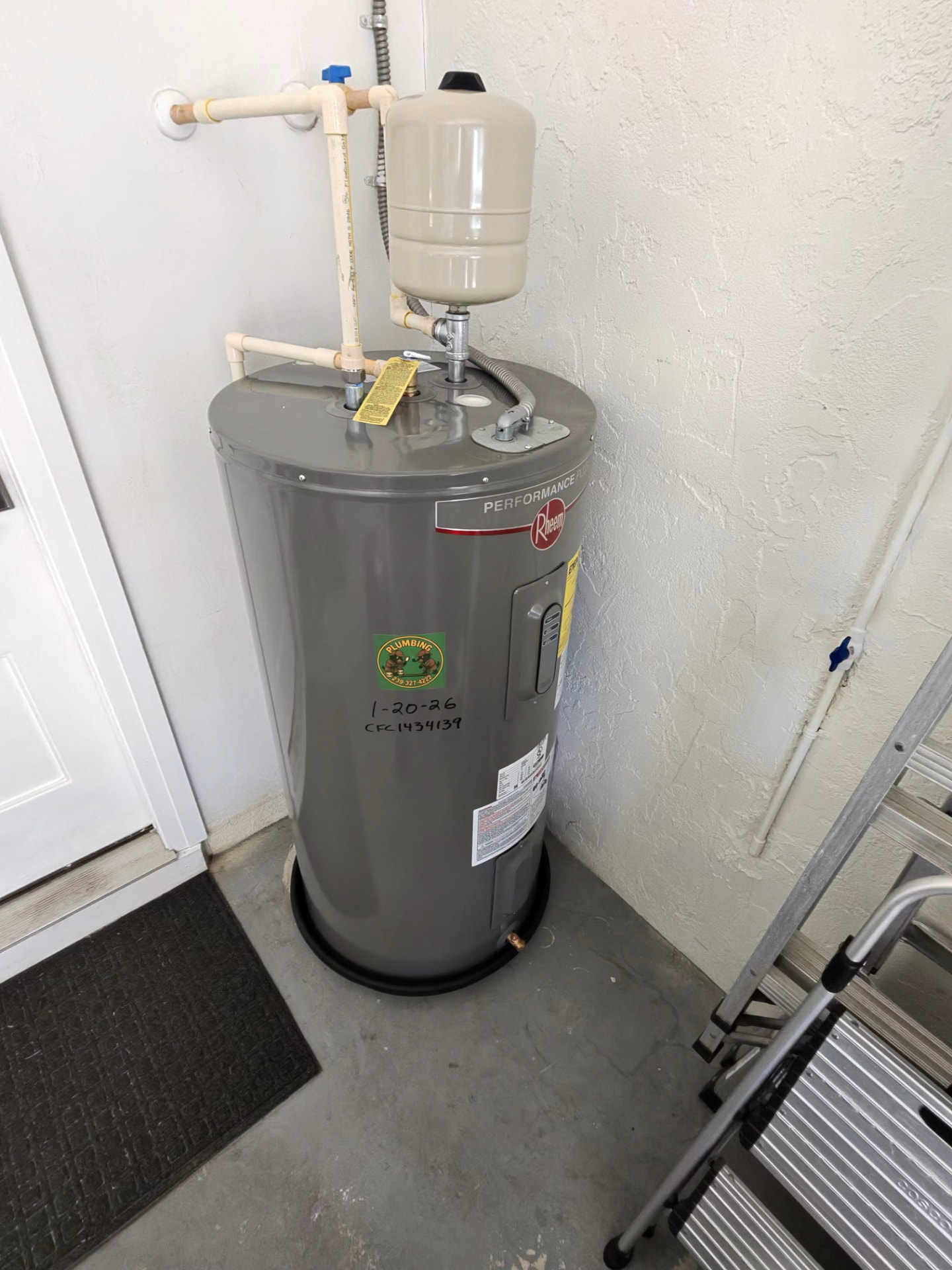
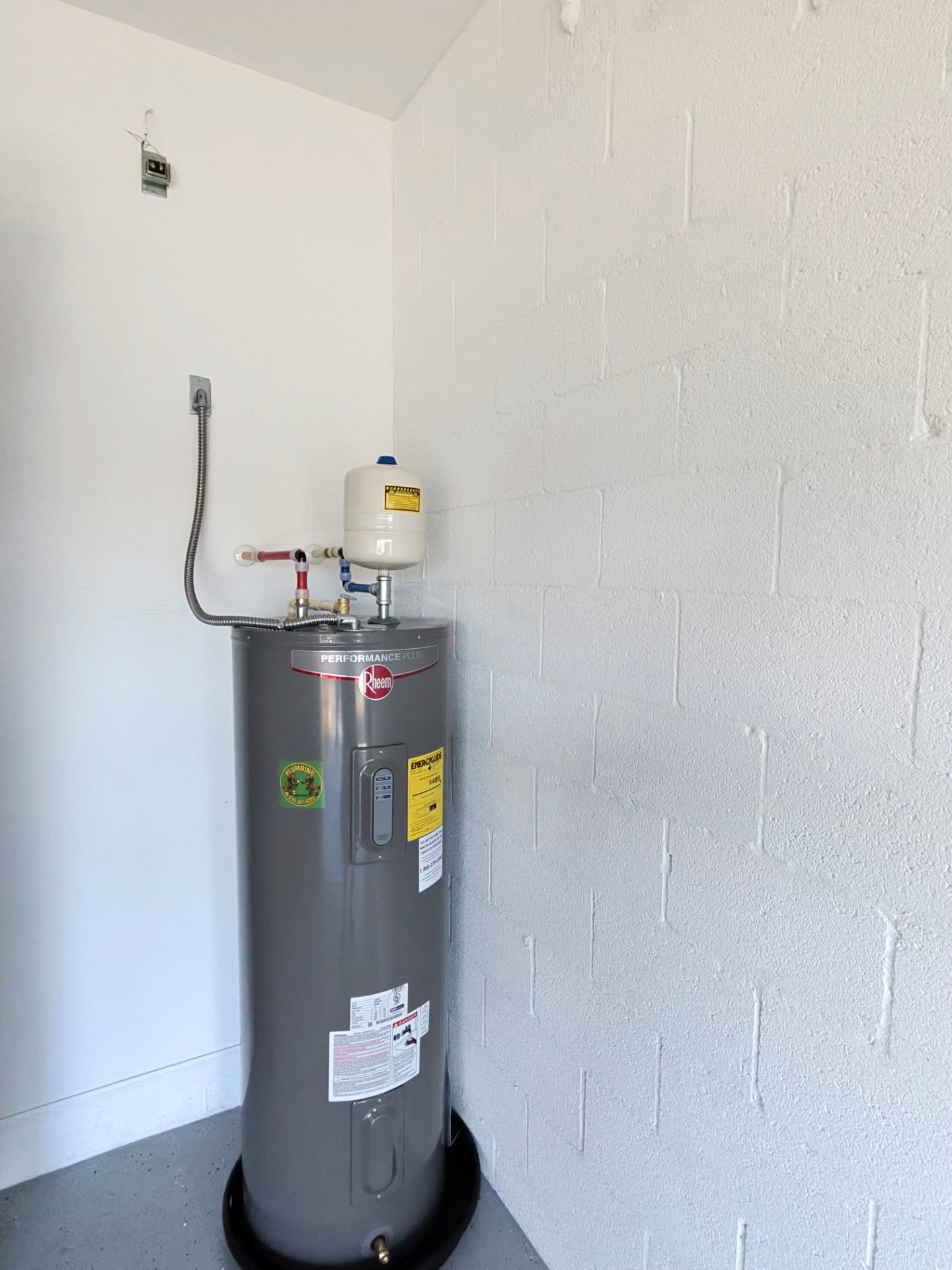
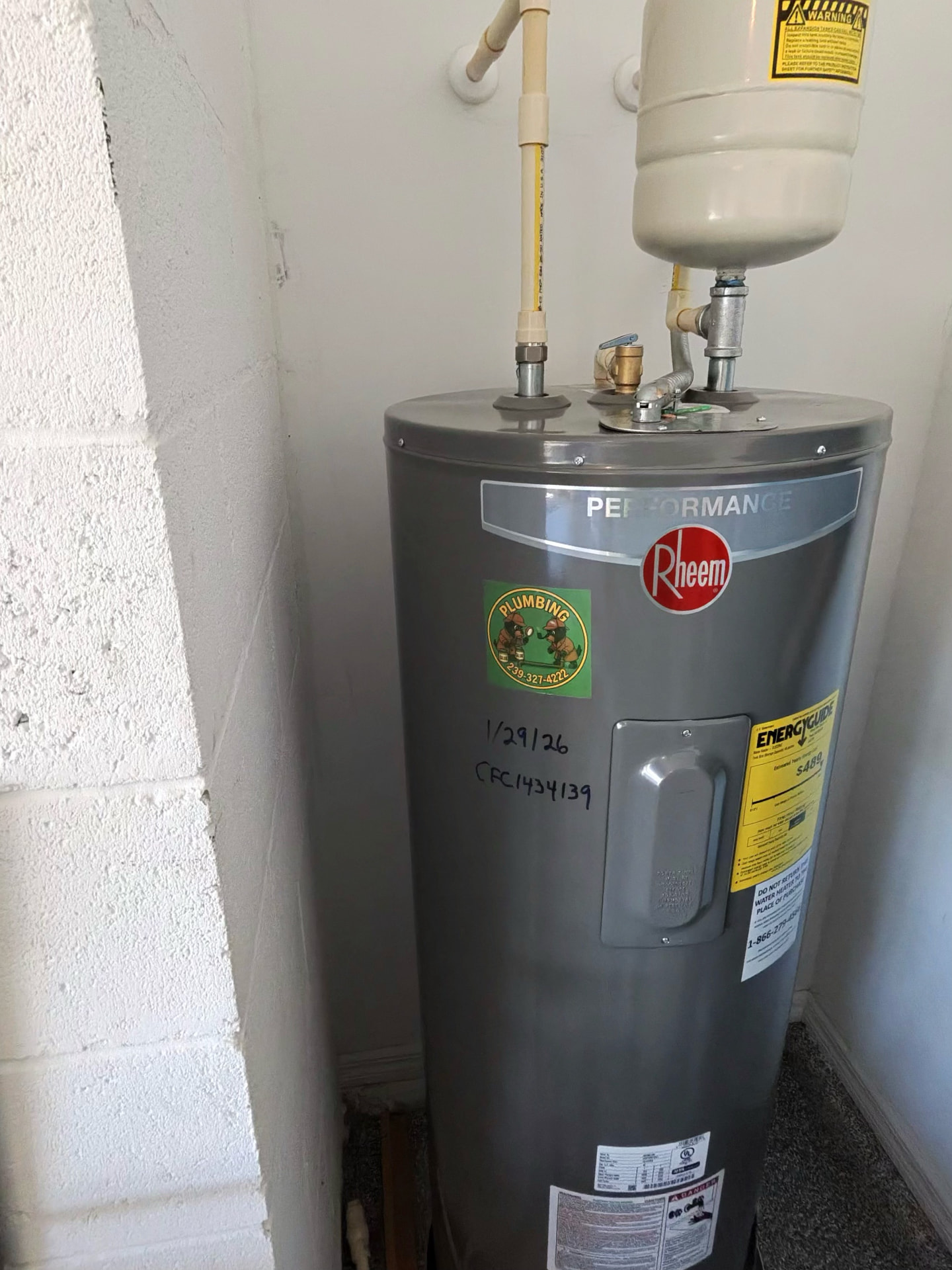
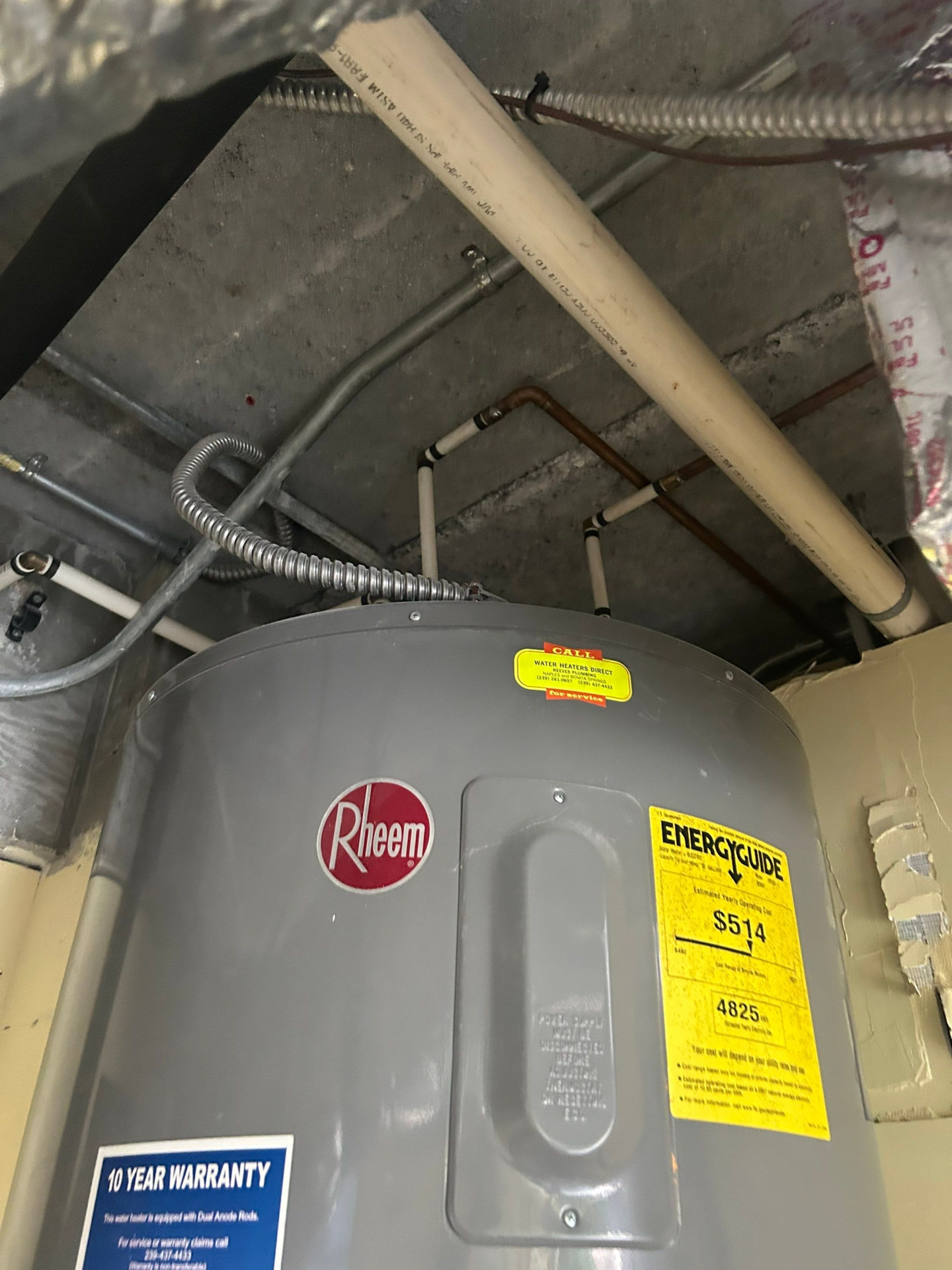
Water Heater Installs, Photographed on the Job
Answers
Frequently Asked Questions — Water Heater Installation in Englewood, FL
If you’ve read this far, you now understand water heater installation in Englewood better than most homeowners in this market — and better than any competitor page currently explains it. You know the difference between raw source water and treated tap water, why that matters for your anode rod, what chloramine is actually doing at the tank, which county governs your permit, and what Hurricane Ian may have left behind in your connections. If your water heater is showing any of the signs on this page, or if you simply want to know what shape it’s actually in, call me at 239-388-3631. I’ll come out, look at the whole system, and tell you exactly what I find before I recommend anything.
Plumbing Detectives LLC | Venice, FL | License CFC1434139
239-388-3631 | plumbingdetectivesfl.com