
Water Heater Installation · Bradenton, FL
Water Heater Installation in Bradenton, FL
A river city with housing stock spanning 1840s bungalows to 2024 production builds. Two utilities, two permit offices, a century of pipe materials. Diagnosis first, always. Licensed master plumber CFC1434139.
Call Now239-388-3631Bradenton is a river city with deep roots and a complicated plumbing story. The Manatee River runs through the middle of it. The oldest homes in the Old Manatee Historic District date to the 1840s. The cottages in the Village of the Arts and along Wares Creek were built in the 1920s and 1930s. The postwar ranch homes in Bayshore Gardens and Palma Sola went up in the 1950s and 1960s. And right now, DR Horton is framing new homes in Del Tierra out in zip code 34212 while older homes a few miles west are dealing with galvanized supply lines that haven’t been touched since they were installed.
That range — from 1840s bungalows to 2024 production builder construction — is what makes Bradenton genuinely different from every other market I serve. No single pipe material, no single water quality story, no single permitting authority. Bradenton splits across two separate permit offices depending on which side of the city limits your address falls on. It’s served by two different utilities — the City of Bradenton drawing from the Manatee River and Lake Manatee Reservoir, and Manatee County Utilities blending Floridan Aquifer groundwater with Lake Manatee surface water in proportions that shift seasonally. The water hardness, the pipe materials, the maintenance history — all of it varies block by block in ways that matter before I recommend anything.
When someone in Bradenton calls me about a water heater, the first thing I want to know is what kind of home I’m walking into. The answer changes everything.
My name is Mike Reynolds. I’m the owner of Plumbing Detectives LLC and a licensed master plumber, license CFC1434139. I’m based in Venice and I serve Bradenton and the surrounding Manatee County market. Here’s what I’d tell you if I were standing at your water heater right now.
Market Context
What Makes Bradenton Different From Every Other Market I Serve
The first thing that distinguishes Bradenton is the sheer spread of its housing age. Nearly one in five homes within the city limits was built before 1970. Another large cohort dates to the 1970s through 1990s. Only about a quarter of the housing stock was built in the last twenty-five years. In the older neighborhoods — Point Pleasant on the Manatee River peninsula, the Village of the Arts, Wares Creek, Old Manatee, Palma Sola, Braden Castle Park — you’re looking at homes from the 1920s, 1930s, 1940s, and 1950s that carry the full range of mid-century plumbing problems. Galvanized steel supply lines that have been corroding from the inside for sixty or seventy years. Cast iron drain lines under the slab that were standard through the early 1970s and are now well past their expected service life. First-generation copper supply lines laid directly in the concrete without protective sleeving — a practice that accelerated corrosion and is responsible for a significant share of the slab leaks I see in this market.
The second thing is the dual-utility, dual-jurisdiction structure. Most homeowners with a Bradenton mailing address are actually in unincorporated Manatee County — not the City of Bradenton. The city limits cover roughly 14 square miles. The ZIP codes commonly associated with Bradenton — 34201, 34202, 34203, 34209, 34210, 34211, 34212 — extend far beyond those limits into county territory. This matters for permits. Properties inside city limits get their plumbing permits from the City of Bradenton Building Division at 101 Old Main Street. Properties in unincorporated Manatee County get permits from Manatee County Development Services at 1112 Manatee Ave W. These are different departments, different fee schedules, different inspection contacts, different portals. A city permit is not valid in the county and vice versa.
I verify jurisdiction for every Bradenton job before I pull a permit. Most homeowners don’t know which side of the line they’re on until someone checks.
The third distinction is the water. The City of Bradenton Utilities draws primarily from the Manatee River and the Lake Manatee Reservoir, treated at the Bill Evers Water Treatment Plant — a facility whose reservoir was created by a 1939 dam on the Braden River. Manatee County Utilities blends Floridan Aquifer groundwater from seven wells drilled 1,200 feet deep with Lake Manatee surface water, treating the groundwater with lime softening before blending. The two systems produce water with somewhat different mineral profiles. The county’s blended approach means hardness and taste can vary seasonally as the blend ratio shifts. Both systems add corrosion inhibitors. Neither produces soft water.
For a water heater in a Bradenton home, the practical result is the same regardless of which utility serves the address: mineral sediment is accumulating inside the tank, the anode rod is depleting at a rate influenced by the local water chemistry, and the equipment that was specified when the home was built is working in conditions harder than the manufacturer’s documentation assumes.
Housing Eras
The Housing Eras of Bradenton — What’s Behind the Walls Depends on When Your Home Was Built
Bradenton’s pipe material situation is more complicated than any market I serve, because the housing stock genuinely spans every era of Florida residential plumbing practice. Here’s how I think about it by decade.
Pre-1960 homes — Old Manatee, Point Pleasant, Village of the Arts, Wares Creek, Braden Castle Park, early Palma Sola, Riverview District. These are the oldest residential buildings in Manatee County. Galvanized steel supply lines were the Florida standard through the 1950s and into the early 1960s. Cast iron was the standard drain material through the same period. In unrenovated homes from this era, I expect to find galvanized supply lines that have been corroding from the inside for sixty to seventy years — their internal diameter narrowed by decades of rust scale, their walls thinning toward eventual failure. I also expect cast iron drain lines under the slab that are equally aged. One of the most common things I find in Bradenton’s oldest homes is a water heater that gets blamed for water pressure problems and discolored water when the actual source is the galvanized supply lines feeding it. A new water heater installed on sixty-year-old galvanized supply lines is addressing the wrong end of the problem.
1960s-1980s homes — Bayshore Gardens, Trailer Estates, Palma Sola Park, postwar ranch expansion into west Bradenton, the 1970s-1980s growth neighborhoods. Copper supply lines became the Florida standard during this period, and most homes from this era in Bradenton have copper. Here’s the complication: copper supply lines installed in Florida during the 1970s and 1980s were frequently laid directly in or under the concrete slab without protective sleeving. That unsleeved copper is now forty to fifty years old, in direct contact with concrete that carries moisture, mineral salts, and the slight acidity that Florida’s groundwater chemistry produces. Pinhole leaks in unsleeved copper under slabs are one of the most common plumbing emergencies in Bradenton’s mid-century housing stock. Some homes from this era also have polybutylene pipe — the gray flexible plastic installed between 1978 and the mid-1990s that degrades from the inside when exposed to chlorinated water.
1990s-2000s homes — the Peridia, Braden Woods, Greyhawk Landing, Heritage Harbour corridor, and the established gated communities south and east of the city. Copper remained common through the 1990s into the early 2000s, with CPVC appearing as an alternative. These homes are now twenty to thirty years old. The copper in this era is entering the age range where pinhole leaks become a realistic concern, particularly in any sections that run under the slab without sleeving.
2010s-present — Del Tierra, Esplanade at the Heights, Arbor Reserve, and the continuing east Manatee County growth corridor. PEX supply lines, PVC drains, modern code-compliant installation. The plumbing conversation in these homes is entirely different — maintenance and water quality, not aging infrastructure.
Not sure what pipe material is in your Bradenton home? I can tell you what you have in about 15 minutes from a few access points. Knowing is worth the call, especially before an insurance renewal or a home sale. Call 239-388-3631.
Water Chemistry
Bradenton’s Water — Two Utilities, One Important Difference
Most homeowners in the Bradenton area don’t know which utility is serving their home. The distinction matters for understanding what the water is doing to their plumbing.
The City of Bradenton Utilities draws primarily from surface water — the Manatee River and the Lake Manatee Reservoir, a supply secured by a dam on the Braden River constructed in 1939. Surface water from a river system has different seasonal characteristics than deep aquifer groundwater. The Manatee River’s mineral content and taste profile shift with rainfall, agricultural runoff, and seasonal water management. The City’s water is treated for corrosion control and disinfection, but its character changes in ways that the county water, drawn from deeper sources, does not.
Manatee County Utilities draws from both the Floridan Aquifer — via seven wells drilled approximately 1,200 feet deep — and Lake Manatee surface water, blending the two at the Lake Manatee Water Purification Plant. The groundwater portion receives lime softening specifically to reduce hardness before blending. The result is a mixed supply whose hardness varies with the blend ratio, which shifts seasonally based on availability and water quality. The county explicitly acknowledges seasonal taste and odor variation in its own Consumer Confidence Report, and independent analysis rates Bradenton’s water at approximately 372 ppm total dissolved solids — reflecting the mineral contribution of the Floridan Aquifer groundwater that makes up a significant share of the supply.
For a water heater, what matters is the consistent presence of dissolved calcium and magnesium entering the tank with every gallon. Both utilities deliver water with residual hardness after treatment. Regional plumbing specialists for the broader Southwest Florida market commonly cite 15 to 25 grains per gallon as the range for groundwater-influenced municipal systems in this area — well above the 10.5 grains per gallon threshold that defines very hard water. At those levels, mineral sediment accumulates meaningfully inside an unserviced tank in a relatively short time.
One of the most common things I find in Bradenton homes is a water heater that was installed without an expansion tank. On a closed municipal water system — which describes both City of Bradenton and Manatee County Utilities connections — Florida Building Code requires an expansion tank on the cold supply line for every water heater replacement. When heated water expands and has nowhere to go in a closed system, it pressurizes every fitting and valve in the home. The temperature and pressure relief valve takes the excess and begins to drip. In Bradenton’s mid-century homes where the water heater has been replaced once or twice, I find missing expansion tanks behind a pattern of replacement T&P valves that kept dripping regardless of how many times they were swapped out.
Slab Leaks
Slab Leaks — Why They’re More Common in Bradenton Than Anywhere Else I Work
Bradenton has one of the highest concentrations of slab leak risk I encounter in this market, and the reason is specific to how the mid-century homes here were built.
When copper supply lines became the Florida standard in the 1960s and 1970s, the common practice was to lay the copper directly in or under the concrete slab without a protective sleeve. The pipe sits in direct contact with concrete, which in Florida’s environment is not inert. Moisture migrates through concrete. Minerals in the groundwater and in the concrete itself react with the copper. The slight abrasion of the pipe moving against concrete as it expands and contracts with temperature change creates microscopic wear points. Over forty or fifty years, those wear points become pinhole leaks.
A slab leak from the supply side of the plumbing shows up differently than a visible pipe leak. The water migrates through the slab, finds path of least resistance, and shows up as unexplained wet spots in flooring, warm areas on tile in a slab with hot water lines, a water meter that runs when all fixtures are off, or a water bill that’s increasing with no explanation. By the time it’s visible, it’s been leaking for a while.
This matters for the water heater conversation because a Bradenton home with a slab leak on the hot supply side needs leak detection and assessment before a water heater replacement makes sense. Replacing the heater doesn’t address a leaking supply line under the slab. I’ll tell you if what I see suggests a slab leak investigation is warranted before I recommend any other action.
Installation Quality
Why Most Water Heater Installations in Bradenton’s Older Homes Miss the Same Things
This section applies whether you’re in a 1950s Palma Sola ranch home, a 1970s Bayshore Gardens split-level, or a 1990s Peridia residence. The most consequential installation errors I find in Bradenton are the same across all of them.
Every tank water heater ships from the factory with galvanized steel nipples at the hot and cold ports at the top of the tank. In a home with copper supply lines, the standard shortcut is to thread a copper fitting directly onto those galvanized nipples. It looks complete. It holds water. And it creates a condition called galvanic corrosion at the most important connection point in the installation.
When copper and galvanized steel make direct contact in the presence of water, a small electrical current flows between them. The more reactive metal — the zinc coating on the galvanized nipple — begins to dissolve into the water. It’s an invisible, silent process that takes place inside the threaded joint with no external indicator until the nipple fails. In Bradenton’s water, which carries the mineral load of either a river system or a deep aquifer depending on your utility, this electrochemical reaction runs at a pace influenced by the water’s conductivity and mineral content.
The fix is a brass fitting as a transition between the galvanized nipple and the copper supply line. Brass sits between copper and galvanized steel on the electrochemical scale and reduces the corrosive driving force by roughly 86 percent. Here’s what a correct installation looks like in a Bradenton copper-plumbed home.
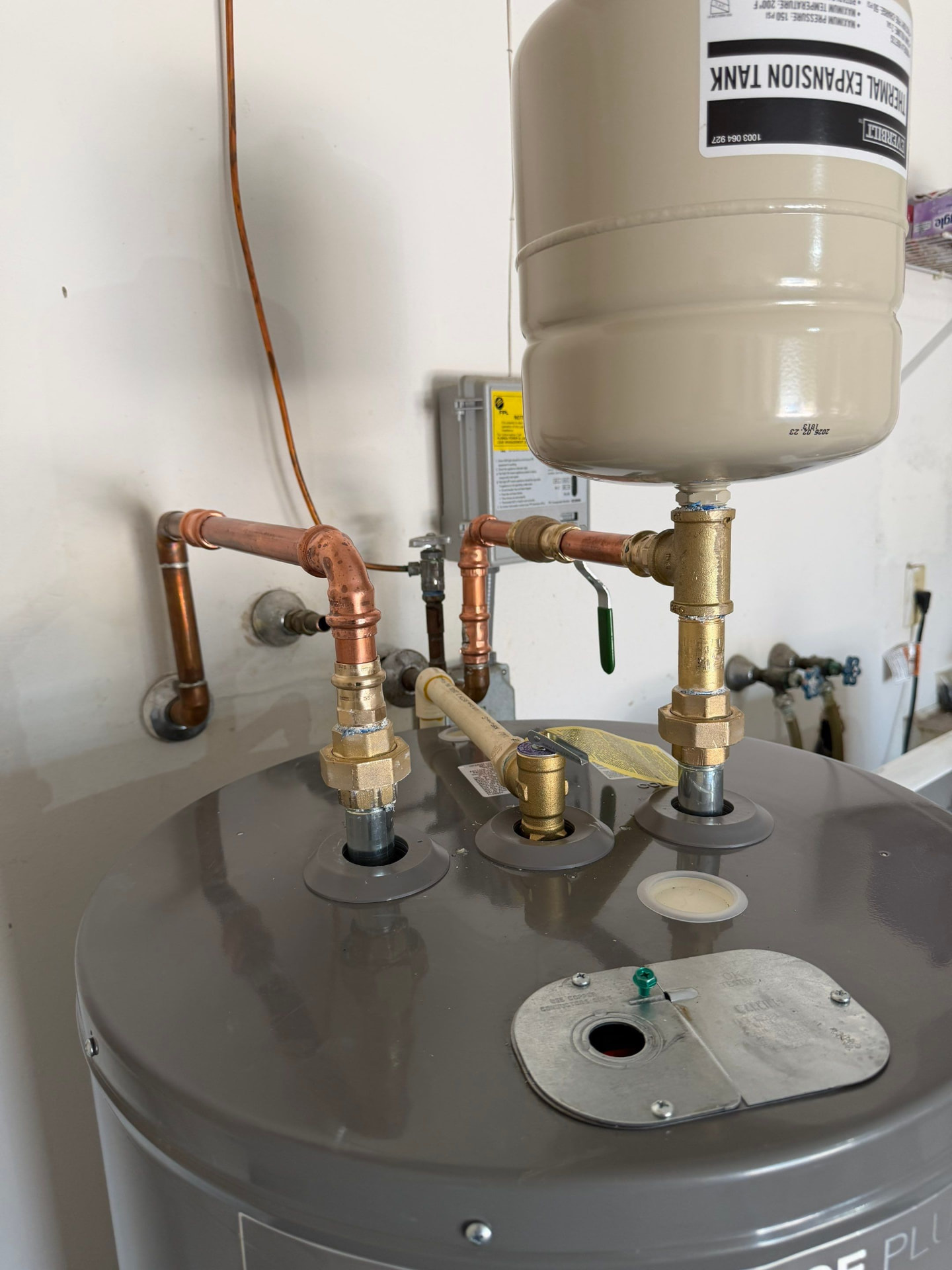
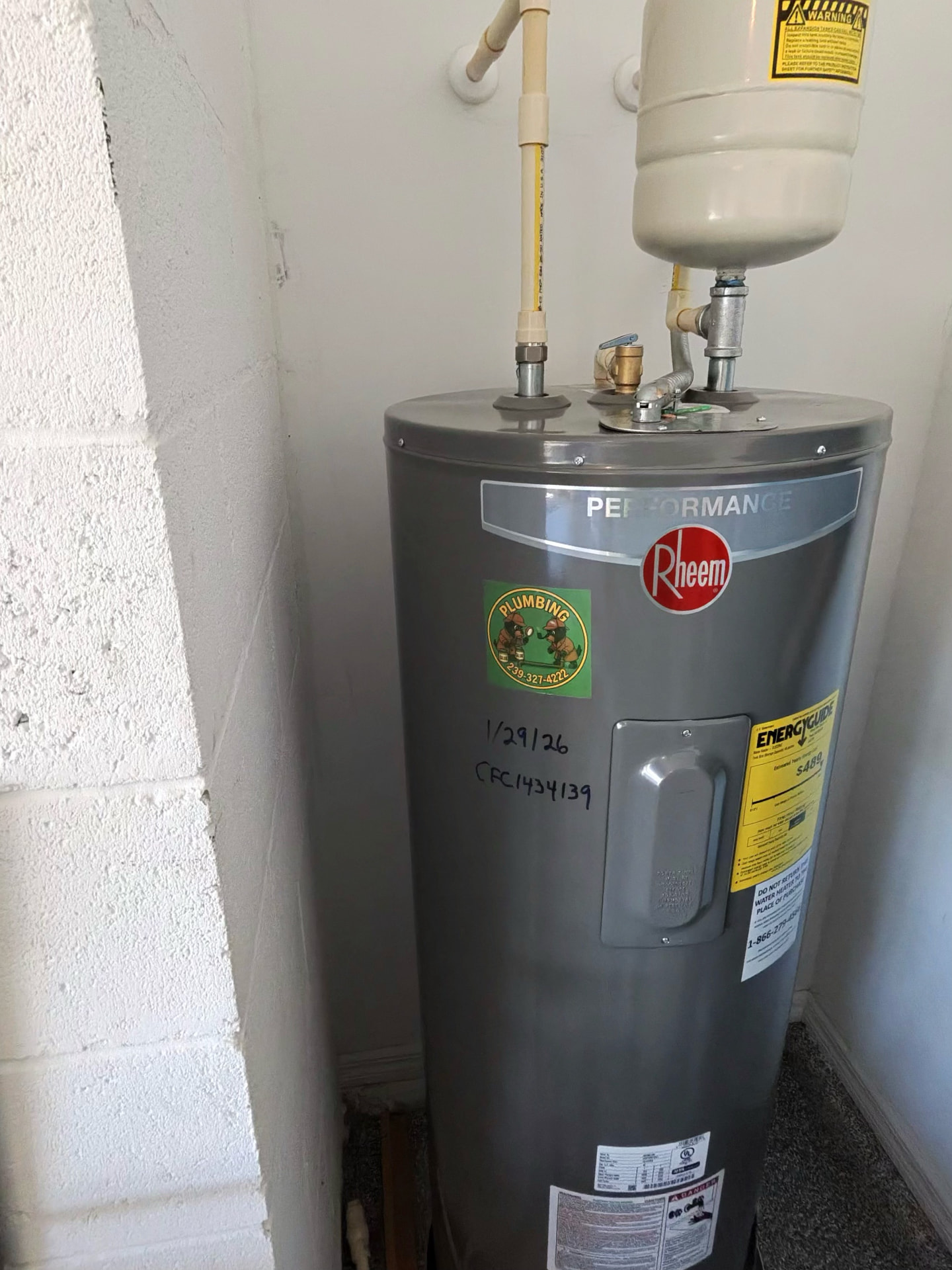
Cold side: A brass female union threads directly onto the galvanized cold nipple. A brass nipple runs into the other side of the union. A brass tee threads onto the brass nipple — the expansion tank connects off the top port of the tee, and a copper male adapter transitions out of the side port to copper pipe, which runs to a ball valve and the cold supply line. The galvanized nipple never contacts copper.
Hot side: A brass female union threads onto the galvanized hot nipple. A copper male adapter threads into the union’s other side. Copper pipe continues from there.
Unions on both sides, not couplings. A union disconnects with a wrench when the next replacement comes. In a Bradenton home where the supply lines might date to the 1970s, building in unions is protecting whoever does the next service call from having to cut into aging copper unnecessarily.
For CPVC-plumbed homes — which appear in some of Bradenton’s 1980s and 1990s construction — the fitting types change but the principle is identical. No improvising at the connection points.
Plumbing Detectives LLC Professional Opinion
In Bradenton’s older housing stock — Point Pleasant, Bayshore Gardens, Palma Sola, the postwar neighborhoods west of US-41 — I’d look at the connections on any water heater and the condition of any visible supply pipe before recommending a replacement. A water heater that’s performing poorly in a home with aging galvanized or unsleeved copper supply lines may be absorbing the consequences of infrastructure that was failing before the heater was ever installed. Replacing the heater without evaluating the supply system is solving the visible problem while leaving the real one in place.
Expansion Tank
The Expansion Tank — Non-Negotiable in Bradenton’s Closed System
Both the City of Bradenton utility and Manatee County Utilities serve homes on closed plumbing systems — backflow prevention devices at the meter stop water from flowing back toward the supply. In a closed system, the water that expands when your water heater runs has nowhere to go without an expansion tank.
The expansion tank is a small cylindrical vessel that mounts on the cold supply line near the heater. It absorbs the pressure of thermal expansion through a rubber bladder with air on one side. When properly sized and charged for the specific system pressure, it eliminates the stress that would otherwise cycle through every fitting and valve in the home with every heat cycle.
In Bradenton’s mid-century homes specifically, I find missing expansion tanks more often than in any other market I work in. The reason is generational — the water heaters in these homes have been replaced multiple times by multiple plumbers over the decades, and not every replacement added the expansion tank that the code requires. The homeowner inherits whatever the last installer did. In many cases what they inherited is a closed system with no pressure relief, a T&P valve that weeps, and a history of T&P valve replacements that never addressed the cause.
Every replacement water heater installation I do in a Bradenton home on city or county water includes a properly sized and charged expansion tank. It’s not an add-on conversation. It’s part of the job.
Anode Rod
The Anode Rod — The Part of Your Bradenton Water Heater Nobody Checks
Inside every tank water heater is a sacrificial anode rod — a metal rod suspended in the water whose purpose is to corrode in place of the steel tank walls. It attracts the electrochemical attack to itself. When it’s consumed, the protection ends and the tank becomes the target.
Standard factory anode rods are magnesium. In the water chemistry of either the City of Bradenton or Manatee County utility — blended surface and groundwater with residual hardness and chlorine treatment — magnesium rods deplete faster than in softer water markets. In Bradenton’s older homes, where a water heater may have been installed by a contractor who never mentioned the anode rod and where no maintenance schedule was ever established, I find rods that have been completely consumed with no replacement. The tank has been corroding from the inside for however long it took the rod to deplete.
In a newer Bradenton home on Manatee County water in the 34211 or 34212 corridor, the situation is different — newer equipment, newer installation, but the same hard water chemistry affecting the rod. The age of the home doesn’t change the depletion rate. What changes is whether anyone has been paying attention.
We offer a Corro-Protec powered titanium anode rod upgrade on every installation. It uses a small impressed electrical current — less than three dollars per year — to actively repel corrosion from the tank walls rather than absorbing it. It never depletes. The manufacturer backs it with a 20-year warranty. In Bradenton’s water, particularly for homes on the county’s groundwater-blended supply, it’s a meaningful long-term investment in a tank that’s going to face mineral-rich water for its entire service life.
Manufactured Homes
Manufactured Homes in Bradenton — A Different Service Call
Bradenton and Manatee County have one of the highest concentrations of manufactured and mobile home communities in Southwest Florida — approximately 80 mobile home parks near Bradenton and around 128 across Manatee County. Trailer Estates, one of Bradenton’s longest-established manufactured home communities, is a distinct service market within the broader Bradenton footprint.
Manufactured home water heater service calls are different from site-built home calls in ways that matter. Access to the water heater is often through exterior skirting panels or a separate utility compartment rather than an indoor utility room. Supply connections under the chassis use flexible lines and fittings specific to manufactured construction. Units are often smaller-capacity models — 30-gallon short units rather than the 40 or 50-gallon tanks standard in site-built construction.
In Bradenton’s older manufactured home parks, some of these units are at or near the end of their service life and may be on plumbing infrastructure that’s been in place for decades. After the hurricanes of 2022 through 2024, some manufactured home communities in the Bradenton and Cortez area experienced significant structural damage and emergency utility reconnection work that wasn’t always done under standard permit processes.
I work in manufactured homes and I’m familiar with their configurations. I don’t treat a manufactured home call like a site-built installation.
Common Mistakes
Mistakes I Commonly Find on Water Heater Installations in Bradenton
Bradenton’s diverse housing stock means I find different installation errors depending on the era of the home. Here’s what I see most often across the market.
Copper directly on galvanized nipples with no brass transition. The most common installation error in the older housing stock — Point Pleasant, Bayshore Gardens, Palma Sola, the Village of the Arts area. Every replacement installation that repeated this error without correcting it compounded the problem.
Missing expansion tank on a closed municipal water system. On City of Bradenton or Manatee County Utilities connections, the expansion tank is required. I find it missing on old and relatively newer installations alike, particularly in homes where the water heater has been replaced multiple times by different contractors who each skipped this step.
No evaluation of the supply line condition before recommending replacement. In a Bradenton home with galvanized supply lines or unsleeved copper under the slab, recommending a water heater replacement without evaluating what’s feeding it is solving the visible problem while leaving the real one in place. I’ve been called to Bradenton homes where a new water heater was installed on supply infrastructure that needed addressing at the same time.
No unions on the connection fittings. Couplings instead of unions on hot and cold sides. In a home where the copper supply lines have been in place since the 1970s, couplings mean cutting into aging copper during the next replacement. Unions cost two dollars more and eliminate that problem.
Wrong unit for the application. A standard tank heater specified for a home on well water in the outer Manatee County area — some of the rural east county still has private wells — without considering the well water chemistry. Iron and sulfide in well water affect water heaters differently than municipal water. Specifying for the application rather than the average case is part of a correct installation.
Improper T&P discharge routing. In Bradenton’s older homes where the utility space may be tight or unusual, I find discharge pipes terminated in ways that don’t route safely. This is a safety issue.
Plumbing Detectives LLC Tips
If your Bradenton home was built before 1980 and has never had a repipe, have someone evaluate the supply line condition before the next water heater replacement. Installing a new heater on galvanized supply lines that are at the end of their service life is doing the work twice. Understanding the supply line situation first saves money overall.
If you’re not sure whether your Bradenton home is in the City of Bradenton or unincorporated Manatee County — and therefore which permit office applies — check your property tax bill or search your address through the Manatee County Property Appraiser’s online tool. The answer determines which permit office handles your plumbing work and which inspector shows up.
If your hot water pressure has been declining over the past few years in a pre-1980 Bradenton home, that’s almost certainly the galvanized supply lines narrowing from internal corrosion — not the water heater, not the city water supply. The pressure at the street meter is fine. The corrosion is happening between the meter and your fixtures.
Bradenton’s hurricane history is real and documented. Water main breaks during major storms — like the break in east Bradenton during Hurricane Milton — and boil-water notices affecting mobile home communities after Ian are part of the infrastructure risk profile here. If your home experienced any flooding or utility disruption during the 2022-2024 storm cycle and you haven’t had the water heater or supply connections evaluated since, that’s worth doing.
Storm Exposure
Storms, Flooding, and What They Do to a Bradenton Water Heater
Bradenton and Manatee County have been part of 26 federal flood disaster declarations. The Manatee River is the primary flood risk driver — not coastal storm surge directly, but the combination of storm surge pushing up the river and inland flooding from rainfall. Hurricane Ian’s storm surge was forecast at 7 to 10 feet for Bradenton and Anna Maria Island, with the Manatee River serving as the primary surge pathway into inland areas. Hurricane Idalia brought surge and flooding along Riverside Drive East. Hurricane Debby dropped nearly 12 inches of rain at the Sarasota-Bradenton airport, causing flooding that exceeded 25-to-100-year levels at several locations. Hurricane Helene strained the city’s water treatment system badly enough that Bradenton asked residents to conserve water — storm surge had “severely strained” treatment operations. During Hurricane Milton, a major water main break disrupted service in east Bradenton between 9th Ave E and 26th Ave E.
That’s four consecutive hurricane seasons with documented infrastructure impact in this market.
For a water heater, flood intrusion creates specific problems. Submersion or significant water contact with an electric water heater’s electrical components can damage the elements, thermostat, or wiring in ways that don’t show up immediately. Contaminated floodwater entering the tank through the relief valve or supply connections can affect water quality. And the physical stress of a home that’s been flooded — including the soil movement that accompanies saturation of sandy Florida soils — can stress the supply connections at the bottom of a tank or the slab-level entry points where supply lines meet the structure.
If your home took water intrusion during any of the recent storm events and you haven’t had a plumber look at the water heater since, that’s a conversation worth having.
Maintenance
Annual Maintenance — What It Prevents in a Market This Complex
In a market with Bradenton’s range of housing ages, water chemistry variables, and storm exposure, annual water heater maintenance isn’t optional if you want the equipment to reach its rated service life.
For a pre-1980 Bradenton home, annual maintenance includes everything I’d do anywhere — sediment flush, anode rod inspection and replacement, T&P valve test, connection check, expansion tank pressure verification — plus a look at any visible supply line sections for early signs of galvanized corrosion or copper deterioration. In these homes the water heater doesn’t exist in isolation from the plumbing around it. What’s happening in the supply lines affects what’s happening in the tank.
For a newer Bradenton home in the east county corridor, the maintenance conversation is more standard — hard water sediment management, anode rod condition, expansion tank charge. The equipment is newer but the water chemistry is the same.
For seasonal residents — Bradenton has a significant snowbird population, with a city vacancy rate around 21 percent — a pre-departure check and return inspection address the specific risks of extended vacancy. A home left unoccupied from May through November with a powered water heater accumulates sediment, runs the anode rod down against standing water, and sits waiting for someone to return and find whatever developed during the vacancy.
We offer maintenance plans for Bradenton homeowners built around all of these scenarios.
Diagnosis First
Diagnosis First — In Every Bradenton Home, Regardless of Age
In a market this varied, the diagnosis-first approach isn’t just a philosophy — it’s a practical necessity. The right answer for a water heater in a 1928 Point Pleasant cottage is completely different from the right answer in a 2021 Del Tierra home. Neither answer comes from looking at just the water heater.
I’ve evaluated Bradenton water heaters that were quoted for replacement and only needed maintenance. I’ve found galvanized supply lines being blamed on a water heater that was performing correctly. I’ve found unsleeved copper under slabs showing signs of corrosion that needed to be addressed before a heater replacement made sense. I’ve found missing expansion tanks behind patterns of T&P valve failures that had nothing to do with the heater itself.
When I look at a Bradenton water heater I want to know: What era was this home built, and what pipe materials are likely present? What utility serves this address — city or county — and what does the water look like? What’s the maintenance history of the unit? What do the connection fittings look like at the top of the tank? Is there an expansion tank? What does the visible supply pipe tell me about the condition of what’s inside the walls and under the slab?
Those answers determine what I recommend. Not the make and model of the unit, not the age sticker alone, not the symptom the homeowner called about. The full picture.
Not sure what your Bradenton water heater actually needs? I’ll look at the whole system — connections, anode rod, expansion tank, supply line condition, water chemistry — and tell you what I find before recommending anything. Call 239-388-3631.
Equipment Options
Water Heater Options for Bradenton Homes
Tank water heaters are the right choice for most Bradenton residential applications. We install Bradford White and Rheem — brands I trust in Florida’s climate. Available in natural gas, propane, and electric configurations. For the older Bradenton neighborhoods where the infrastructure question often needs to be addressed alongside the water heater, I’ll tell you whether the repipe and heater replacement belong together or whether the heater replacement alone makes sense right now.
Tankless water heaters are worth discussing for Bradenton homeowners who want to upgrade from a standard tank unit, particularly seasonal residents and homeowners in larger homes with high peak hot water demand. The water quality consideration is real in Bradenton’s supply — hard water affects tankless heat exchangers, and I recommend a water softener upstream of any tankless installation in this market.
Heat pump water heaters are the most energy-efficient electric option and work well in Florida’s climate year-round. For homes converting from gas or for homeowners focused on long-term operating cost, they’re worth a serious conversation.
Warning Signs
Signs Your Bradenton Water Heater Needs Attention
Water pressure has been declining gradually, especially in a pre-1980 home. In Bradenton’s older housing stock this is almost always galvanized supply lines corroding from the inside — not the water heater, not the utility. The pressure drop is happening between the meter and the fixture.
The water has an orange or rust tint from the hot tap, especially first thing in the morning. Could be galvanized pipe corrosion, internal tank corrosion from a depleted anode rod, or both. The answer determines the solution.
Hot water smells like sulfur. In Bradenton on either utility, this is typically the magnesium anode rod reacting with sulfates in the water. A rod swap resolves it in most cases.
You’re running out of hot water faster than you used to. Sediment accumulation reducing effective tank volume. Maintenance issue, not necessarily replacement.
The T&P valve has dripped and been replaced before without improvement. Missing expansion tank on a closed system. Replacing the valve again won’t fix it.
Moisture or staining at the base of the unit or at the top connections. Don’t wait on this.
You’ve noticed unexplained wet spots in flooring, a warm area on tile, or a water meter that runs with all fixtures off. These are classic slab leak indicators — a separate evaluation from the water heater, but related to the same infrastructure conversation.
Your home took water intrusion during a recent hurricane and the plumbing hasn’t been evaluated since.
Our Approach
Why Plumbing Detectives LLC
I named the company Plumbing Detectives LLC because too many homeowners get sold expensive repairs before anyone figures out what’s actually wrong. In a market as varied as Bradenton — where a call in Point Pleasant requires a completely different starting point than a call in Del Tierra — figuring out what’s actually wrong first is not just the honest approach, it’s the only approach that makes sense. Diagnosis first. Explanation second. Action third.
License CFC1434139. Fully insured. We pull permits in both City of Bradenton and Manatee County jurisdictions.
Permitting
Professional Installation Done Right
Bradenton splits across two permit authorities. City of Bradenton properties permit through the City of Bradenton Building Division at 101 Old Main Street, Bradenton, FL 34205 — phone 941-932-9414. Manatee County properties — which cover the large majority of ZIP codes associated with Bradenton — permit through Manatee County Development Services at 1112 Manatee Ave W, Bradenton, FL 34205 — phone 941-748-4501. We verify jurisdiction for every job before pulling a permit and explain what’s required before work begins.
Documented Work
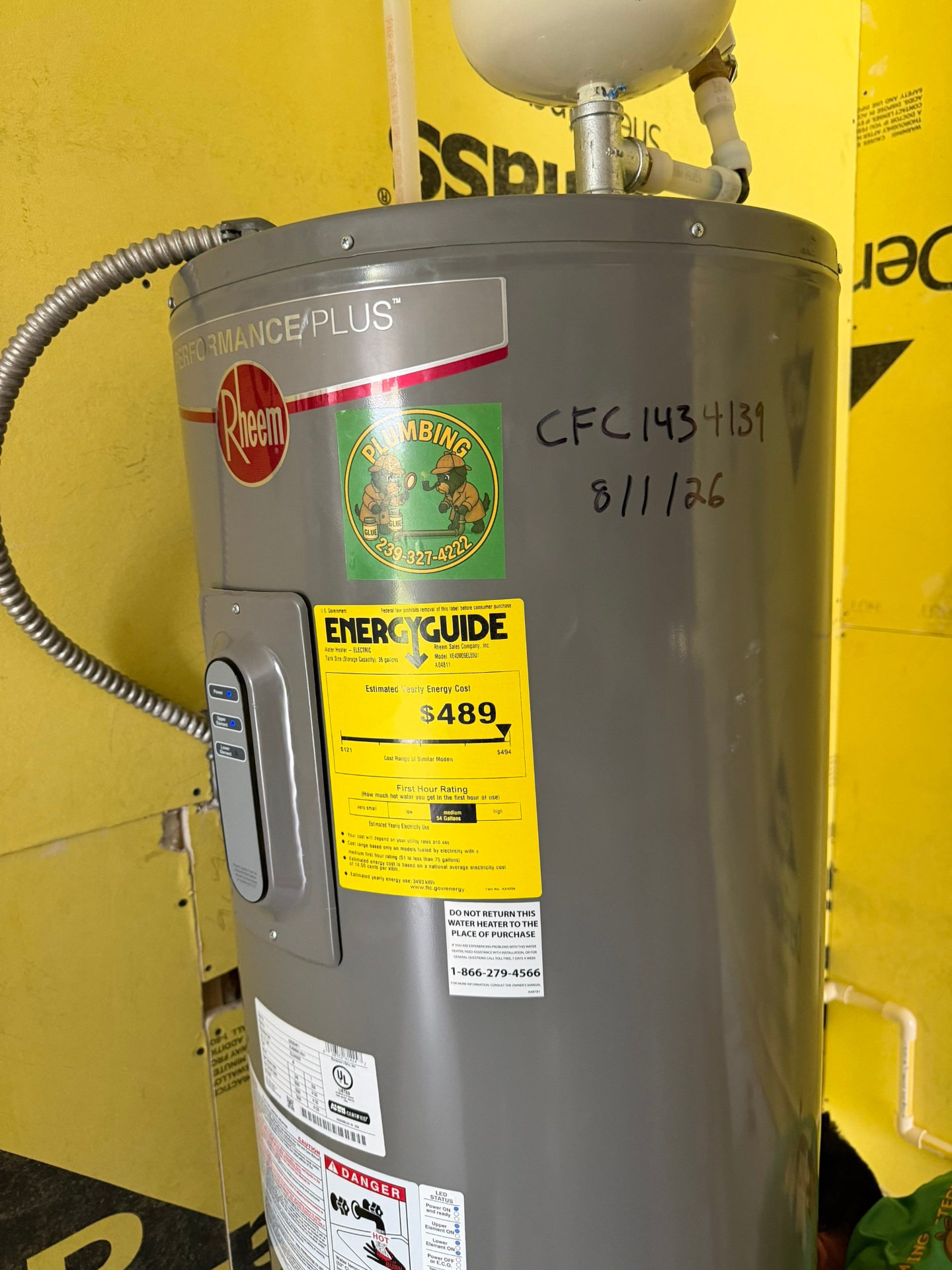
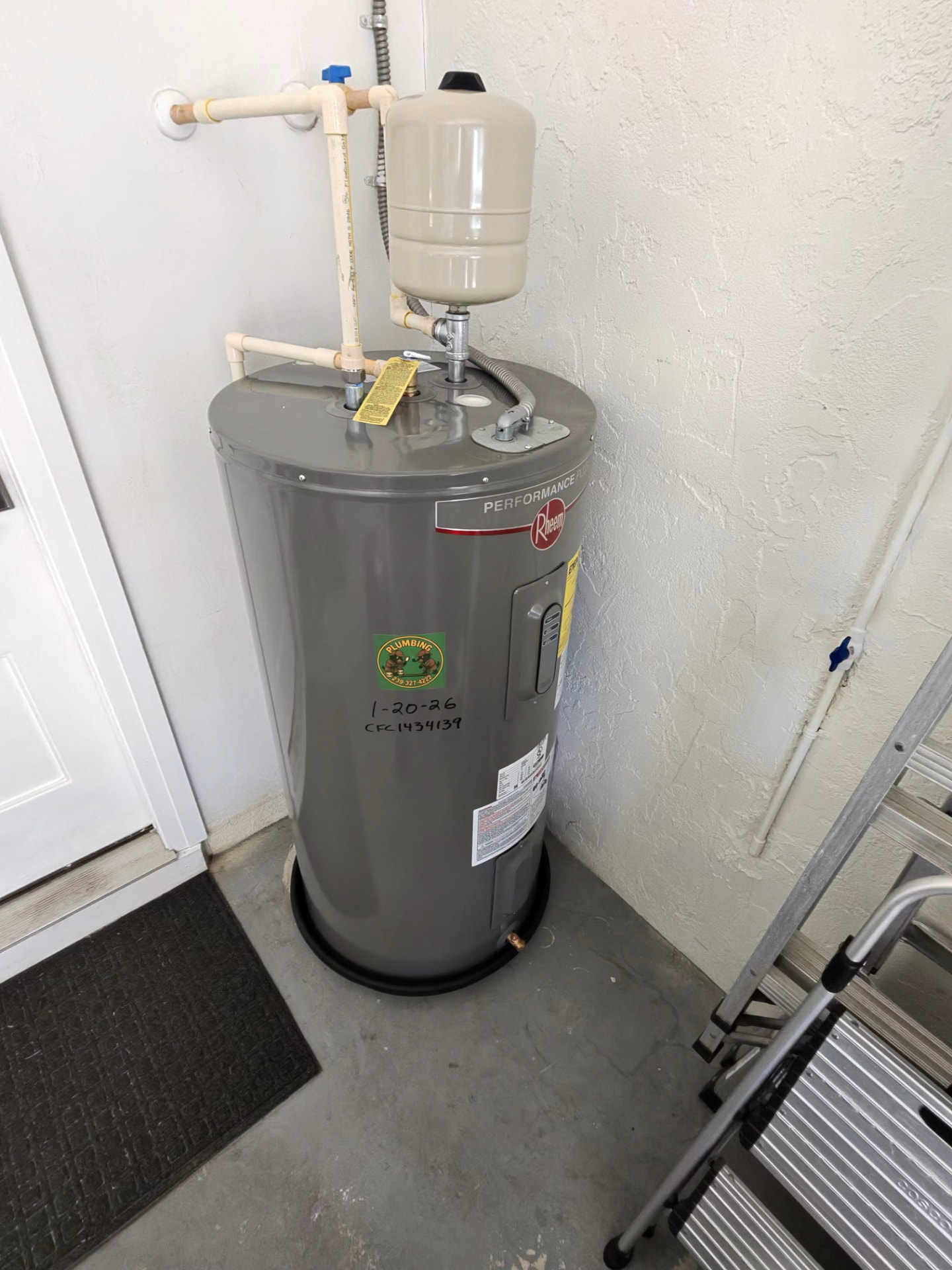
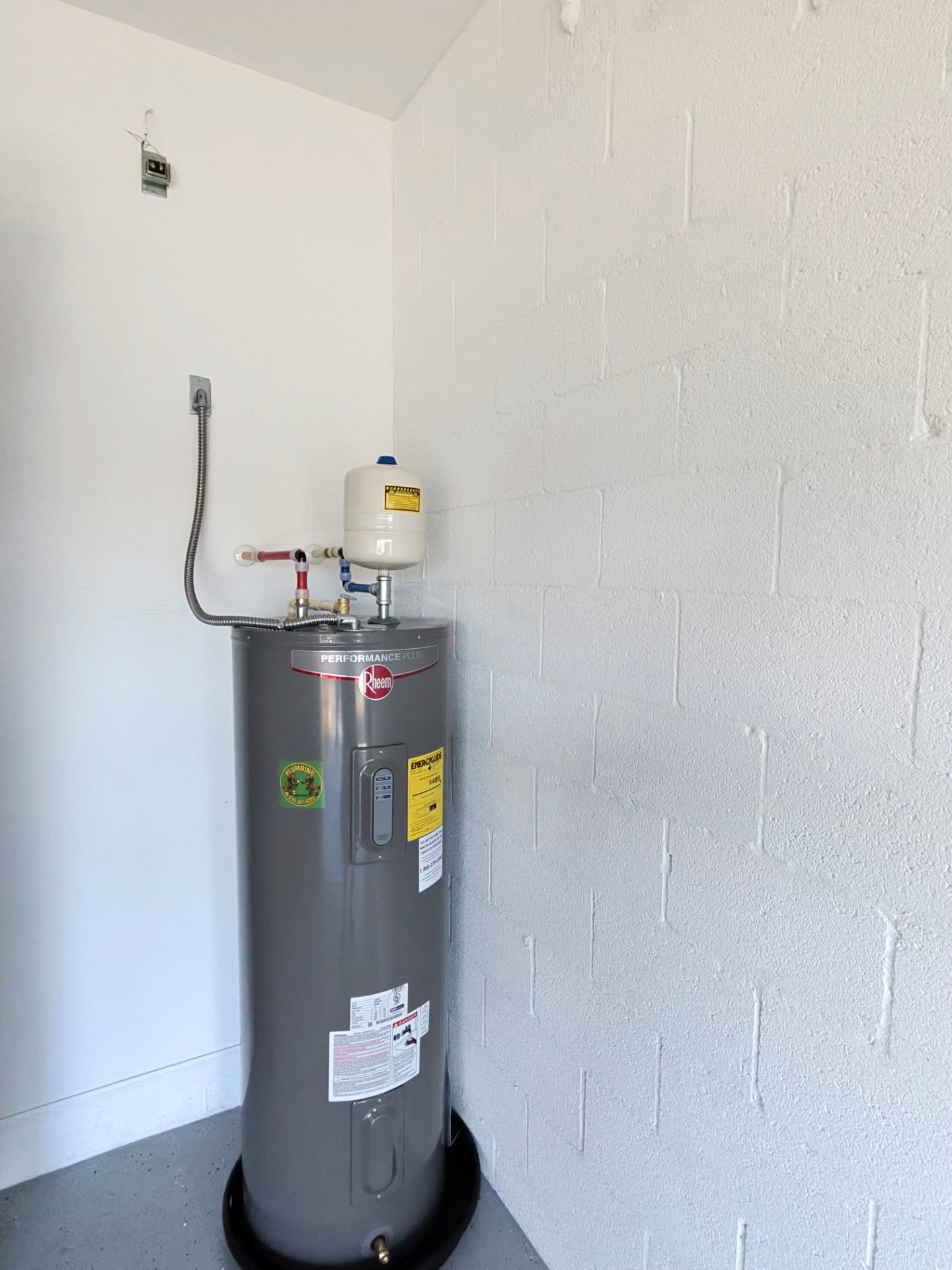
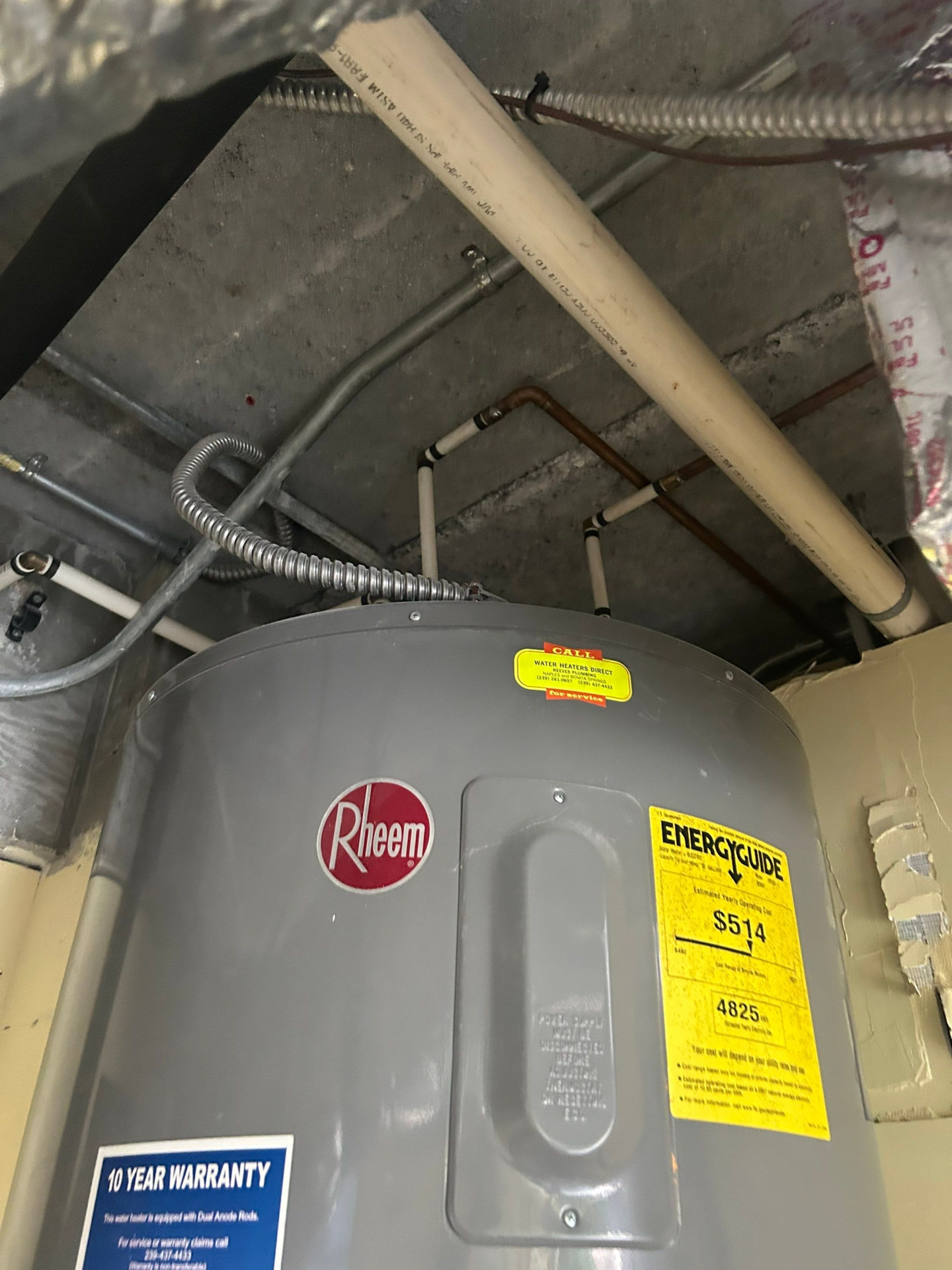
Water Heater Installs, Photographed on the Job
Answers
Frequently Asked Questions — Water Heater Installation in Bradenton, FL
If you’ve read this far, you now know more about water heaters in Bradenton than most homeowners in this market — and you understand why the era your home was built, which utility serves your address, which permit office applies, and what’s actually in your walls all matter before any recommendation gets made. If your water heater is showing any of the signs on this page, if you’ve never had the system properly evaluated, or if you simply want a straight answer about what you actually have, call me at 239-388-3631. I’ll come out, look at the whole system, and tell you exactly what I find before I recommend anything.
Plumbing Detectives LLC | Venice, FL | License CFC1434139
239-388-3631 | plumbingdetectivesfl.com