
Water Heater Installation · Bradenton Beach, FL
Water Heater Installation in Bradenton Beach, FL
Salt air, very hard water, vintage 1950s plumbing, extreme vacation rental usage, and two hurricanes in two weeks. A barrier island water heater market unlike anywhere else. Licensed master plumber CFC1434139.
Call Now239-388-3631Bradenton Beach is 1.19 square miles. More than half of that is water. The city has 1,769 housing units and roughly 908 year-round residents — meaning on any given day, nearly seventy percent of the homes on this island are empty, occupied by guests, or being turned over between rental groups. It is not a neighborhood. It is not a suburb. It is a barrier island that functions primarily as a vacation rental economy, accessed by crossing the Cortez Bridge from the mainland, bounded by the Gulf of Mexico on one side and Anna Maria Sound on the other, and surrounded by salt air every hour of every day.
That environment — constant salt air, very hard water from Manatee County Utilities, vintage 1950s and 1960s plumbing infrastructure in many of the original beach cottages, extreme vacation rental usage patterns, and a direct hit from two major hurricanes in two weeks in the fall of 2024 — creates a water heater situation that is unlike anything I deal with anywhere else I work.
In September 2024, Hurricane Helene’s storm surge put three to four feet of water into essentially every home in Bradenton Beach. The state’s damage assessment team surveyed the city and classified it as ninety to ninety-five percent destroyed or damaged — officially designated a catastrophic area. Two weeks later, Hurricane Milton made landfall twenty miles south at Siesta Key as a Category 3 storm and compounded everything Helene left behind. The Cortez Bridge, the only road onto and off this island from the mainland, was closed to all but essential personnel. The Rod & Reel Pier, one of the island’s three piers, was destroyed. What remained of several older beach cottages did not survive the second storm.
The island has been rebuilding since. Many homes have been elevated, rebuilt with new plumbing, and returned to rental service. Others are still in the process. And the water heaters in every home that survived — whether they sat in three feet of floodwater or escaped surge damage — have been through an event that changes what a proper post-storm plumbing evaluation looks like.
My name is Mike Reynolds. I’m the owner of Plumbing Detectives LLC and a licensed master plumber, license CFC1434139. I’m based in Venice, about 45 minutes from the Cortez Bridge. I serve Bradenton Beach, Holmes Beach, and Anna Maria Island. Here’s what I’d tell you about your water heater before I even walk through the door.
Market Context
What Makes Bradenton Beach Completely Different From the Mainland Market
Everything about plumbing service on a barrier island is different. The water is the same Manatee County supply that serves the mainland — pipes running under Longboat Pass and Anna Maria Sound from county infrastructure — but the environment that water heater lives in is not. Let me explain the three factors that separate Bradenton Beach from every other market in this system.
Salt air. Bradenton Beach is surrounded by salt water on both sides. The Gulf of Mexico is the western boundary. Anna Maria Sound is the eastern boundary. The air on this island carries salt continuously, not occasionally. That matters for a water heater because salt air attacks exposed metal components in ways that inland environments don’t. The temperature and pressure relief valve — a brass and steel assembly that sits on top of the water heater — degrades faster in constant salt air than in an inland garage. The fittings at the top of the tank corrode on the outside while the hard water works on them from the inside. Hose bibs, exterior fixtures, any exposed copper or brass — all of it deteriorates faster here. A unit that might deliver twelve years of reliable service in a Venice garage may show significant external deterioration at seven or eight years in a Bradenton Beach utility closet.
Vacation rental usage patterns. Roughly half of all housing units in Bradenton Beach are used for seasonal or vacation rental purposes. Many of the other half are second homes occupied only during winter months. What this means for a water heater is a usage pattern that has no analog on the mainland. A vacation rental water heater doesn’t get the moderate, consistent demand of an owner-occupied home. It gets zero demand for a week, then six guests arrive for a long weekend and all want to shower before dinner on Friday night. Then zero demand again until the next rental group checks in. That cycling between complete idle and peak demand stresses equipment differently than steady use. It accelerates sediment compaction during idle periods and puts repeated thermal stress on the tank during peak cycles. One of the most consistently cited plumbing service categories among property managers on Anna Maria Island is water heater failure — not because the equipment is poor quality, but because the usage pattern is extreme and the maintenance attention is often minimal.
The 2024 hurricane damage. In a market where ninety to ninety-five percent of the city’s homes sustained damage or destruction from storm surge flooding, the post-storm plumbing situation is still being worked through. Homes that took three or four feet of saltwater intrusion and have since been repaired may have water heaters, supply connections, or drain lines that were affected by that intrusion in ways that weren’t fully addressed during the repair. Saltwater contact with the electrical components of an electric water heater — elements, thermostat, wiring — can cause damage that doesn’t show up immediately but surfaces as premature failure months later. Salt contamination of tank interiors affects water quality. Pressure restoration after a utility shutoff — Manatee County proactively cuts water and sewer service to the entire island ahead of major storm events — can dislodge sediment and stress aged joints in ways that reveal latent problems.
Housing Stock
The Housing Stock — What’s Actually in Your Bradenton Beach Home
Bradenton Beach was incorporated in 1952. The concrete bridge that replaced the original wooden span across Longboat Pass opened in 1957 and triggered the island’s primary construction boom. The bulk of today’s surviving housing stock — the “Old Florida cottage” character that defines the historic Bridge Street district and the older sections of the city — dates from the 1950s and 1960s.
That era of Florida residential construction means galvanized steel supply lines in the oldest unrenovated homes and early copper in those that were built or updated through the 1970s and 1980s. It also means cast iron drain lines under the slabs of homes that were built before the mid-1970s transition to PVC drainage.
Galvanized supply lines from the 1950s and 1960s are now 60 to 70 years old — well past the 40 to 50 year typical service life. The zinc coating that protected the steel from corrosion has been dissolving from the inside for decades. The pipe interior is narrowed by rust scale. Water pressure has declined gradually. The water may carry a faint orange or rust tint, particularly from fixtures that haven’t been used recently. In a Bradenton Beach cottage that’s been in a family for thirty years, the owner may have adapted to declining pressure without ever identifying the cause.
Copper supply lines from the 1970s and 1980s are now in the age range where pinhole leaks become realistic. In Bradenton Beach’s salt air environment, copper develops external corrosion in addition to the internal chemistry-driven pinhole failures that affect copper throughout the region. The combination accelerates deterioration relative to inland copper of the same age.
Post-hurricane rebuilds are changing this picture rapidly. Homes that were damaged or destroyed in the 2024 storms and rebuilt from the ground up are coming back with new PEX or CPVC supply lines, new PVC drains, and new plumbing throughout. The building height and density caps in Bradenton Beach’s charter — a maximum of 29 feet above Flood Protection Elevation and a maximum of two habitable stories — mean new construction stays comparable in scale to what it replaced, but the plumbing inside is modern.
The practical reality is a market split between original 1950s-1980s plumbing in the surviving unrenovated cottages, and brand-new post-hurricane construction in the homes that were rebuilt after 2024. Both situations require a plumber who understands the specific context.
If your Bradenton Beach property has never had a plumbing evaluation and the home predates 1980, that conversation is overdue. If your home took storm surge during the 2024 hurricanes and hasn’t had a full post-storm plumbing inspection, call me before assuming everything is fine. 239-388-3631.
Water Chemistry
Very Hard Water on a Coastal Island — A Double Problem
Bradenton Beach is served by Manatee County Utilities — the same county system that serves the mainland. The county’s own 2024 water quality data reports total hardness at 259 mg/L as calcium carbonate, which converts to approximately 15.1 grains per gallon. That places it solidly in the very hard water category — the Water Quality Association’s threshold for very hard is 10.5 GPG and this water is 44 percent above that threshold.
What that means for a water heater on a barrier island is a double problem. Hard water deposits mineral sediment at the bottom of the tank from the inside. Salt air attacks the fittings and external components from the outside. Both processes accelerate the deterioration of the unit relative to what the manufacturer’s documentation assumes.
Inside the tank, the dissolved calcium and magnesium that enter with every gallon of heated water fall out of solution and settle to the bottom as mineral scale. That layer accumulates steadily. In a vacation rental water heater that sees high-peak demand followed by extended idle periods, the sediment settles and compacts harder during idle time than it would in a unit with consistent daily use. A water heater that’s been in a Bradenton Beach rental property for eight or nine years without a flush has a meaningful sediment layer affecting its efficiency and element life.
On the outside, the salt air and coastal humidity are attacking every exposed metal component. The relief valve. The fittings at the top of the tank. The valve handles and connection points. This external deterioration is invisible until it causes a problem — a weeping fitting, a valve that doesn’t reseat correctly, a corrosion point that develops into a slow leak at a connection that looked fine from the outside.
One of the most common things I find on service calls to older Bradenton Beach homes is a water heater with significant external corrosion at the top connections and meaningful sediment accumulation inside — a unit that has been dealing with hard water and salt air simultaneously for years without any maintenance attention. These units don’t always need replacement. But they always need evaluation.
Installation Quality
Why Most Water Heaters in Older Bradenton Beach Homes Are Installed Wrong
This is the technical section I include on every page because it directly affects how long any water heater lasts — and in Bradenton Beach’s environment, getting the installation right matters more than almost anywhere I work.
Every tank water heater ships from the factory with galvanized steel nipples at the hot and cold ports at the top of the tank. In a home with copper supply lines — which describes most of Bradenton Beach’s 1970s and 1980s housing stock — the standard shortcut is to connect the copper directly to those galvanized nipples with no transition fitting in between. The installation looks complete. It holds water. And it creates a condition called galvanic corrosion that begins working on the joint from the moment water touches it.
The explanation is electrochemical but the concept is simple. Copper and galvanized steel are dissimilar metals. When they make physical contact in the presence of water — which conducts tiny electrical currents — the more reactive metal in the pairing begins to dissolve into the water. In this case that’s the zinc coating on the galvanized nipple. It dissolves atom by atom, silently, inside the threaded joint. No visible rust on the outside. No drip. No odor. The zinc goes first. When it’s gone, the bare steel underneath corrodes faster. Eventually the nipple fails.
In Bradenton Beach’s environment this process is accelerated. Hard water is a more effective electrolyte than soft water — it conducts the tiny currents that drive galvanic corrosion more efficiently. Salt air increases the ambient corrosion rate on external surfaces. A connection that might take ten years to fail in a soft-water inland environment fails sooner here.
The correct installation uses brass as a transition fitting. Brass sits between copper and galvanized steel on the electrochemical scale and reduces the corrosive driving force by roughly 86 percent. Here’s what a correct installation looks like in a copper-plumbed Bradenton Beach home.
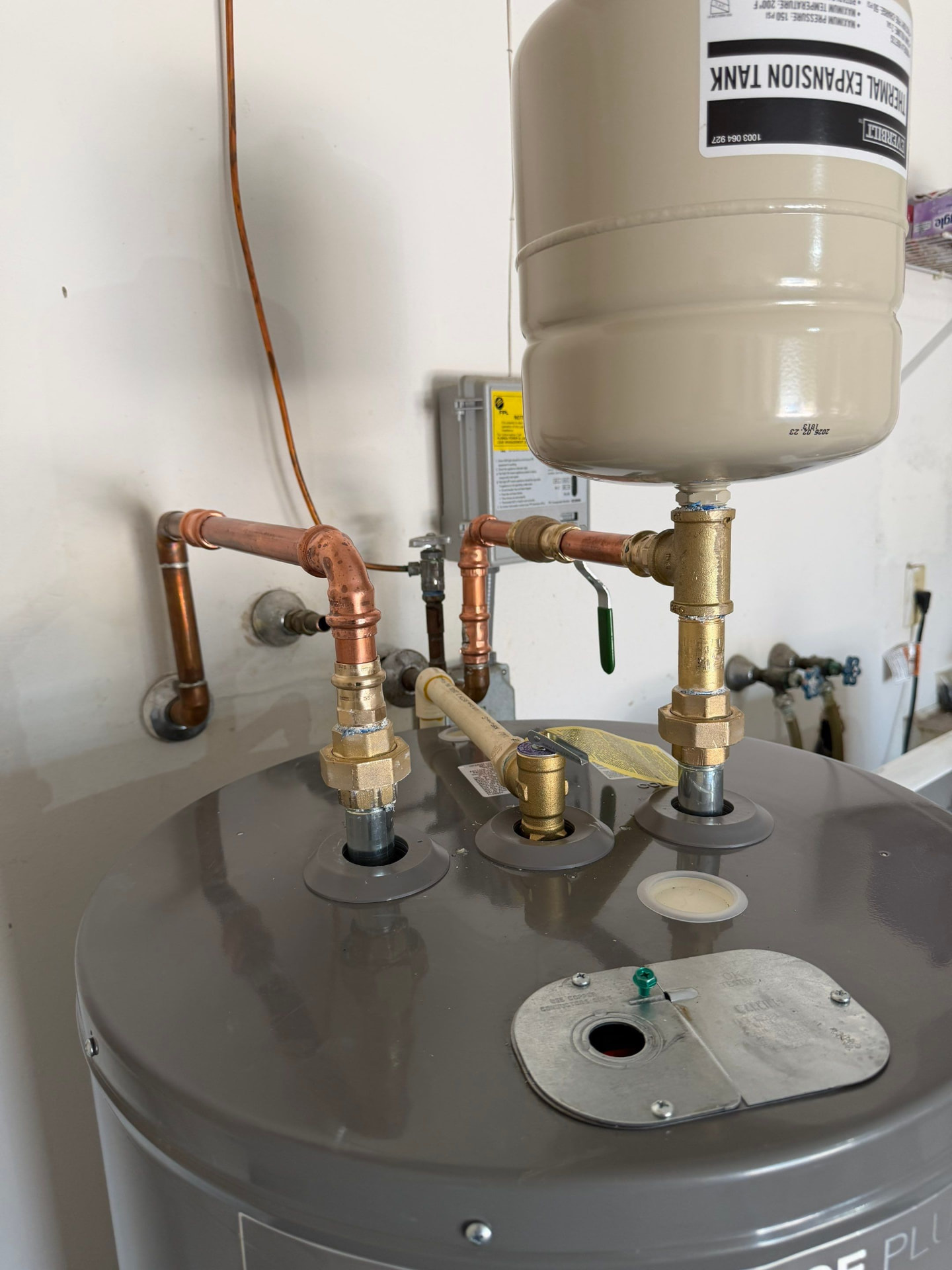
Cold side: A brass female union threads directly onto the galvanized cold nipple at the top of the tank. A brass nipple runs into the other side of the union. A brass tee threads onto the brass nipple — the expansion tank connects off the top port of the tee, and a copper male adapter transitions out of the side port to copper pipe, which runs to a ball valve and the cold supply line. The galvanized nipple never contacts copper directly.
Hot side: A brass female union threads onto the galvanized hot nipple. A copper male adapter threads into the union’s other side. Copper pipe continues from there.
Unions on both sides. A union disconnects with a wrench. A coupling requires cutting pipe. In a vacation rental home where the next water heater replacement may be done by a different contractor working under time pressure, a union on both sides is the professional standard that makes future service easier and cleaner.
Plumbing Detectives LLC Professional Opinion
In a vacation rental home on Bradenton Beach, the water heater is a critical piece of equipment that directly affects your guests’ experience and your property’s rental reviews. A guest who runs out of hot water on Friday night leaves a review that costs you bookings. The investment in a correctly installed unit — right fittings, right expansion tank, right anode rod protection — is a fraction of what one bad review cycle costs a rental property. I’d rather spend twenty minutes explaining why the installation needs to be done correctly than take a call six months from now about a premature failure that was preventable.
Expansion Tank
The Expansion Tank — Required, Often Missing, and Critical in This Market
Bradenton Beach is served by Manatee County Utilities on a closed plumbing system — a backflow prevention device on the service line prevents water from flowing back toward the county supply. In a closed system, water that heats up and expands has nowhere to go without an expansion tank to absorb it.
Without an expansion tank, the pressure from every heat cycle pushes against every fitting, every valve, and every connection in the home’s plumbing. Over time this fatigues components. In a vacation rental home where the water heater runs heavy peak cycles followed by idle periods, this pressure cycling is more variable and in some ways more stressful than the consistent use pattern of an owner-occupied home.
The temperature and pressure relief valve is the component most visibly affected by a missing expansion tank. It begins to drip as it relieves the excess thermal expansion pressure. In a vacation rental property this is often discovered by a property manager during a turnover inspection or reported by a guest. The valve gets replaced. The new one does the same thing. The root cause — no expansion tank on a closed system — was never addressed.
Florida Building Code requires an expansion tank on every water heater replacement in a closed plumbing system. I include one on every installation. It’s not a separate conversation.
Anode Rod
The Anode Rod in a Hard-Water Coastal Environment
Inside every tank water heater is a sacrificial anode rod — a metal rod suspended in the tank whose electrochemical properties attract corrosion away from the steel tank walls. It corrodes so the tank doesn’t have to. When it’s consumed, the protection ends and the tank walls become the target.
In Bradenton Beach’s hard water — 15.1 grains per gallon documented in Manatee County’s own 2024 water quality report — a standard magnesium factory anode rod depletes faster than the manufacturer’s documentation assumes. In a vacation rental home where the unit cycles between heavy peak demand and extended idle periods, the rod’s interaction with standing water during idle periods can accelerate depletion further.
One of the most common things I find in older Bradenton Beach homes is an anode rod that’s been completely consumed with no replacement — in some cases for years — because nobody was monitoring it. The hot water quality in these homes often has a faintly metallic character that owners and property managers attribute to the water supply when it’s actually the tank corroding from the inside with no protective rod.
We offer a Corro-Protec powered titanium anode rod upgrade on every installation. Rather than depleting, it uses a small impressed electrical current — less than three dollars per year in electricity — to actively repel corrosion from the tank walls. It never degrades. The manufacturer backs it with a 20-year warranty. For a vacation rental water heater in a hard-water coastal environment, this is the most practical long-term protection investment available at the time of installation. It protects the tank investment, it removes one maintenance variable from the property management equation, and it reduces the risk of the hot water quality problem that generates negative rental reviews.
Vacation Rental
Vacation Rental Water Heaters — A Different Standard
A water heater in an owner-occupied home gets used by the same people in roughly the same patterns every day. A water heater in a vacation rental gets used by strangers, in unpredictable patterns, with no continuity from one group to the next, and with zero user accountability for how it’s treated.
In practical terms for the equipment: multiple guests arriving the same afternoon and all wanting to shower within an hour of check-in creates a peak hot water demand that a standard tank heater may struggle to meet if it’s undersized or has sediment accumulation reducing its effective capacity. The property gets a negative review about cold water. The property manager gets a call. The plumber gets dispatched.
In many of these situations the unit isn’t failed — it’s undersized for the peak demand pattern of a fully occupied vacation rental, or it has sediment accumulation that’s reduced its effective tank volume below what the household size requires, or it simply needs a flush and an anode rod inspection that it’s never received.
Tankless water heaters address the running-out-of-hot-water problem directly. A tankless unit heats water on demand with no stored tank — it cannot run out because it doesn’t store. For a vacation rental property with multiple simultaneous showers, a high-flow outdoor shower for beach rinses, and unpredictable peak demand, a properly sized tankless unit eliminates the category of complaint entirely. The consideration in Bradenton Beach specifically is the water quality — very hard water is aggressive toward tankless heat exchangers, and I strongly recommend a water softener upstream of any tankless installation in this market. Without upstream softening, the hard water will scale the heat exchanger faster than the efficiency gains justify. I’ll tell you this honestly before recommending a tankless installation.
Property managers: if you’re managing multiple vacation rental properties on the island and you don’t have an established relationship with a licensed plumber who understands this market, that gap costs you in emergency response fees, preventable failures, and the guest experience disruption of a cold-water complaint. We can discuss turnover inspection programs, scheduled maintenance visits, and priority response for managed properties. The plumbing on a vacation rental is infrastructure, not an afterthought.
Common Mistakes
Mistakes I Commonly Find on Water Heater Installations in Bradenton Beach
Copper directly on galvanized nipples. In the older 1950s-1970s Bradenton Beach cottages with copper supply lines, this is the most common installation error. In a coastal hard-water environment, galvanic corrosion runs faster than it would on the mainland. I find it on original installations and on replacement installations done by contractors who didn’t address the transition fittings.
Missing expansion tank. On a Manatee County Utilities closed system, the expansion tank is required. Missing expansion tanks show up in Bradenton Beach vacation rental homes where the property changed hands, the water heater was replaced in a hurry, and nobody checked what the previous installation included.
No unions on the connection fittings. In a vacation rental context where the property may be serviced by different contractors across different ownership periods, a union on both the hot and cold sides means the next replacement doesn’t require cutting into aging supply lines. Most replacements I see on the island were done with couplings.
Unit undersized for vacation rental demand. A 40-gallon tank in a three-bedroom home that gets rented to six or eight guests at a time. The unit is code-compliant for the bedroom count but undersized for the actual peak demand pattern of a full vacation rental group. Nobody sized it for the rental use case.
No maintenance since installation. In a vacation rental home that sees heavy turnover, the water heater often gets zero maintenance attention because nobody is thinking about it — the property manager is focused on guest experience and the owner is focused on rental income. Annual flushing and anode rod inspection aren’t happening. The hard water and the usage cycles are working on the equipment unchecked.
External component corrosion not addressed during turnover. Salt air deterioration of the T&P valve, the top fittings, and any exposed connections is visible during an inspection but easy to overlook during a fast turnover. By the time it causes a problem, the damage is more extensive than it would have been if caught earlier.
Improper T&P discharge routing in an elevated rebuilt home.Post-hurricane elevated construction changes the geometry of utility spaces. I’ve found T&P discharge pipes in post-rebuild homes that were routed in ways that don’t terminate safely given the new floor heights and configurations. This is a safety issue.
Plumbing Detectives LLC Tips
If you’re a property owner or manager on Bradenton Beach and your vacation rental home’s water heater is more than 7 years old with no documented maintenance, schedule a service call before the unit fails mid-rental. A failed water heater during a rental stay costs you more than a proactive replacement — in emergency service fees, refunds, and the review that follows.
Manatee County proactively shuts off water and sewer service to the entire island ahead of major storm surge events. After utility restoration following a storm, the first pressurization of the system can dislodge sediment and reveal latent leaks at aged connections. If your property has had the utility restored after a storm event, a brief post-restoration inspection is worth scheduling.
Post-hurricane elevated construction changes the routing requirements for water heater T&P discharge pipes and supply connections. If your Bradenton Beach home was rebuilt after 2024 and you haven’t had a licensed plumber verify the installation, that’s worth doing before the first extended rental season.
The Bridge Street Historic Pier was the only pier on the island to survive the 2024 hurricanes largely intact. The piers get rebuilt. The water heater connections in homes that took storm surge don’t rebuild themselves. If your home was flooded and the heater stayed in place, have it evaluated.
Hurricane Damage
The 2024 Hurricanes — What They Did to Plumbing Systems on the Island
The 2024 hurricane season hit Bradenton Beach harder than any other event in the city’s modern history. Hurricane Helene made landfall in Florida’s Big Bend as a Category 4 storm on September 26, 2024 — more than 100 miles from Anna Maria Island — and still produced a storm surge that put three to four feet of water into essentially every home in the city. The Florida Department of Environmental Protection’s official impact report documented the devastation. The state’s CERT damage assessment team surveyed Bradenton Beach and designated it a catastrophic area with ninety to ninety-five percent of structures damaged or destroyed.
Two weeks later, Hurricane Milton made landfall twenty miles south at Siesta Key as a Category 3 storm. What Helene had left standing, Milton challenged again. The Rod & Reel Pier at the north end of Anna Maria Island was destroyed. The Anna Maria City Pier was severely damaged. At least one home near Bradenton Beach’s Bridge Street district was toppled. Manatee County cut water and sewer service to the island proactively before both storms — the utility shutoff itself becoming a recurring plumbing event as the island cycled through pressure loss and restoration multiple times in a short period.
From a plumbing standpoint, what saltwater flooding does to a home’s plumbing system is specific and worth understanding. An electric water heater that sat in three feet of saltwater has components — the electrical elements, the thermostat, the wiring connections — that were exposed to saltwater intrusion. Salt is highly corrosive to electrical systems. Damage from this exposure doesn’t always show up immediately. The unit may appear to function normally for weeks or months before the failure appears. If your Bradenton Beach home took flooding during the 2024 storms and the water heater was in place, a full evaluation of the unit is worth doing regardless of whether it appears to be working.
The pressure cycling that comes with utility shutdowns and restorations is also relevant. Manatee County’s controlled shutoffs protect the island’s sewer lift stations and treatment infrastructure from contamination during surge events — a sound engineering decision. But the restoration of pressure after an extended shutoff can disturb sediment in water heater tanks, stress aged fittings, and reveal pinhole leaks in old copper that were stable under normal pressure but opened under the surge of re-pressurization. Post-storm plumbing inspection is not optional on a barrier island with aging infrastructure that just went through two major flooding events in two weeks.
Permitting
Permitting in Bradenton Beach — Your Own City Building Department
Unlike Bradenton itself — which splits permits between the City of Bradenton and Manatee County depending on the address — Bradenton Beach has its own city building department that handles all permits within city limits. Permits are filed through the City of Bradenton Beach Building and Planning Department at 107 Gulf Dr N, with applications submitted via the city’s Citizenserve online portal.
Important distinctions for Bradenton Beach specifically:
Condo owners cannot self-permit. If your property is a condominium or multi-family unit, all plumbing work requires a State Licensed contractor — owners cannot pull their own permits for condo work in Bradenton Beach.
Flood zone review adds to the permit scope. Most of Bradenton Beach sits in FEMA AE and VE flood zones. The permit fee schedule includes additional charges for floodplain code compliance inspections, flood elevation written determinations, and floodplain review with required Elevation Certificates. These are not optional for applicable work.
Post-hurricane rebuilt and elevated homes have specific requirements.Water heaters and mechanical equipment in elevated structures must be located above flood elevation. If your home was elevated during post-2024 reconstruction, the water heater location and supply/drain routing may have changed from the original configuration. Any replumbing associated with that elevation change requires its own permit scope.
After-the-fact fees are double. Unpermitted plumbing work discovered after the fact costs double the normal fee plus the original fees. On a barrier island where inspector access requires crossing a bridge, it’s not worth the risk.
We pull permits through the City of Bradenton Beach Citizenserve portal for every job and explain what the flood zone review requirements mean for your specific project before work begins.
Maintenance
Annual Maintenance for Vacation Rental Properties — A Different Schedule
The maintenance schedule that makes sense for a Bradenton Beach vacation rental is not the same as the maintenance schedule for a primary residence anywhere else.
A vacation rental water heater in Bradenton Beach is dealing with three simultaneous stressors: very hard water from Manatee County Utilities depositing mineral sediment, salt air attacking external components, and erratic high-demand usage cycles from rotating guest groups. The combination of these three factors means the unit needs more frequent attention than any other category of residential water heater in our service area.
Annual maintenance on a Bradenton Beach vacation rental water heater means: flushing the mineral sediment that’s accumulated from the hard water, inspecting and replacing the anode rod when significantly depleted — which in 15 GPG water with vacation rental usage patterns may be more frequent than standard guidance suggests, testing the T&P relief valve, inspecting every external fitting and connection for salt air corrosion, and verifying the expansion tank is properly charged.
For properties managed by property management companies — Duncan Real Estate, Anchor Down, FVH Property Management, Island Real Estate, AMI Locals, and the others — we can work directly with property managers to coordinate service timing around rental calendars, maintain documentation of service history for each property, and provide priority response when a water heater issue affects a guest stay.
If you own a vacation rental on Bradenton Beach and you don’t have a plumber in the rotation who knows what your property’s plumbing looks like, that’s a gap. Call 239-388-3631 and we’ll fix that.
Diagnosis First
Diagnosis First — Even in an Emergency on the Island
I understand that vacation rental property calls have urgency attached to them in a way that other service calls don’t. A failed water heater at a rental property on a Saturday afternoon is not a “schedule something for Monday” situation — there are guests in the home and they paid to be comfortable.
I also know that urgency is when installation shortcuts are most likely to happen. A plumber who shows up under time pressure, swaps the unit, and leaves without addressing the connection fittings, the expansion tank, or the anode rod protection has done half a job. The new unit starts its life in the same conditions that shortened the old one.
What I try to do — even under time pressure on a vacation rental call — is take the fifteen minutes required to understand what the existing installation looked like and what needs to be corrected, rather than repeating the same mistakes under the urgency of the moment. That’s a harder discipline when a property manager is calling every twenty minutes asking for a status update. But it’s the difference between a water heater replacement that solves the problem and one that restarts the clock on the same problem with a new unit.
I’ll tell you what I find and what needs to be done before I start work. That’s not going to change because the property has guests.
Water heater issue at a Bradenton Beach rental property? Call 239-388-3631. I’ll tell you what I find before I recommend anything — and I’ll get there without padding the trip fee into the bill.
Equipment Options
Water Heater Options for Bradenton Beach Properties
Tank water heaters in the correct size for the rental occupancy are the right call for most Bradenton Beach properties where the existing infrastructure and budget align with a like-for-like replacement. We install Bradford White and Rheem — brands I trust in Florida’s coastal climate. The sizing conversation matters on a vacation rental: a three-bedroom home that gets rented to six guests needs a unit sized for six-person peak demand, not sized for a three-bedroom average household. Those are different numbers and the difference matters in a guest experience context.
Tankless water heaters eliminate the running-out-of-hot-water problem entirely. For a vacation rental property with unpredictable peak demand and multiple simultaneous users, a properly sized tankless unit is the right long-term solution. The mandatory conversation before a tankless installation in Bradenton Beach is water quality — 15.1 GPG hard water scales tankless heat exchangers and I will not install a tankless unit in this market without discussing upstream water softening. Done correctly with a softener upstream, a tankless unit is the best investment a vacation rental property owner can make in their water heating system. For more detail, see our tankless water heater page.
Heat pump water heaters are the most energy-efficient electric option and work well in Florida’s climate. For a vacation rental property where energy cost matters to the owner’s operating margin, they’re worth a conversation.
Warning Signs
Signs Your Bradenton Beach Property’s Water Heater Needs Attention
Guests are reporting cold water or running out of hot water. In a vacation rental context this is an urgent call. It’s either a unit that’s failed, undersized for the occupancy, or has sediment accumulation reducing capacity. I’ll tell you which one.
You can see green staining, white deposits, or any sign of corrosion at the fittings on top of the tank. Salt air corrosion on the external connections. Worth addressing before it progresses to a leak.
The unit took flood water during the 2024 storms and hasn’t been evaluated since. Even if it appears to work, the internal and external damage from saltwater exposure warrants a full inspection.
The T&P valve is dripping and has been replaced before without improvement. Missing expansion tank on a closed system. The valve replacement didn’t address the cause.
The unit is more than 7 years old and has no documented maintenance history.In Bradenton Beach’s hard water and salt air environment, seven years is the threshold where a full evaluation makes sense regardless of whether symptoms have appeared.
Hot water has a slight metallic quality or slightly off taste. Could be anode rod near depletion. A rod inspection is the starting point.
You have a pre-1975 home and have never had the supply lines evaluated.Galvanized steel in a 70-year-old coastal cottage is past its expected service life. That evaluation should happen before something fails at the worst possible moment.
Our Approach
Why Plumbing Detectives LLC
I named the company Plumbing Detectives LLC because too many homeowners and property owners get sold expensive replacements before anyone figures out what’s actually wrong. On a barrier island vacation rental property where there’s always urgency, always a guest experience at stake, and always pressure to get it done fast, the temptation for that shortcut is especially strong. My job is to figure out what’s actually going on, explain it clearly, and give you an answer you can trust — whether the property is your primary residence, your family’s vacation home, or an investment rental that you’re managing remotely.
Diagnosis first. Explanation second. Action third. That doesn’t change because the Cortez Bridge is in the way.
License CFC1434139. Fully insured. We pull permits through the City of Bradenton Beach building department.
Permitting
Professional Installation Done Right
Permits for plumbing work in Bradenton Beach run through the City of Bradenton Beach Building and Planning Department at 107 Gulf Dr N — not Manatee County. Applications are filed through the city’s Citizenserve online portal. If permits or inspections are required for your project, we explain what’s involved including any flood zone review requirements before work begins. Condo and multi-family plumbing work requires a State Licensed contractor — owner self-permitting is not allowed for those property types in Bradenton Beach.
Documented Work
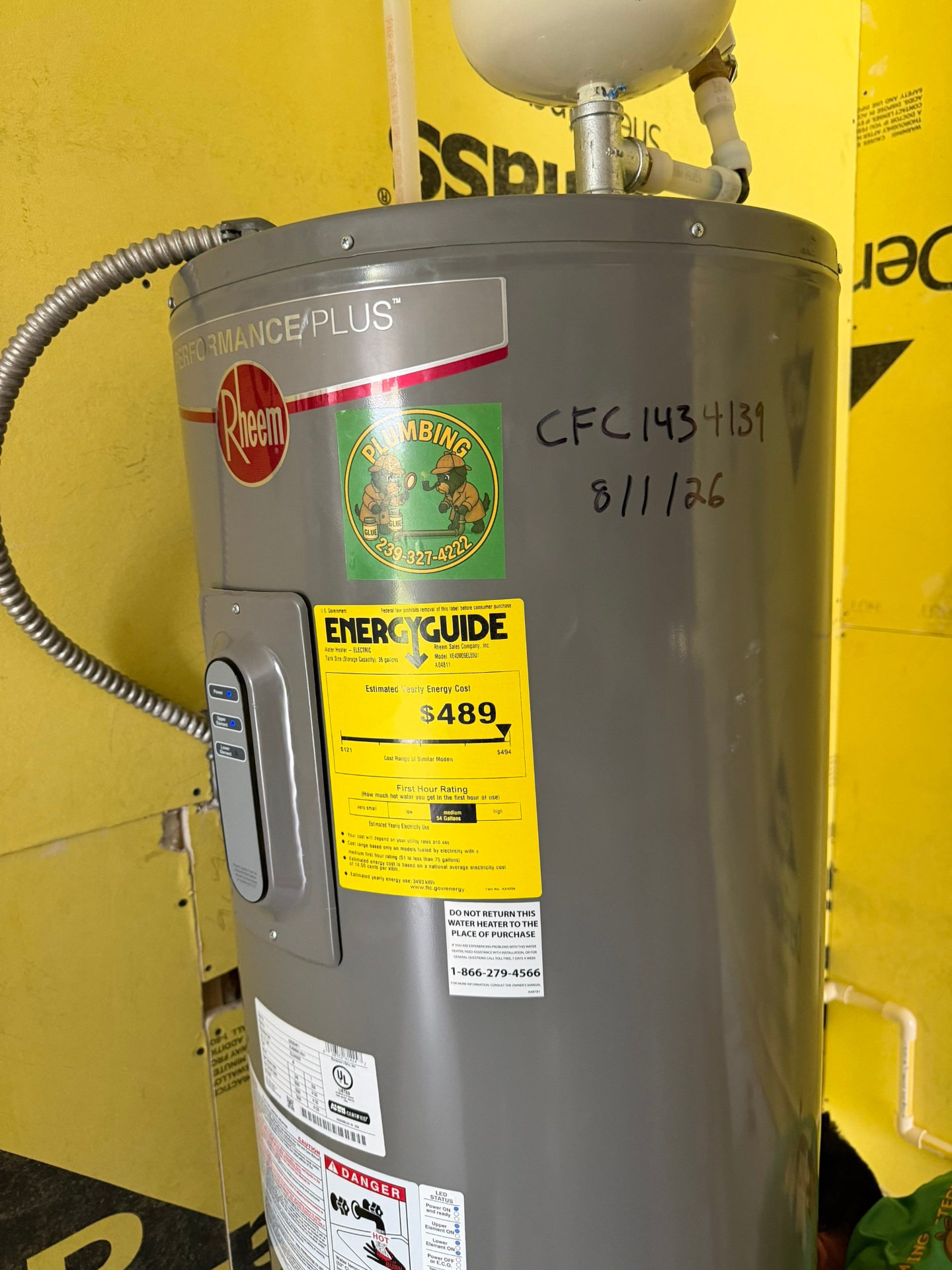
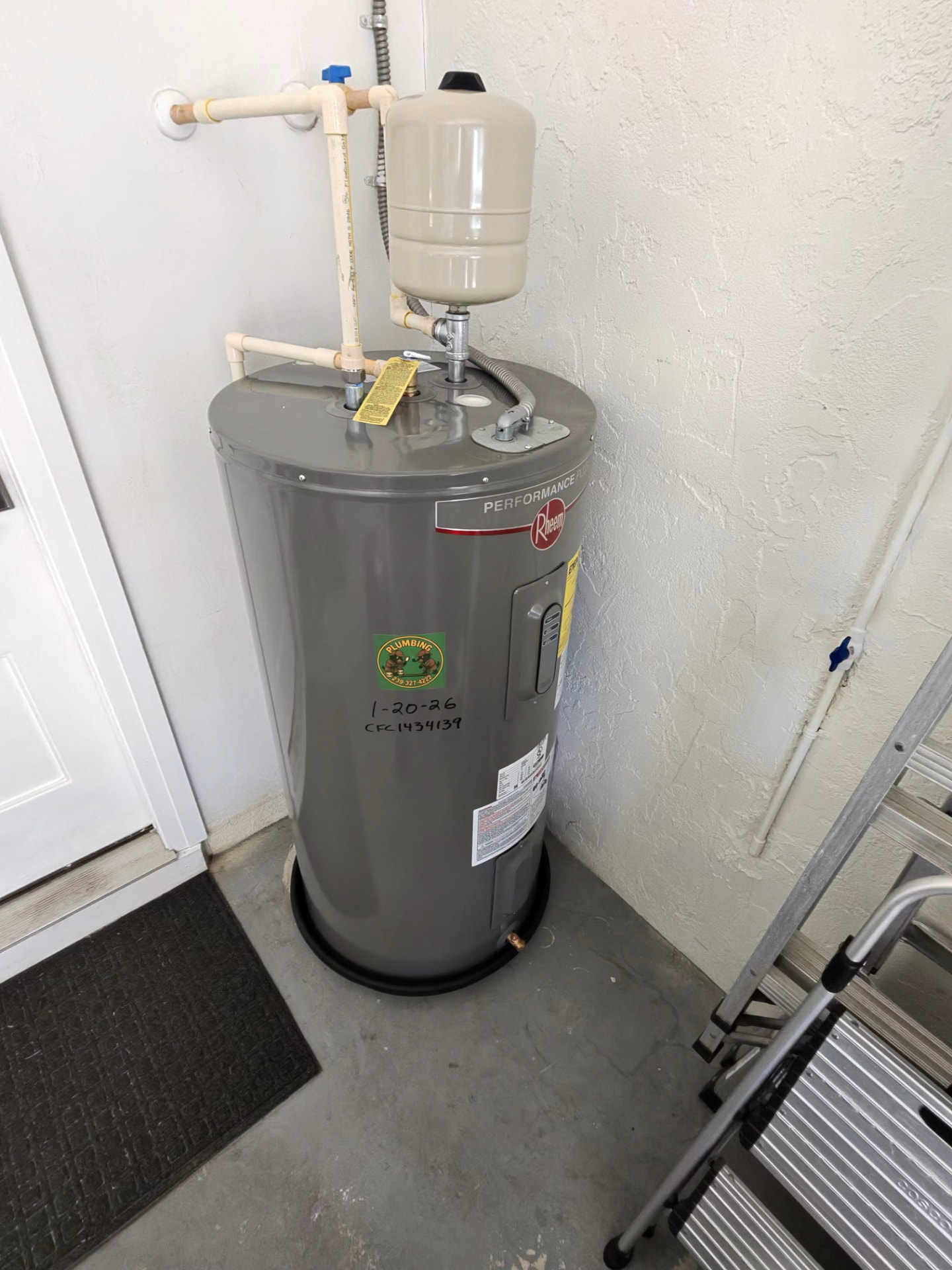
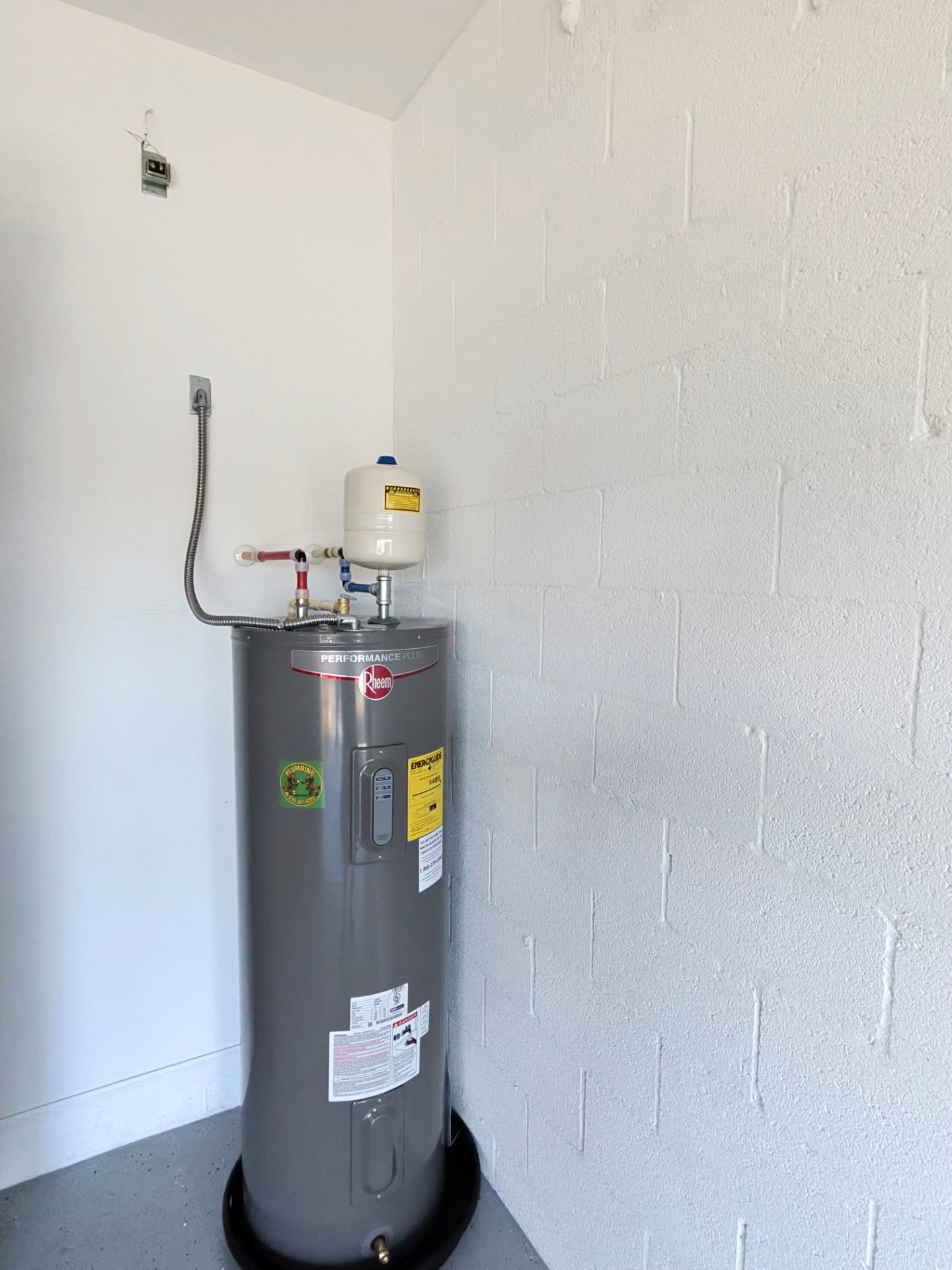
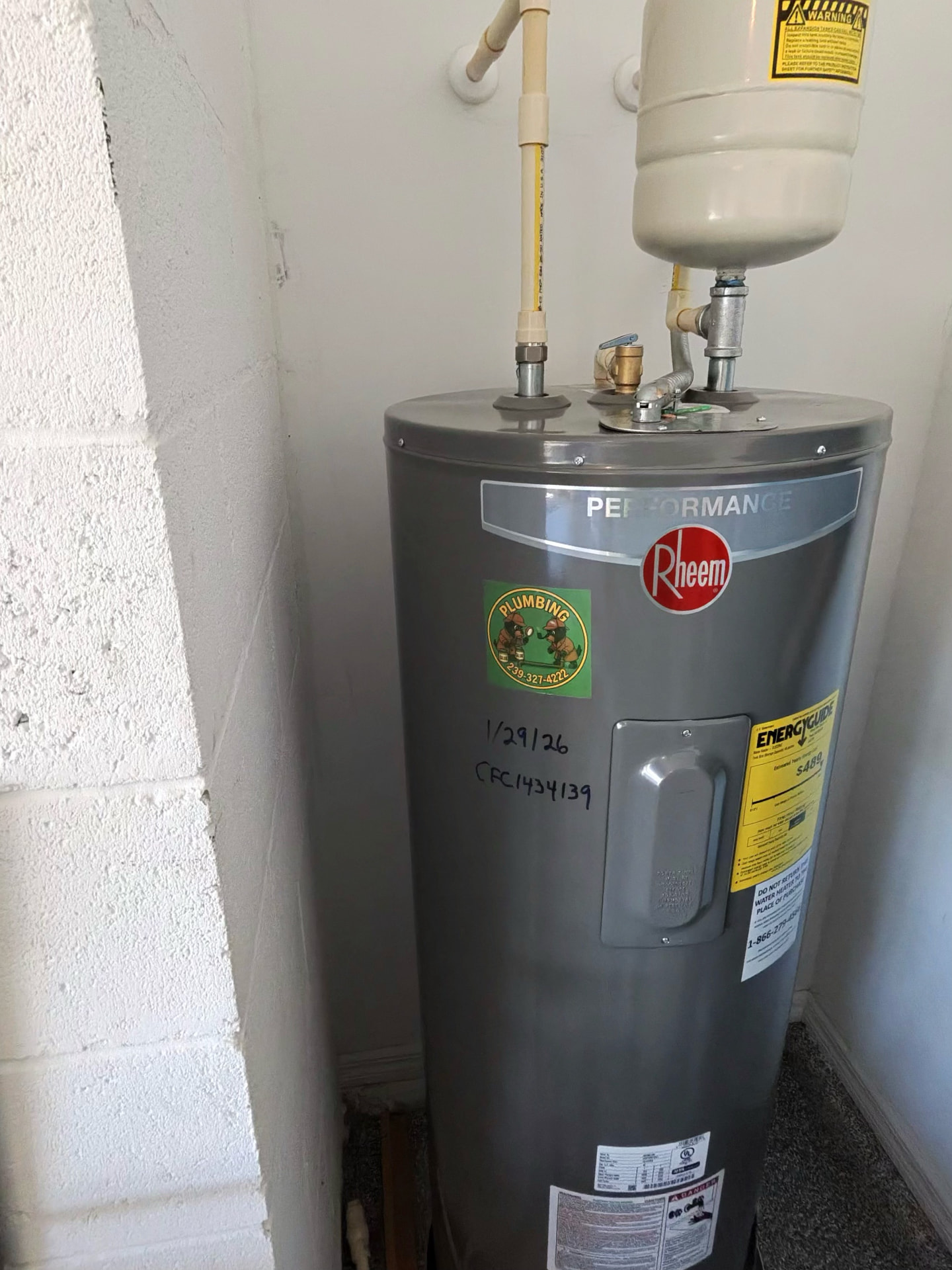
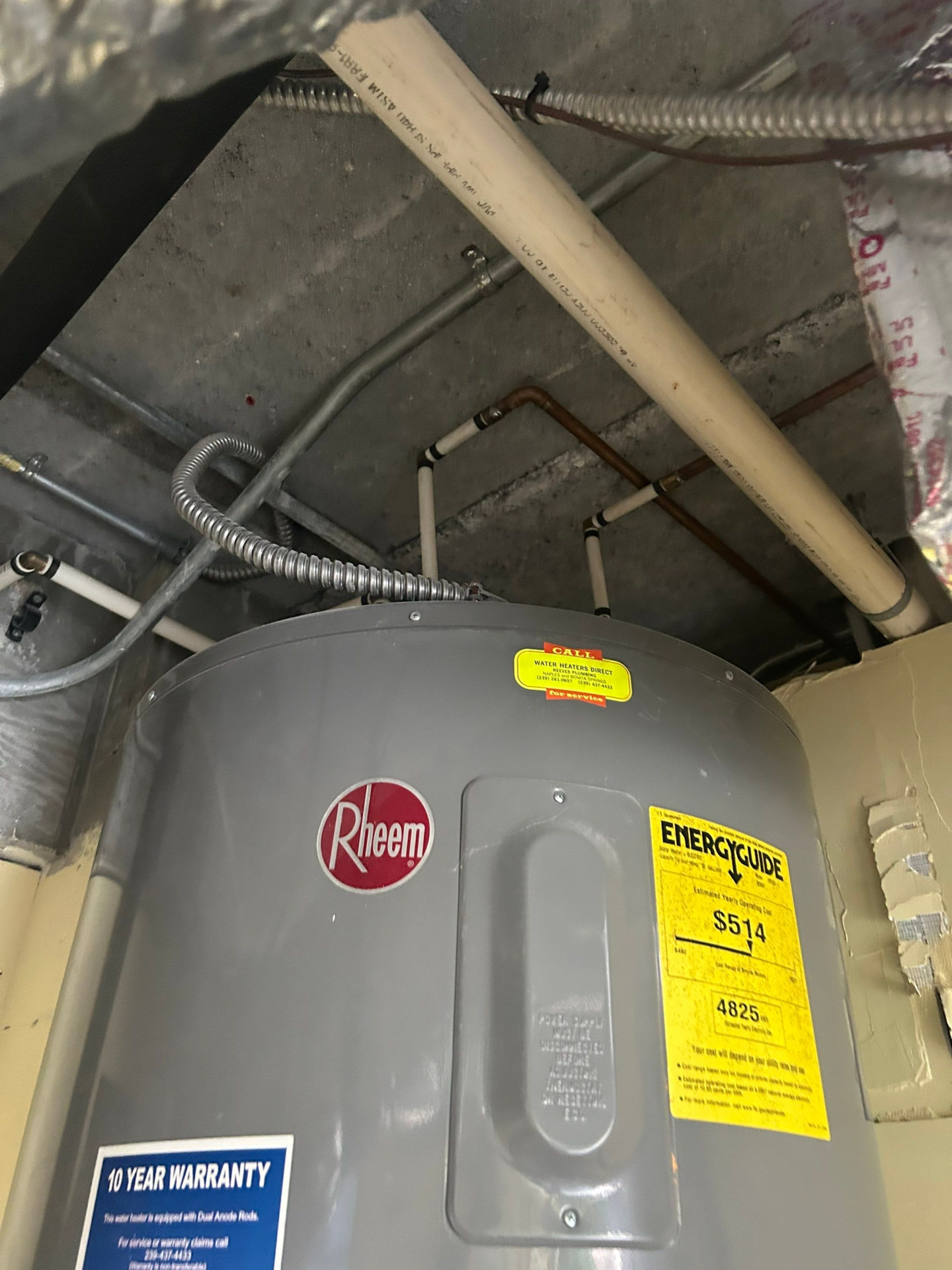
Water Heater Installs, Photographed on the Job
Answers
Frequently Asked Questions — Water Heater Installation in Bradenton Beach, FL
If you’ve read this far, you now know more about water heaters in Bradenton Beach than most property owners on this island — and you understand why the salt air, the hard water, the vacation rental usage patterns, the post-hurricane damage, and the island’s specific permitting structure all matter before any recommendation gets made. Whether you’re a year-round resident, a seasonal homeowner, or a property owner managing the rental remotely, if your water heater is showing any of the signs on this page, call me at 239-388-3631. I’ll cross the bridge, look at the whole system, and tell you exactly what I find before I recommend anything.
Plumbing Detectives LLC | Venice, FL | License CFC1434139
239-388-3631 | plumbingdetectivesfl.com