Sewer Line Repair · Nokomis, FL
Sewer Line Repair in Nokomis, FL
Camera-verified diagnosis first, always. Licensed master plumber CFC1434139. Emergency service available — call 239-388-3631.
Call Now239-388-3631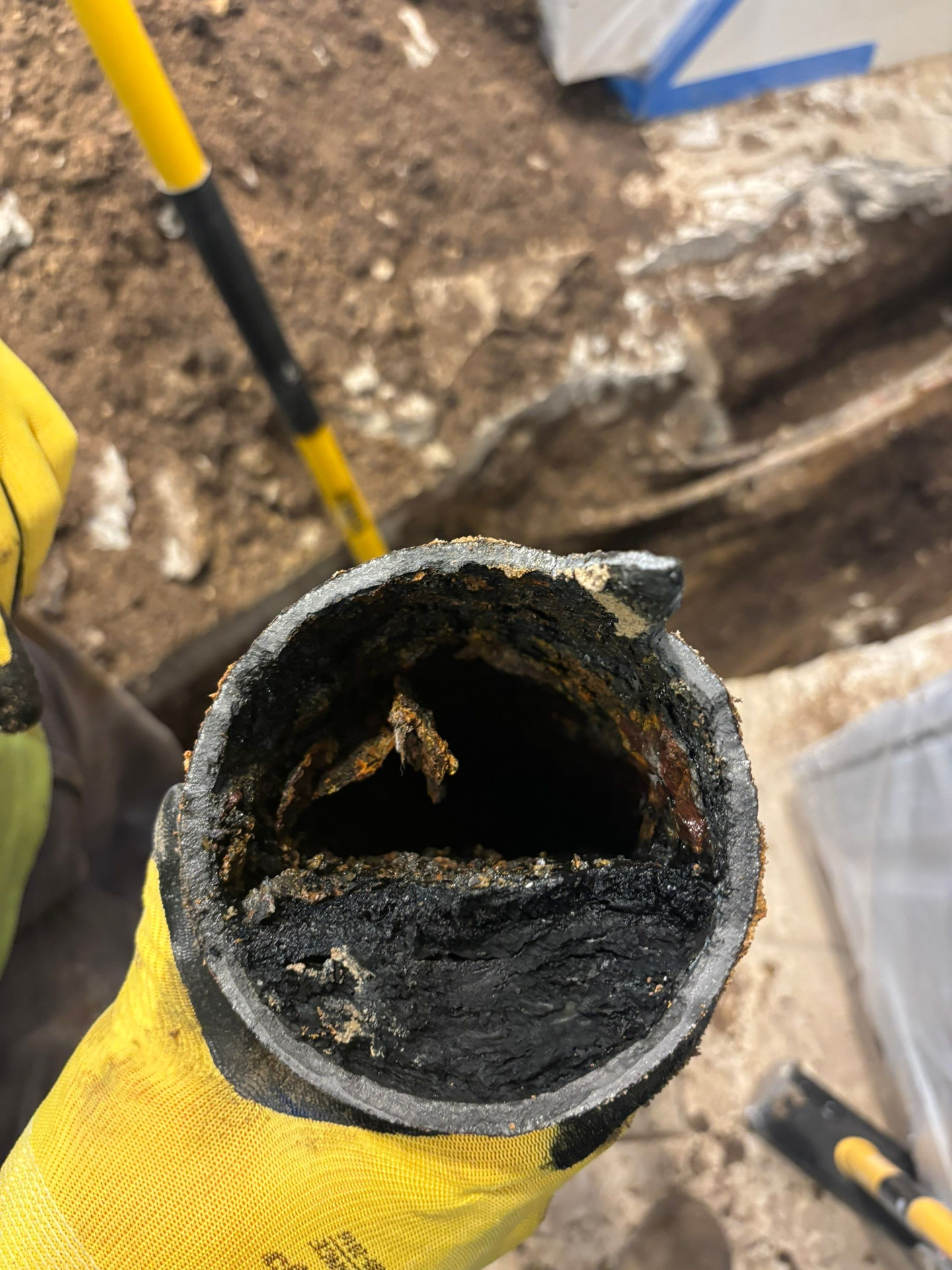
Camera log · one line, 43 feet
What the camera actually found, foot by foot
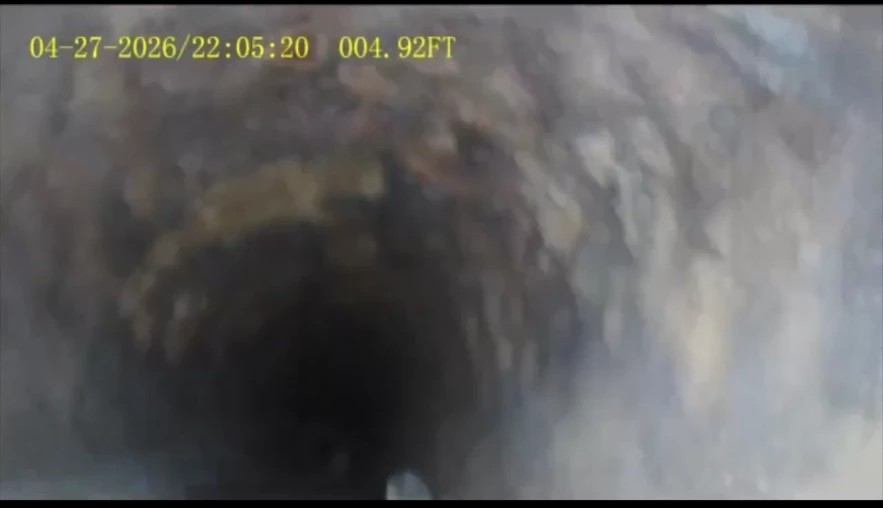
These are real stills off one inspection, with the footage counter burned into the picture. Nothing staged, nothing borrowed — this is how a failing line reads on camera from the cleanout out to the collapse, including a second belly at 37 feet.
 4 ft
4 ftScale building on the pipe wall
Four feet in and the scale is already obvious — the inside of the pipe is no longer smooth. That rough, built-up surface is what catches paper and grease and starts the backups.
Nokomis is five minutes from my own driveway in Venice Gardens, and I’ve run more calls up and down US-41 and Old Trail through this community than I can count. But I’ll say something here I can’t say on my Venice Gardens page: Nokomis isn’t one neighborhood with one sewer story. It’s not even one utility.
Nokomis has no city hall, no building department, and no water or sewer utility of its own. It’s an unincorporated community — a Census-designated place — sitting between Osprey and Venice, and it includes a stretch of Casey Key, the barrier island. That matters more than it sounds like it should, because it means two completely different plumbing realities exist under the “Nokomis” name: homes on the mainland side that are connected to Sarasota County sewer, and homes on Casey Key that are still, today, running on septic tanks — even the ones with public water hooked up.
I’m not going to pretend Nokomis has the kind of single, uniform story Venice Gardens does. It doesn’t. What I can give you is what’s actually documented about this community, what I’ve found in homes of this era, and an honest answer about which situation you’re probably in — sewer or septic, because I work both. My name is Mike Reynolds, I’m the owner of Plumbing Detectives LLC and a licensed master plumber, license CFC1434139. Here’s what a Nokomis homeowner needs to know before spending a dollar on sewer work.
Two Different Sewer Stories
Nokomis Isn’t One Neighborhood — It’s Two Different Sewer Stories
Sarasota County’s own utility rate schedule lists Nokomis as multiple separate sewer assessment districts — Nokomis 3A, 3B, 3C West, 3C East, 3D, and Nokomis Northeast, each tied back to a county ordinance from 2010. That’s not bureaucratic trivia. It tells you Nokomis was converted from septic to county sewer in pieces, district by district, over time — not all at once, the way a single-developer neighborhood gets built.
Then there’s Casey Key. Individual property records for homes on S. Casey Key Road inside the Nokomis boundary show “Sewer: Septic Tank” listed as the system type — even on homes with public water service. Sarasota County’s own septic-permitting guidance specifically calls out “sandy coastal soils with high water tables” as the reason the Gulf-front barrier islands, Casey Key included, still rely on septic rather than county sewer.
So step one for any Nokomis homeowner, before we talk about pipe material or repair method, is simple: do you know which system your house is actually on? Either way, this is a page for you. If you’re on county sewer, everything below about lateral repair applies directly. If you’re on septic, the tank and drainfield are a licensed septic contractor’s territory — but the pipe running from your house to that tank is ours, same as any sewer lateral. I’ll cover both, honestly, because I’d rather tell you exactly what we do and don’t handle than blur the line.
Median Build Year 1978
What the Building Records Actually Show (And What They Don’t)
The best available figure for Nokomis is a median year built of 1978 — that’s the typical Nokomis home, per Census-derived data at the community level. A neighborhood-level breakdown adds more texture: roughly 20% of Nokomis housing was built between 1940 and 1969, a large share between 1970 and 1999, about 12% from 2000 or later, and under 3% built before 1939.
I want to be straight about what that does and doesn’t tell you. It tells you Nokomis, on average, is a few years younger than Venice Gardens — which sits at a uniform 1969 average, built out entirely by one developer in one window. Nokomis wasn’t built that way. It grew in pieces, over decades, the way most unincorporated Florida communities did. So a precise “percentage of Nokomis homes built before 1975” figure doesn’t exist in any source I’ve found — the honest answer is that it’s a meaningful chunk, not the near-universal share you’d find in Venice Gardens.
What that means for your pipe: homes from that 1940s-to-1960s slice of Nokomis are squarely in cast iron territory, the same material and the same failure mechanics I describe on my other pages — sulfuric acid eating the pipe crown from hydrogen sulfide gas, scale narrowing the channel, six-plus decades of Florida sand shifting under an unsupported line. Homes from the late 1970s into the 1980s are more of a mixed bag; some builders in Florida had started moving toward PVC drain-waste-vent piping by then, though I can’t tell you with certainty which materials went into which Nokomis subdivision without opening the floor. And for anyone in that oldest slice of Nokomis housing, from the 1940s and 1950s specifically, Orangeburg pipe — the tar-paper pipe that was common in that era before cast iron took over completely — is a real possibility on the sewer lateral running out to the street, even if the interior drain lines are cast iron.
Bottom line: I’m not going to tell a Nokomis homeowner their pipe is definitely cast iron the way I can for Venice Gardens. What I will tell you is that the age range puts a real share of this community’s homes squarely at risk for the same aging-pipe problems, and the only way to know what’s actually under your specific home is a camera, not a guess based on the year on your deed.
What the Camera Found
A Real Job From a Home the Same Age — What the Camera Found
I’ve documented a job in a 1980 South Venice slab home — right in the same construction window as a big share of Nokomis housing — that shows exactly what four to five decades does to a drain line from this era. The homeowner’s only symptom was a guest toilet gurgling louder over the course of a week.
The toilet was cemented in — I had to break the bowl for camera access. Within the first ten feet, the camera hit standing water under a bedroom closet in the next room. Past that section, the pipe was bone dry — the water wasn’t flowing, it was pooling in a sag and seeping into the sand through pipe that had rotted from the inside out. Further along, in the kitchen run, the 4-inch trunk line had narrowed to what looked like 2-inch pipe from interior buildup. Near the end of the kitchen the camera could barely pass at all — the line had sunk so badly it was remarkable there hadn’t been a backup yet. When the floor came open, the pipe was more than half full of black, soot-like buildup, with a sagging fitting that had to be seen to be believed.
Here’s the part that matters most for a Nokomis homeowner in a home this age: the camera also showed the last fifteen feet of that run — past the master bath — was still in good condition. So it stayed. Roughly three-quarters of that home’s drain system was replaced; the sound section was left alone. That’s what the camera buys you in a community with this much age variation: proof of what’s actually failing in your specific house, not a repair sized off the year the neighborhood was platted.
Old Trail Lift Station
The Water Reclamation System Underneath Nokomis
Nokomis doesn’t have its own sewer plant. The sewered portion of this community ties into Sarasota County’s Venice Gardens Water Reclamation Facility system — the same plant I cover on my Venice Gardens page. One piece of that infrastructure sits inside Nokomis itself: the Old Trail Lift Station, just east of US-41. In August 2012, a power outage at that lift station spilled roughly 3,000 gallons of wastewater onto the ground and into a ditch, with about half of it recovered by vacuum truck. That’s an old, non-storm incident, but it confirms Nokomis’ sewer infrastructure is genuinely tied into the same regional system, not a standalone setup.
More recently, and more useful for a homeowner to know: in May 2025, roughly 100 gallons spilled at a home on Wyeth Drive in Nokomis from a broken pipe outside the septic tank — exactly the kind of pipe-to-tank failure we camera and repair on septic-connected properties. And in December 2025, a mainline blockage on Brindisi Circle in Nokomis, on the county sewer side, spilled about 250 gallons — and Sarasota County Public Utilities traced the cause not to a failing pipe, but to energy drink cans and trash that had been flushed or dumped into the system. I bring that one up because it’s a good, honest example of something I tell every customer: not every backup is a pipe problem. Sometimes it’s what’s going down the pipe.
What Your House Is Telling You
The Warning Signs — Sewer Side and Septic Side
If your Nokomis home is on county sewer, the signs are the same ones I look for anywhere: a toilet that gurgles when the washing machine or dishwasher runs, slow drains at multiple fixtures at once, recurring clogs in the same spot, sewage odor inside or outside the home, wet or unusually green patches in the yard along the lateral path, backups during heavy rain, and — in slab homes — unexplained moisture at the floor.
If your Nokomis home is on septic — which, if you’re anywhere on Casey Key, is worth assuming until proven otherwise — some symptoms point to the tank or drainfield itself: unusually green or lush grass over the drainfield specifically, and standing water or soggy spots in that exact area even when it hasn’t rained. Those are outside our scope — we don’t install or service tanks and drainfields. But a backup, a sewage smell, or standing water closer to the house rather than out at the drainfield often means a broken or blocked pipe between your house and the tank — and that’s exactly what we camera-diagnose and repair, same as any sewer lateral. The May 2025 spill on Wyeth Drive in Nokomis was precisely this: a broken pipe outside the tank, not a drainfield failure.
Either way, don’t wait once you notice something. A gurgle or an odor only moves in one direction, and in a community with this much variation in pipe age and system type, the cost of finding out early is a lot smaller than the cost of finding out from a backup.
The Camera Comes First
Diagnosis First — The Camera Comes Before the Quote
I will not quote a sewer repair I haven’t seen from the inside — and in Nokomis specifically, where housing age and system type both vary block to block, guessing is a worse idea than usual.
Every job here starts with a camera inspection, whether your line runs to a county main or to a septic tank. I run a camera with a self-leveling head, a distance counter, and a 512 Hz locator — which means I can see the condition of the pipe, measure exactly where each problem is, and mark its location on your floor or yard from above. If I see something, I call you over and show you on the screen in real time. Then you get a written report of the findings.
That’s a separate service with its own transparent pricing: Camera Inspection & Surface Locate is $325, and the optional recorded-video add-on is +$70 — the full footage is delivered by Google Drive within 24 to 48 hours ($395 total). In Nokomis, the camera is what actually tells me whether your home needs a spot repair, a partial replacement, or something more extensive — sewer lateral or septic-tank pipe, same process either way.
Plumbing Detectives LLC Professional Opinion
Nokomis gets treated like a single market in a lot of plumbing advertising, and it isn’t one. I’ve seen homes five minutes apart where one is on 1960s cast iron and county sewer, and the other is on a 1978 slab with a septic tank in the backyard. Before anyone quotes you a repair in Nokomis, make sure they’ve confirmed which system you actually have — and make sure they’ve run a camera before pricing anything, on either kind of line. And if anyone proposes lining your pipe, Florida code now requires a video camera survey before and after — ask to see it.
The Honest Decision Tree
Repair, Reline, or Replace — The Honest Decision Tree
Spot repair. When the camera shows an isolated problem — one separated joint, one crushed section, one root intrusion point — in an otherwise sound line, the answer is a targeted repair: open the floor or yard at the marked location, replace the failed section with new PVC at correct pitch, and put everything back.
Trenchless relining (CIPP). Right when the host pipe has internal corrosion and scaling but is still structurally intact and still holding its pitch. Lining doesn’t fix gravity — if the soil has shifted a section out of pitch, a liner just follows the shape of the pipe it’s installed in. Since April 2024, Florida Building Code Section 717 requires a video camera survey of the line both before any CIPP relining begins and after it’s complete. This applies to any pipe we’re relining — including the run to a septic tank — when the camera confirms it’s structurally sound and holding pitch.
Excavation and replacement. When the line has collapsed sections, severe bellies, rotted-through pipe, or buildup so advanced the line can’t be restored — like the South Venice job described above — the answer is opening the floor and replacing the failed pipe with new PVC at correct pitch and grade, properly bedded so the replacement doesn’t repeat the same failure in another four or five decades.
Septic-connected homes. If your Nokomis home runs to a septic tank instead of county sewer, the pipe between your house and that tank is still ours to diagnose and repair — same camera, same spot-repair-or-replace decision above. What we don’t do is install a septic system itself; a new tank or drainfield is a licensed septic contractor’s scope under the Florida DOH OSTDS program, not ours.
Section by Section, Not All or Nothing
How I Replace a Sewer Line — Section by Section, Not All or Nothing
Sometimes the camera can’t get through the worst section. I’m not going to quote work on pipe I haven’t seen. So I give you a price for the section the camera has documented. Once the floor is open and I’ve cleared the bad section, I run the camera upstream and diagnose the next stretch, and tell you honestly whether we should keep going or stop there — the same way I handled the South Venice job, where we stopped once the camera confirmed the remaining fifteen feet was sound.
The white glove approach. A sewer replacement inside a Nokomis home means concrete saws, excavation, and spoil. On every interior job: wall protection goes up, floor protection goes down, dust control is in place, and the work area stays clean and contained. Everything is documented in photos and video — the condition we found, the work in progress, and the finished installation.
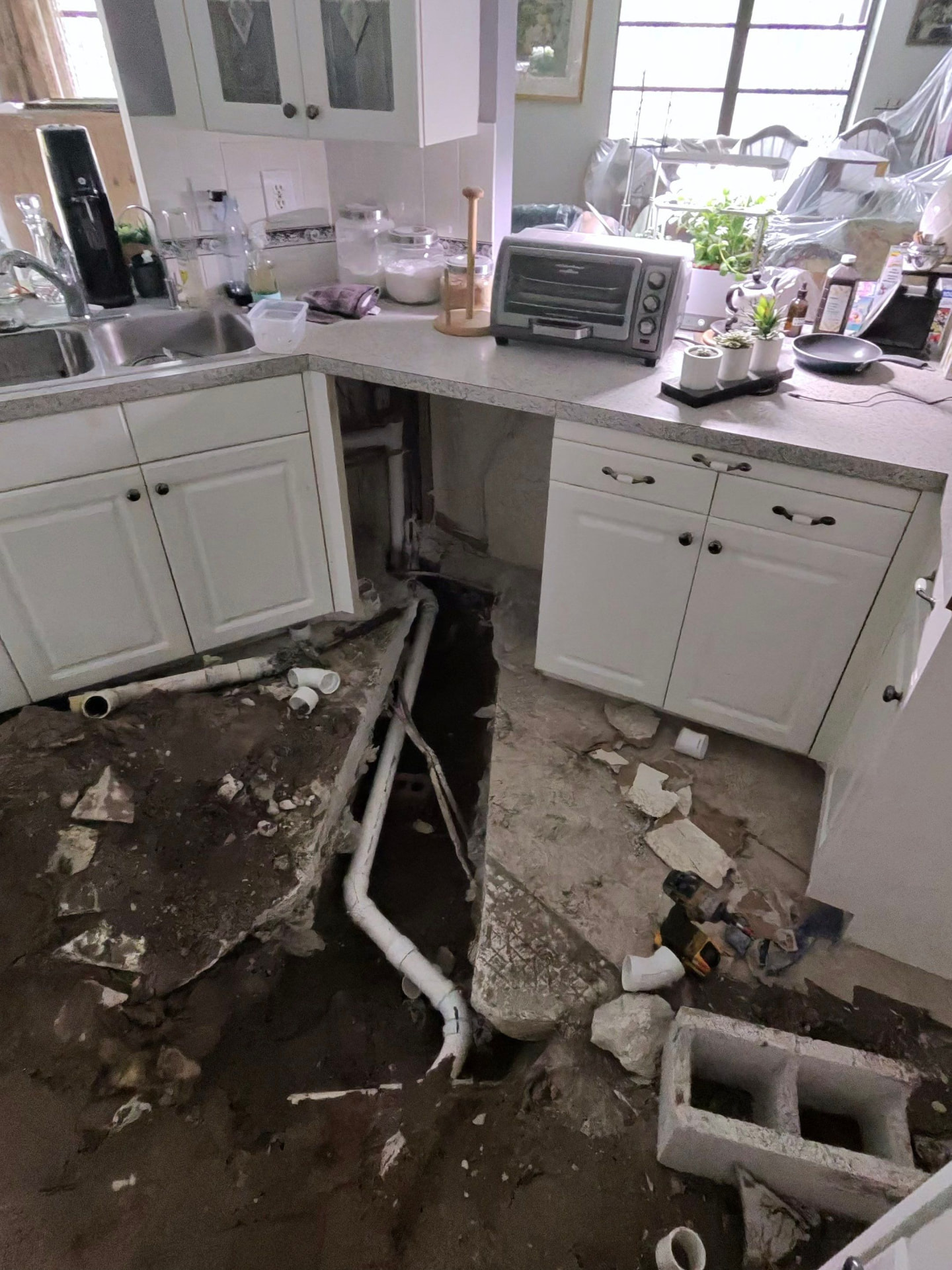
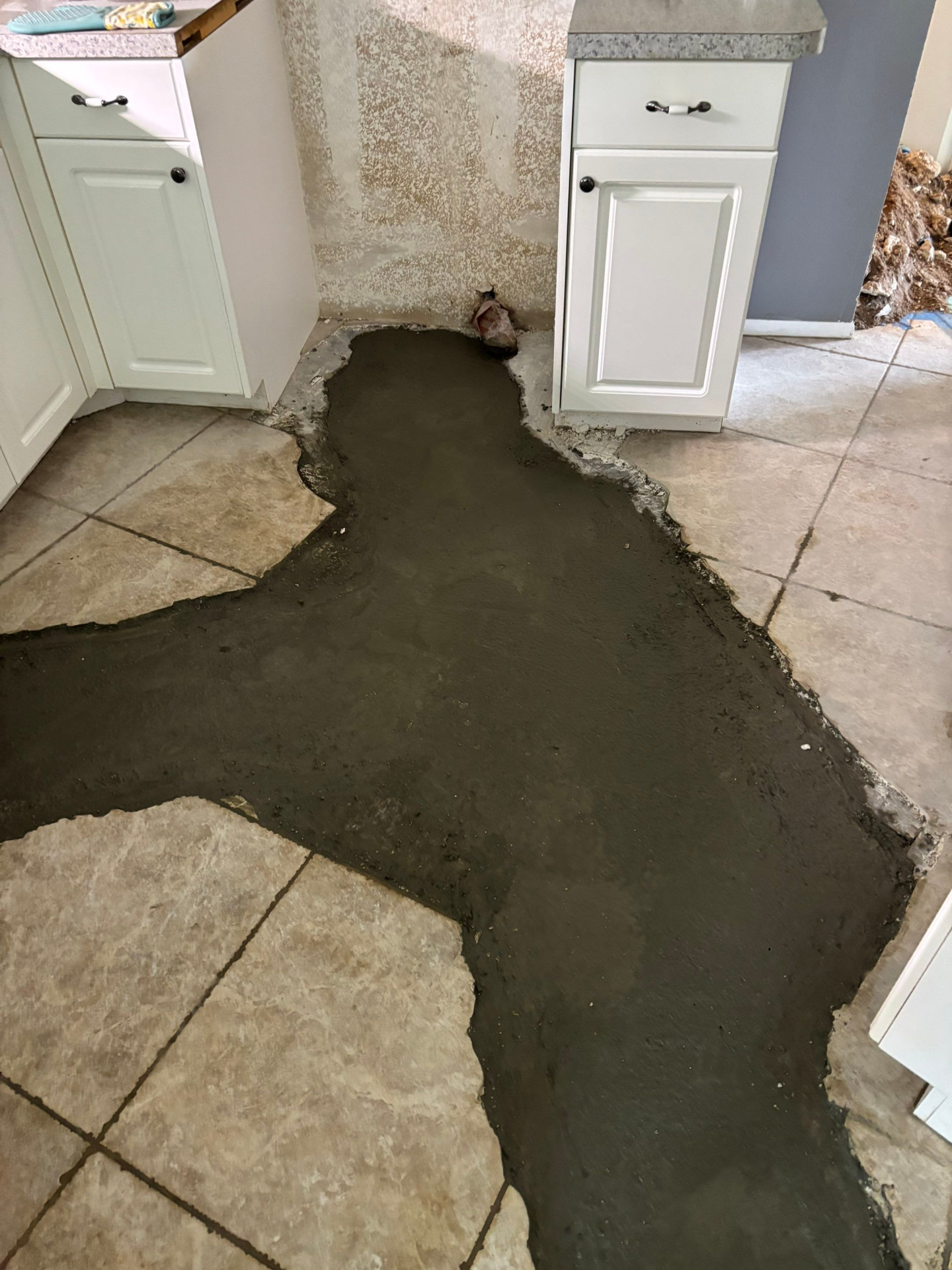
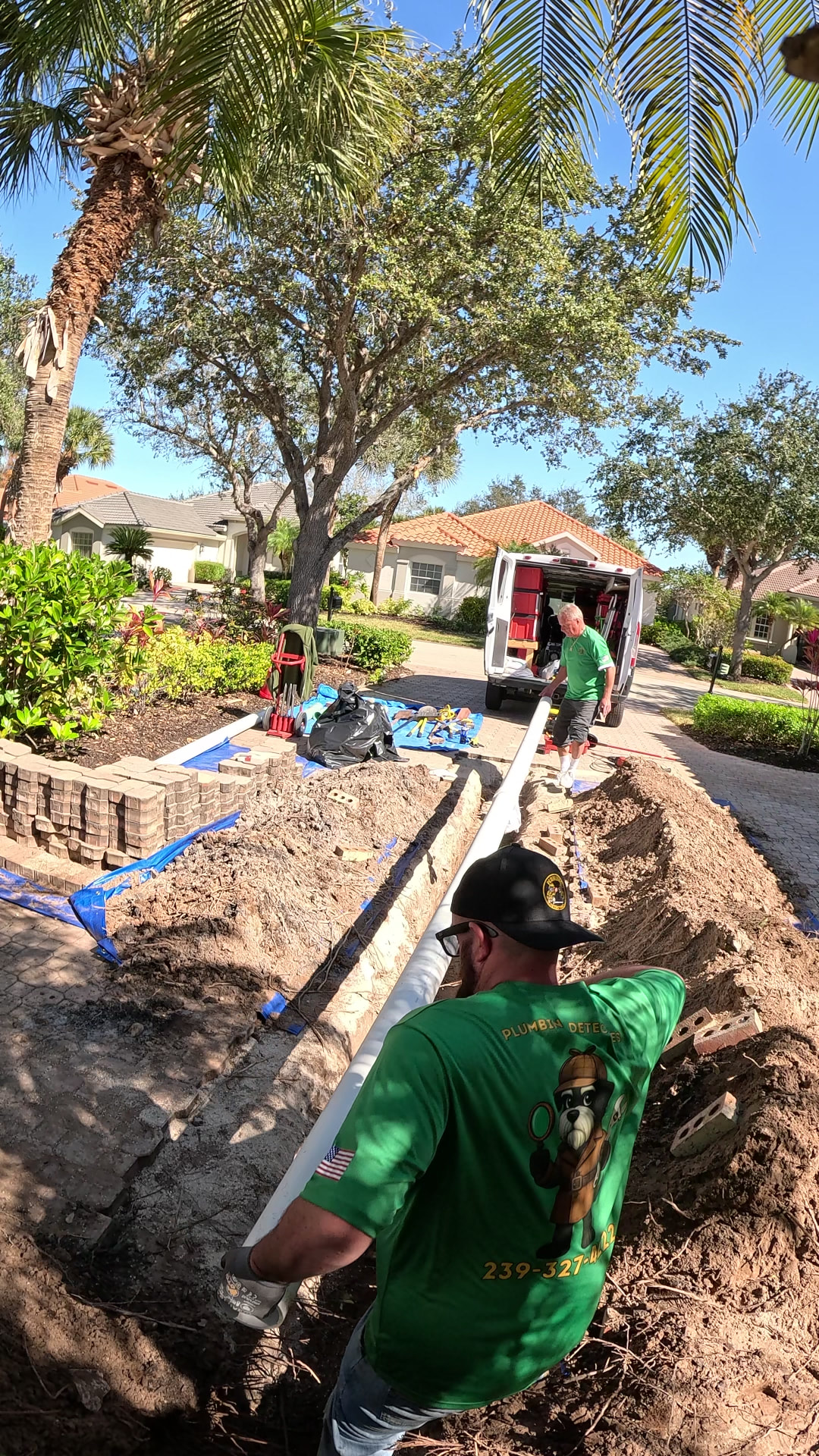
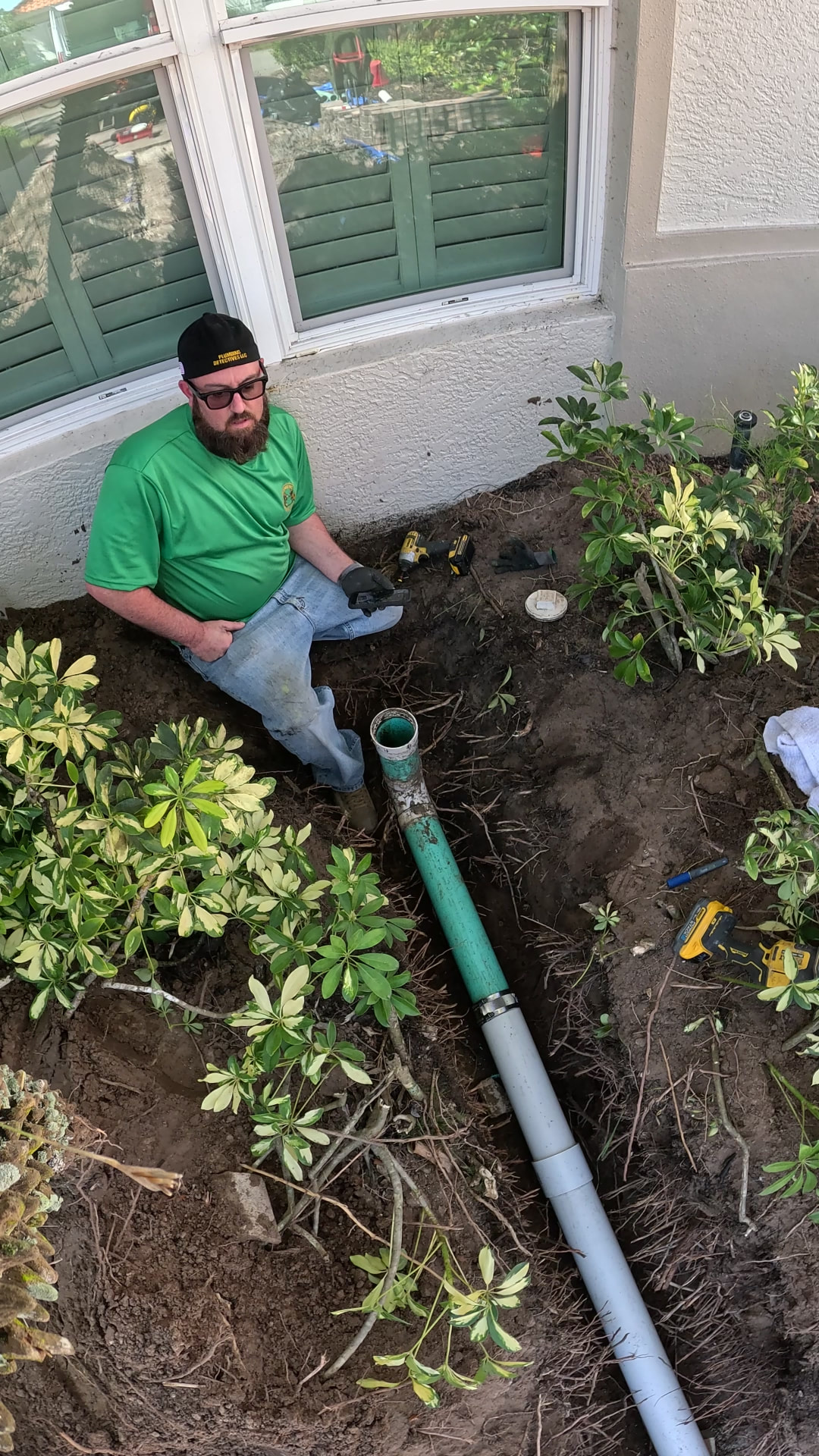
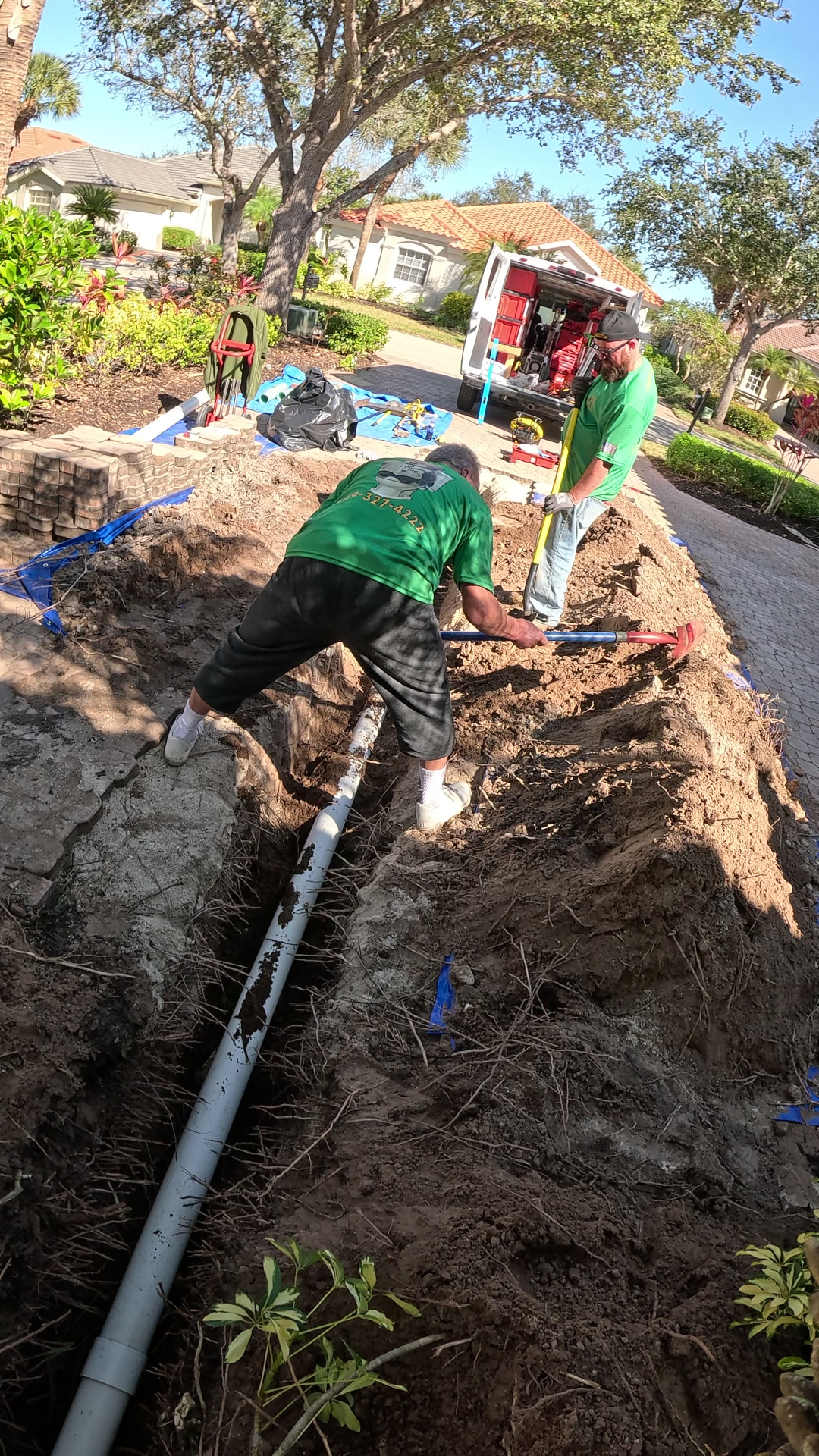
How the new pipe gets supported. Sarasota County’s soils, county-wide, are dominated by poorly-drained sand — roughly 92% of the county’s soil is rated “very limited” for structures with basements, and the barrier-island stretch that includes Casey Key runs sandier still, with a high water table on top of it. I tamp the native sand, add bedrock, and tamp again until firm — at least 8 to 9 inches of compacted base under the pipe wherever I have the height. Where I have room, I set cinder blocks to support the pipe. Where height is tight, I set two bricks in a V under the line every six feet. More bedrock, tamp, check pitch, continue the run — and only when pitch is verified along the entire length does backfill go in.
Cleanouts to code. Every replacement includes cleanouts where the Florida Plumbing Code requires them — at the junction of the building drain and building sewer, at the base of stacks, at horizontal runs over 100 feet, and at aggregate direction changes exceeding 135 degrees.
Permit and inspection. Nokomis is unincorporated Sarasota County with no building department of its own. All plumbing permits — including sewer lateral work and the pipe run between a house and an existing septic tank — route through Sarasota County Planning and Development Services, with utility connection permitting for taps into a county main handled separately through the Sarasota County Utilities Permitting Office. Installing or replacing the septic tank or drainfield itself runs through the Florida Department of Health’s Onsite Sewage Disposal program instead — a different office, and outside our scope. We verify jurisdiction and pull the correct permit before work begins on every job.
Gurgling toilet? Recurring backups? Not sure if you’re even on sewer or septic?
Call 239-388-3631. The camera comes first, you see everything I see, and you get a straight answer before anyone talks about opening a floor.
Nokomis Context
Repair Method Quick Reference — Nokomis Context
| Method | Best For | Not Appropriate When | Typical Regional Cost Range |
|---|---|---|---|
| Spot / Point Repair | One isolated failure in an otherwise sound line — a separated joint, a single crushed or rotted section, one root intrusion point | The camera shows failures at multiple points along the run; the "isolated" problem is actually a pattern | $800–$5,000 per national data; Florida sewer repairs average $3,430, most homeowners paying $980–$7,350 (CostWhale FL data) |
| Trenchless Relining (CIPP) | Structurally intact pipe with internal corrosion/scale that still holds its pitch | Bellies, sags, or sections out of pitch — common in this area's sandy soil. Florida code (FBC-P Section 717) requires pre- and post-lining camera surveys. | $8,000–$20,000 typical Southwest Florida range; roughly $80–$250 per linear foot |
| Pipe Bursting | Structurally failed pipe on a straight run where a new pipe can be pulled through the old path | Runs with offsets, material transitions, or collapse that would deflect the bursting head | Roughly $60–$200 per linear foot nationally |
| Excavation & Replacement | Collapsed, rotted, severely bellied, or heavily obstructed pipe — restored to new PVC at correct pitch with proper bedding and support | Rarely wrong when done correctly — the tradeoff is floor/yard access, which is why protection and documentation standards matter | $12,000–$30,000+ typical for full replacement; roughly $100–$300 per linear foot |
| Septic Line to Tank (Pipe Only) | A broken, blocked, or failed pipe between the house and an existing septic tank | Not applicable to the tank or drainfield itself — that is a licensed OSTDS septic contractor's scope | Priced the same as a sewer lateral repair — spot repair or replacement, camera-diagnosed |
| Septic Tank / Drainfield Installation | New systems or full drainfield replacement | This is not our scope — we don't install septic systems | Handled by a licensed OSTDS septic contractor |
All figures are typical published market ranges — not quotes for your home. Every Nokomis job starts with confirming whether you’re on sewer or septic, then a camera diagnosis, priced section by section, in writing, before any work begins.
The Pipe's Worst Nightmare
Roots, Soil, and the Casey Key Water Table
Roots are a pipe’s worst nightmare anywhere in this area — they grow with force, and they find the moisture escaping from an aging joint. On the camera, root intrusion looks like a curtain of fine hair at first, then a mat, then a mass that catches everything flowing past it. Sarasota County’s own tree ordinance protects live oak, sand live oak, myrtle oak, bluejack oak, and chapman oak county-wide, and older, established Nokomis neighborhoods — the platted areas near Old Trail and US-41, the mature landscaping around Calusa Lakes — have had decades for those root systems to reach exactly where they shouldn’t.
I’ll give you the same honest answer here I give every homeowner who asks if I can just cut the roots out again: I can, with a Spartan 300 machine running a claw head — and they’ll be back, because if roots are inside your pipe, your line is already compromised. Cutting is maintenance on a failing line, not a fix. At that point the real options are dig it out, replace the section, and cut the roots back substantially at the source — or attempt a reline, if and only if the camera confirms the pitch is still in order. This applies the same way whether roots have found a county sewer lateral or the pipe running to a septic tank.
The soil underneath all of it matters just as much. Sarasota County as a whole sits on poorly-drained sandy soil, and the Gulf-facing barrier islands — Casey Key specifically — run sandier still, with a high water table on top. That combination is exactly what shifts unsupported pipe out of pitch over time, and it’s exactly why a drainfield on Casey Key needs different design consideration than a septic system inland.
Why August Is Different From February
Rainy Season and Barrier Island Risk
From June through September, the water table across this whole area rises, and the ground gets soft — that’s when settling begins. Sand that held a poorly-supported pipe in place through the dry season loses its grip when it saturates. A line that was borderline in February can shift into a full belly or a separation in August. Saturated soil is also when groundwater starts infiltrating through failing joints, adding flow to a line that’s already struggling.
On Casey Key, rainy season carries an extra risk that inland Nokomis doesn’t have: septic drainfields sitting in sandy, high-water-table soil don’t drain as effectively when the water table itself rises to meet them, which is part of why septic performance on barrier islands is a different conversation than septic performance a few miles inland.
The smart move, wherever you are in Nokomis, is a camera inspection — sewer lateral or septic-tank pipe — before the heavy rains arrive, not after the backup happens during them.
Your Lateral, the County's Main, and the Septic Exception
Who Owns What — Your Lateral, the County’s Main, and the Septic Exception
If you’re on county sewer in Nokomis, the same rule applies here as everywhere else in unincorporated Sarasota County: you own your sewer lateral — the pipe running from your house to the connection with the county’s main — and you’re financially responsible for it, including any portion running under the sidewalk or right-of-way. The county owns and maintains only the main itself.
If you’re on septic — Casey Key or otherwise — there’s no county main on the wastewater side, but ownership still splits in a way worth understanding: you own and maintain the pipe running from your house to the tank (the part we handle), and the tank and drainfield themselves (installation and major repair, which is licensed OSTDS contractor work, not ours). Either way, it’s your system to maintain, and its overall permitting runs through the Florida Department of Health rather than Sarasota County Utilities.
Standard homeowners policies generally treat lateral failures from wear, corrosion, or root intrusion — and septic system failures — as maintenance issues, not covered perils. Sewer backup coverage, where it exists, is typically a separate endorsement. Ask your carrier what your policy actually covers before you need the answer.
Read This Before the Contract
Buying or Selling in Nokomis? Read This Before the Contract
Florida Statute 689.301 requires that before executing a contract for sale, a seller must disclose to a prospective purchaser any known defects in the property’s sanitary sewer lateral. I’m not a lawyer and this isn’t legal advice — but the statute exists, and a Nokomis seller who knows their lateral is failing has a legal disclosure obligation.
In Nokomis specifically, there’s a second layer that doesn’t come up in most of the neighborhoods I serve: the standard Florida Realtors Seller’s Property Disclosure form has a dedicated question asking whether the property has a sewer or septic system, and if septic, to describe the system’s location. On Casey Key and other septic pockets of Nokomis, that question isn’t a formality — it’s directly relevant, and it should be answered carefully.
The practical reality every Nokomis buyer should hear: a standard home inspection almost never includes a sewer camera inspection, and it doesn’t evaluate a septic drainfield’s actual condition either — at most it confirms the system exists. Given that a real share of Nokomis housing is now 45-plus years old, well past the roughly 30-year mark that triggers a 4-point inspection with most insurers, a pre-listing camera scope, or a septic evaluation where applicable, is cheap insurance before you put a Nokomis property on the market or close on one.
The Part You'll Never See
If I Could Redesign One Thing About Homes This Age
For the drain side of homes from this era — whether it’s a 1960s cast iron house or a late-1970s build — my answer doesn’t change from neighborhood to neighborhood: none of them were vented the way I’d vent them today.
Homes from this period were plumbed before modern wet venting was standard, and what I typically find instead is a bathroom group with one vent serving three fixtures. My preference, on the vast majority of the work I do, is the traditional approach: vent each fixture individually. Every fixture with its own air path gives you the best flow, the quietest drainage, and the most serviceable system. So when we’re replacing a section of a Nokomis home’s drain system anyway, the venting gets evaluated too — fixing the pipe under the slab while leaving three fixtures fighting over one vent is solving half the problem.
What I Find in Nokomis Sewer and Septic Work
Common Mistakes I Find in Nokomis Sewer and Septic Work
Assuming every Nokomis address is on sewer. It isn’t. Quoting sewer lateral work — or assuming septic work is off-limits — without first confirming which system the home actually has wastes everyone’s time.
Treating a septic-connected home as entirely someone else’s job. It isn’t. The pipe running to the tank is exactly the kind of work we camera and repair — only the tank and drainfield installation itself is outside our scope.
Unsupported pipe. When I camera a Nokomis line another company already “fixed” and find it bellying again, I’d bet money nobody supported it properly in this sandy soil.
No camera before the quote. A sewer proposal written from a drain-cleaning visit and a guess, in a community with this much age and system variation, is a guess twice over.
The disappearing video. Camera inspections where the homeowner never receives the footage. Documented video with a distance counter is accountability.
Lining over a belly. Selling CIPP on a line the camera shows is out of pitch. Lining doesn’t fix gravity.
Cutting roots as a business model. Coming back every year to cut the same roots out of the same compromised joint, without telling the homeowner the line itself is the problem.
Ignoring the drainfield until it fails. On septic-served Nokomis properties, treating a slow drain or a soggy yard as “wait and see” instead of getting the system evaluated before a full failure.
No permit. Concealed drain pipe replaced without the correct Sarasota County or Florida DOH permit and inspection — an easy mistake in a community with two separate permitting paths depending on which system you’re on.
Plumbing Detectives LLC Tips
Before you call anyone about a Nokomis sewer problem, check your last water/utility bill or ask your title company whether your address is on county sewer or septic. It changes the diagnosis, not whether we can help.
Find your main cleanout — usually a capped pipe at grade near the house or along the lateral path — and confirm the cap is present and sealed. Many older Nokomis homes don’t have proper cleanouts.
If you’re on Casey Key or near it and haven’t had your septic system inspected in the past few years, do it before the June rains — a rising water table is exactly when a marginal drainfield struggles.
Before you sign any sewer repair or lining proposal in Nokomis, ask for the recorded camera footage with the distance counter visible, and confirm they’ve verified your system type first.
What the 2024 Season Did
Storm Context — What 2024 Did to Nokomis’ Sewer Picture
I want to be straight about this section: it’s grounded in documented reporting and county records, not my personal storm-repair work in every affected home. Nokomis, and Casey Key in particular, took a harder direct hit in 2024 than most of the communities I serve. The National Hurricane Center’s official report on Hurricane Milton documented 6 to 9 feet of storm surge, with an isolated peak near 10 feet, from Venice south to Boca Grande — a zone that includes Nokomis and Casey Key directly. One national news report on Milton specifically described video of floodwater climbing the stairway of a home in Nokomis.
Casey Key took the worst of it. A follow-up report in early 2025 documented multiple Casey Key homes torn down after the combined damage from Hurricanes Helene and Milton, including the island’s oldest house, built in 1918, which lost half its roof and was demolished. Local businesses on the key had to fully replace equipment and closed for weeks. That same report named the FEMA 50% substantial-improvement rule as a direct, active obstacle for Casey Key homeowners trying to rebuild — with a local realtor quoted saying it makes some properties unfeasible to repair. The two bridges connecting Casey Key to the mainland, Blackburn Point and Albee Road, were both closed during the storm itself.
On the wastewater side specifically: Hurricane Debby in August 2024 dumped enough rain to overwhelm the sewer collection system, triggering a water-quality advisory for Nokomis Beach and North Jetty Beach due to bacterial contamination. A second advisory for North Jetty Beach followed in October 2024, in the direct aftermath of Milton-related sewage spills, for elevated bacteria levels.
Two practical takeaways if this is your Nokomis home. First, if you’re on a sewer lateral or a septic system that took on any backup or unusual drainage behavior during or after these storms, and it hasn’t been inspected since, that’s worth doing now rather than waiting for the next season. Second, if you’re rebuilding or renovating a storm-damaged property — Casey Key especially — understand that any plumbing work bundled into that permit counts toward the cumulative repair-cost total used in FEMA’s 50% calculation. That’s not a reason to skip a needed repair, but it is a reason to talk to your permit office before you assume the scope of work.
The Differentiator
Why Plumbing Detectives LLC
I named the company Plumbing Detectives LLC because the work starts with figuring out what’s actually wrong — and in a community as mixed as Nokomis, that diagnostic step isn’t optional, it’s the whole job. Before pipe material, before repair method, before price, the first question is which system you even have. Get that wrong and nothing after it matters.
Camera first. Documented findings. Section-by-section honesty. White glove protection of your home. Proper bedding you’ll never see but will never have to think about again. And if you’re on septic, we still run the camera and fix the pipe between your house and the tank — we just don’t install septic systems themselves, and we’ll tell you plainly if a job crosses into that territory.
License CFC1434139. Fully insured. We pull permits through Sarasota County Planning and Development Services for sewer and septic-line work. Emergency sewer service available in Nokomis and nearby areas — call for priority scheduling. I’m five minutes up the road in Venice Gardens, and I hold Nokomis jobs to the same standard I hold my own street to.
Answers
Frequently Asked Questions — Sewer Line Repair in Nokomis, FL
If you’ve read this far, you understand why Nokomis doesn’t get a one-size-fits-all answer the way some neighborhoods do — it’s a community split between county sewer and Casey Key septic, with housing spanning five-plus decades of construction. You know why the camera has to answer the pipe-material question instead of the deed, why we work the pipe all the way to a septic tank without touching the tank itself, and what proper diagnosis actually looks like before anyone touches your floor or your yard. If your Nokomis home is showing any of the signs on this page, or you’re simply not sure which system you’re even on, call me at 239-388-3631. The camera goes in first, you see everything I see, and you get the truth before you get a price.
Plumbing Detectives LLC | Venice, FL | License CFC1434139
239-388-3631 | plumbingdetectivesfl.com