
Slab Leak Detection · Lakewood Ranch, FL
Slab Leak Detection in Lakewood Ranch, FL
Thermal imaging, line tracing, and acoustic pinpointing before anyone opens concrete. Licensed master plumber CFC1434139. BBB Accredited.
Call Now239-388-3631The Bottom Line: Thermal Leak Detection & Diagnostic in Lakewood Ranch — $295. With the full Documentation Package for your insurance file — $375. In the 1995–2010 villages, a warm spot on the tile can be an under-slab copper pinhole, a CPVC line under the slab, or a CPVC fitting in the wall draining down a penetration — and those are three different jobs. This page is how I tell them apart before anyone touches your floor, and what your insurance policy actually says about paying for it.
A homeowner in a 1998 Lakewood Ranch house with a warm spot on the tile has a problem nobody on the first page of Google is willing to name: they don’t know what pipe they’re looking at. Under that slab is a hot line that may be copper or may be CPVC, depending on who built the house and in what year. Inside the walls above it is almost certainly CPVC. Those two materials fail in completely different ways, on completely different timelines, and one of them can leak at a fitting in the wall and run down a slab penetration until it looks exactly like a slab leak. Guess wrong, and somebody jackhammers a floor for a leak that was never under it.
I’m Mike Reynolds, owner of Plumbing Detectives LLC, a licensed master plumber — CFC1434139. A few Saturdays ago I did an estimate on a 3,100-square-foot Lakewood Ranch home that had already had three of these: three hot-side leaks under the slab, three holes in the floor, three spot repairs by three different people. Nobody had ever answered the question of why, or what the fourth one was going to cost. This page is how I answer it — with a pressure test, a thermal camera, a line tracer, and a geophone, in that order, before anyone touches concrete.
The Housing Stock
Why Lakewood Ranch Slabs Are Leaking Now
The first villages — Summerfield in 1995, Edgewater in 1996, Riverwalk in 1999, Greenbrook in 2000, the early Country Club streets — are 26 to 31 years old. Roughly 6,500 homes went in during the window when Florida production builders ran CPVC through the walls and attic and, under the slab, either copper or CPVC depending on the builder and the year. I’ve opened both in these villages.
If it’s copper under your slab: every source that publishes a number puts under-slab copper pinhole failures in a 20-to-40-year window, with Florida contractors citing 20 to 25 years as the realistic service life here. Lakewood Ranch’s original copper is squarely inside that window right now.
If it’s CPVC under your slab: it’s the same material failing in the walls of these villages for the same reasons — two decades of hot water, stress at every glued fitting, and a slab that holds heat like an oven all summer. On the Saturday estimate, all three leaks were CPVC, hot side, under the floor. Whole-House Repiping Lakewood Ranch covers why that pipe is brittle; this page covers how I find where it’s leaking.
Either way, the hot line goes first. Scale precipitates faster as water gets hotter, fittings on the hot side cycle through more expansion and contraction, and every under-slab hot line in these villages has been carrying 120-degree water for a quarter century. When I get a slab leak call in Lakewood Ranch, I assume hot side until the pressure test tells me otherwise — and it almost never does.
The Water
What Manatee County Water Does — and Doesn’t Do — to Under-Slab Pipe
You’ll read on other pages that “the water is eating your pipes.” Let me be more careful than that, because the county publishes its numbers and you can check them.
Manatee County water runs a pH of 7.2 to 7.5 — not acidic. Copper measured at the tap is 0.18 ppm against a 1.3 ppm action level — nowhere near a problem. The water is chloraminated at a 3.3 ppm annual average, and the 2025 hardness ranged from 106 to 279 mg/L, or 6.2 to 16.3 grains per gallon. So the honest version is this: Manatee County water is not corrosive by the county’s own measures. What it is, is hard and chloraminated, and those two things matter to a 27-year-old pipe in specific, documented ways:
Scale is not inert. Calcium carbonate deposits inside copper create oxygen-starved pockets under the scale where the covered metal turns anodic and pits; scale traps chlorides against the tube wall; it narrows the bore and raises velocity at elbows and tees, which erodes them; and it harbors bacteria. Scale forms fastest in hot-water service — which is why the hot line is where the pinholes are.
Chloramine is consumed by copper. Lab work on this is clear: both free chlorine and chloramine decay almost completely overnight inside a copper pipe, and the reaction doesn’t slow down with age. The oxidant residual is part of the pit-growth engine, not a bystander. It’s one contributing factor — not the cause, and I won’t tell you it is.
Workmanship and stagnation are co-causes. The most thorough municipal pinhole investigation ever published found excess solder flux from the original installer, not bad water, behind a cluster of failures — and that low-use, stagnant branches pit worse. A guest bath that runs twice a year is a candidate.
Fittings before straight runs. Elbows, tees, and solder joints see turbulence and corrode first. When the pinhole shows up in a straight run, the pipe has reached the end of its life, not hit a local defect. Where the leak is tells me whether you have a repair or a system.
What I won’t put on this page: clay-soil electrolysis stories from Texas and Arizona (Lakewood Ranch sits on sand), or a claim that hard water destroys pipe “three times faster” (a marketing number with no methodology behind it). The sand actually helps me — more on that below.
The Signs
How to Tell You Have One — and Why You Might Not
A water bill that jumped with no explanation. The single most reliable sign. A 20-to-30-percent unexplained increase is a same-week call.
A warm spot on the floor. Hot-side slab leak until proven otherwise. Tile with no floor heat shouldn’t be warm.
Running water you can hear with everything off. Stand in the quietest room and listen.
The water heater running more than it used to. It’s reheating water that went into the ground.
The meter test you can do yourself. Turn every fixture off, go watch the meter. If the low-flow indicator moves, water is leaving the house somewhere. That proves loss; it doesn’t say where.
Later signs: damp or lifting flooring, a mildew smell, low pressure, hairline cracks, doors that stick.
And the honest part: in a well-built slab with an intact vapor barrier, water can migrate for months before a single surface symptom appears. Symptoms are a lagging indicator. In Florida’s humidity, mold can start within 24 to 48 hours of water reaching a wall base. So if the bill jumped and the floor looks fine, don’t wait for the floor.
The Method
How I Actually Find It — Trace, Then Percolate, Then Listen
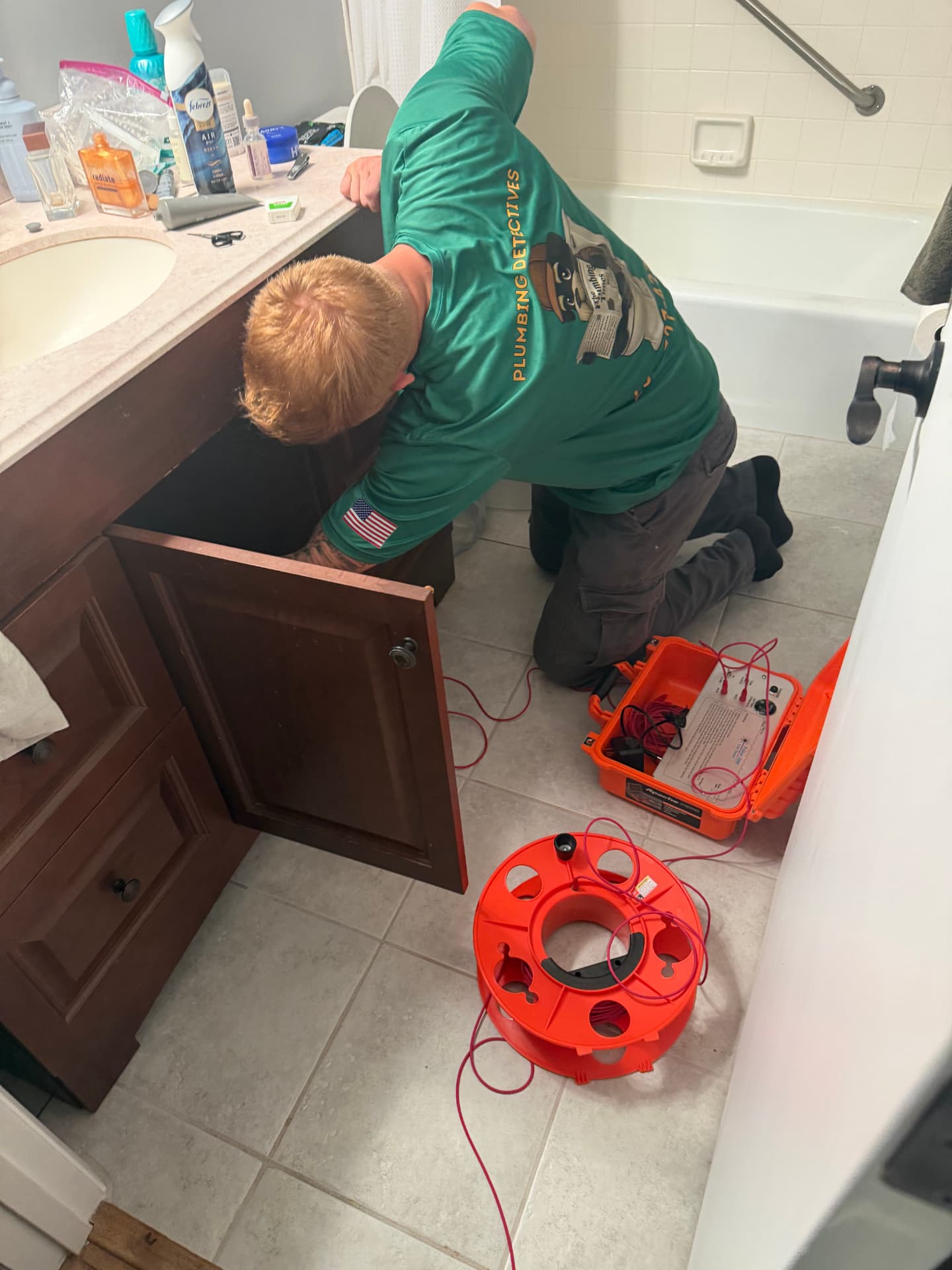
First, the pressure test answers the question that matters most. I isolate the hot line and the cold line from each other and pressure-decay test each one for 15 to 30 minutes. If the cold line holds and the hot line drops, you have a hot-side leak. If both hold and the moisture is at a wall base, you’re probably looking at a CPVC fitting above the slab draining down a penetration, and the floor never needs to be opened. This ten-minute step is what separates a diagnosis from a guess, and it’s the step that gets skipped when someone shows up with a listening device and starts walking the floor.
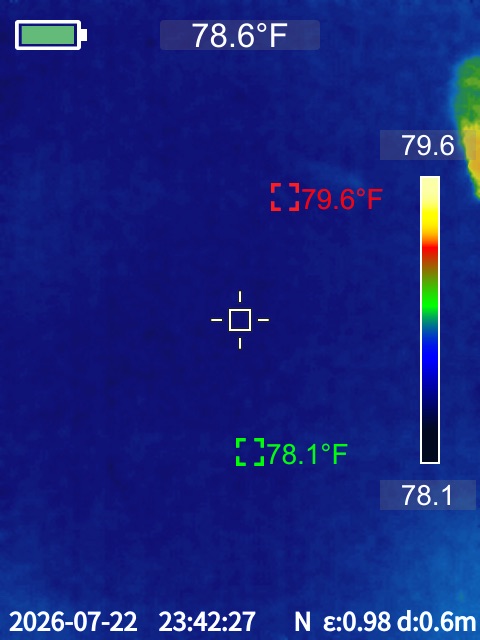
Then the thermal camera — and here’s what it can and can’t do. An infrared camera doesn’t see water. It sees the temperature difference water creates at the surface. A hot line leaking under a slab makes its own contrast: a warm plume that images clearly. A cold line leaking in a Lakewood Ranch house in August — where the slab, the room, and the incoming water are all sitting within a few degrees of each other — may image faintly or not at all, depending on depth and flooring. Thermal imaging needs contrast, not a fixed number, and I’m not going to sell it to you as the whole answer. It’s the tool that tells me the neighborhood. I use a Mileseey TR20 for this because the sensitivity is right for moisture work, and I confirm every anomaly with a moisture meter — a thermal pattern is a hypothesis until the meter says it’s water.
Then I trace the line. The Pulsar 2000 puts a signal on the pipe and lets me mark the actual corridor the line runs in — not where the plans say it runs, where it runs. In a production-built house, those aren’t always the same. Listening to a floor without knowing where the pipe is under it is how holes get cut in the wrong place.
Then I percolate the leak. With the line isolated and drained, I put compressed air on it. Air escaping through a pinhole into wet ground makes a distinct, louder sound than water does — it turns a whisper into something the geophone can lock onto.
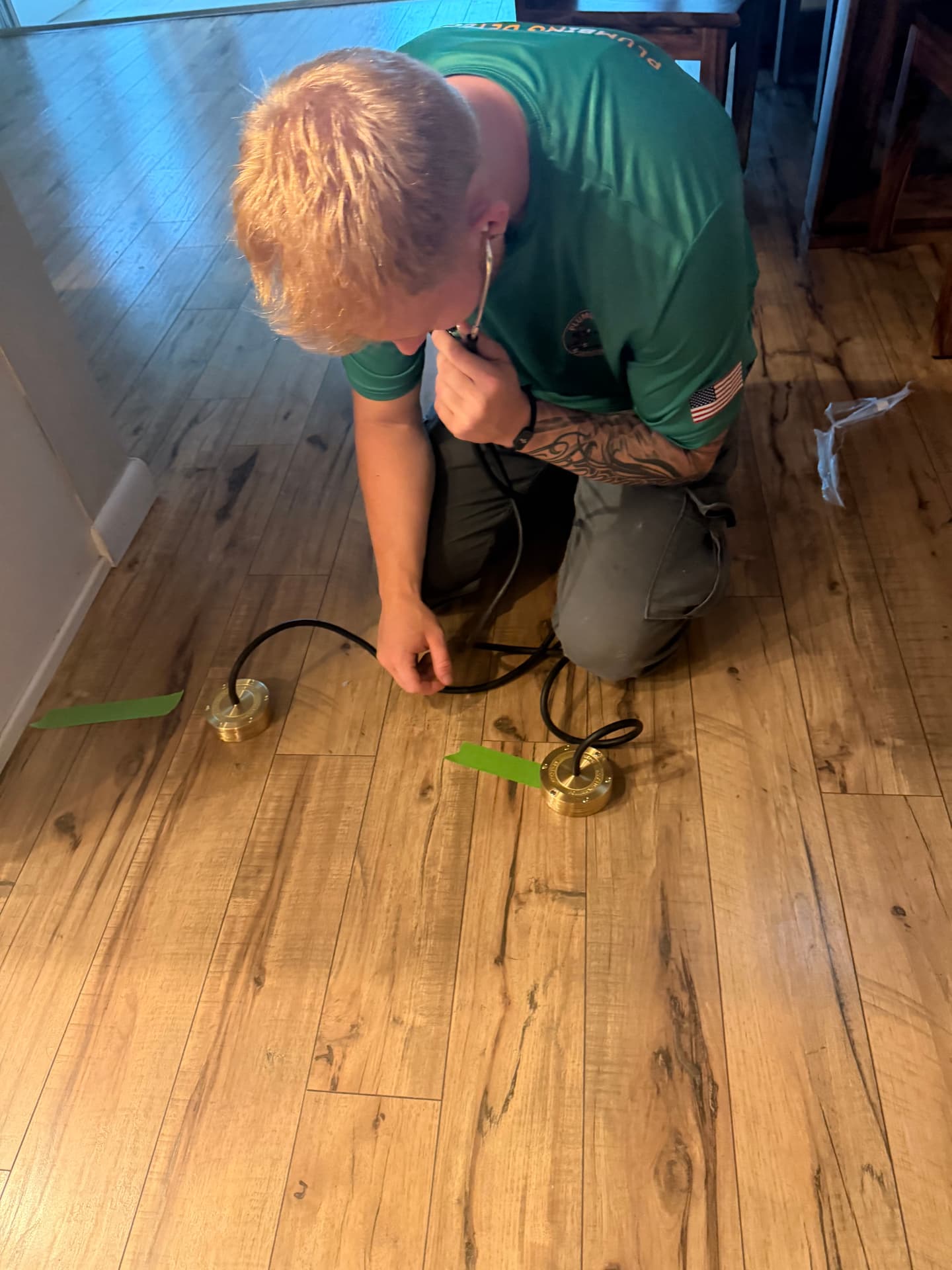
Then I listen. A geophone on the slab, walked along the marked corridor, amplifies the disturbance. The leak is where it peaks. Here’s where Lakewood Ranch does me a favor: sandy soil transmits acoustic energy far better than clay, which absorbs it. The same leak that’s a guess in Houston is a clean signal here.
One cut, not a search pattern. Thermal and acoustic have to agree on the same spot before I mark the slab. Two technologies confirming one location is the standard; one technology and a hunch is how floors get opened twice.
The Process
Step by Step — What Happens When the Leak Is Found
Phone triage. Warm spot, running-water sound, bill change — I decide with you whether a visit is warranted.
Meter check and material ID. Confirm supply-side loss, and read the pipe: copper or CPVC under the slab, CPVC or PEX above it.
Hot/cold isolation and pressure-decay test. Which line is losing water, before any locating equipment comes off the truck.
Thermal scan, moisture-meter confirmation. Every suspect floor, wall base, and ceiling.
Line trace, air percolation, geophone. Mark the corridor, make the leak audible, pinpoint it.
Mark and document. The slab gets marked. You get a written finding.
The decision. Spot repair, reroute, or repipe — with the reasoning, not just the price. The floor is only opened, if at all, after all of that.
The Decision
Spot Repair, Reroute, or Repipe — the Actual Criteria
Nobody in this market publishes when to do which. Here’s mine.
Spot repair — open the slab over the marked leak, cut out the section, splice, test, patch. Right when it’s a first leak, the failure is at a fitting or elbow, the pipe is under about 15 years old, and the spot is reachable without demolishing a kitchen island. One day of plumbing, one to three more for flooring. The risk you need to hear: pinhole corrosion attacks the whole interior of a line roughly evenly, so a first pinhole is commonly followed by more on the same run within months to a few years. Three spot repairs at a few thousand dollars each is the same money as retiring the pipe.
Reroute — cap and abandon the under-slab line, run new PEX-A overhead through the attic and down the wall to the fixture. Right when the leak is on old pipe, when it’s under expensive tile or a built-in, when the slab is post-tensioned, or when the homeowner wants the slab out of the equation permanently. In a 26-to-31-year-old Lakewood Ranch home, this usually wins over spot repair: the failure driver is age plus water acting on the whole line, not a one-off defect. Spot repair fixes the hole; reroute retires the pipe. And done right, a slab leak repair does not mean a jackhammer.
Repipe — every supply line, overhead, in one mobilization. Right when there have been two or more pinholes already, when the copper is original and pre-1995, when leaks are showing up in straight runs, when there have been three or more in six months, or when the reroute quote is approaching the repipe number anyway. The Saturday estimate was this case exactly: three hot-side slab leaks, brittle CPVC in the walls, a house that was going to keep producing holes in the floor. One permit, one crew, one restoration cycle, and the slab never gets opened again. Whole-House Repiping Lakewood Ranch
The order of operations is the whole point: detect first, decide second. The detection visit is what determines which of those three you’re actually buying.
Plumbing Detectives LLC Professional Opinion
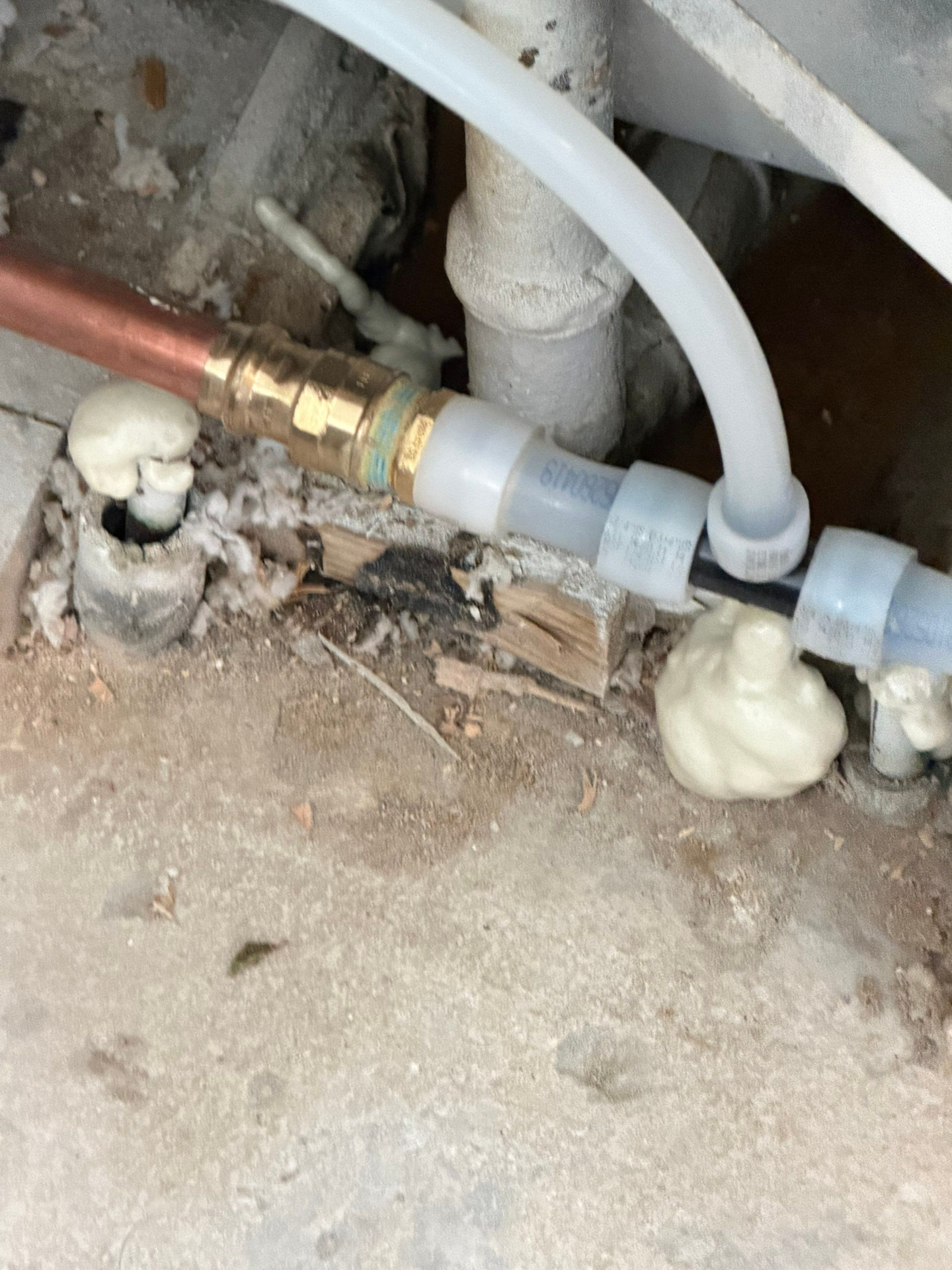
If someone quotes you a slab repair in a 1990s Lakewood Ranch home without pressure-testing the hot and cold lines separately, ask how they know the leak is under the floor. In these villages, a CPVC fitting cracked in the wall above the slab can run water down a penetration and show up as a wet floor, and the only way to tell the difference is the test. I’ve seen floors opened for leaks that were eighteen inches up a wall. The test takes fifteen minutes. The wrong hole takes a week.
Insurance
What Your Policy Actually Pays For — In Its Own Words
This is the longest section on the page because it’s the one nobody else in Lakewood Ranch writes, and it’s general information, not claims advice — I’m a licensed plumber, not a public adjuster or an attorney. What follows is from the certified Citizens homeowner policy on file with the Florida courts; other carriers’ forms differ, so read yours.
The split: tear-out is covered, the pipe is not. Citizens’ form covers “the cost to tear out and repair only that part or portion of a building … necessary to access the system” — the concrete cut, the flooring removed — subject to a $10,000 limit. And then, in the same section: “In no event will we pay for the repair or the replacement of the system or appliance that caused the covered loss.” The hole in your floor can be covered. The new piece of pipe is yours. That distinction is the most useful sentence on this page.
“Sudden and accidental” versus gradual — where claims are won and lost. Florida policies cover a sudden, accidental discharge of water. They exclude water that leaks “constantly or repeatedly over a period of time.” Adjusters build the gradual argument by pointing at aged staining or mold and concluding it’s been leaking for months. A slab leak detected within days of the first sign — the bill spike, the warm spot — is more likely treated as sudden. One that sat for months behind visible mold is more likely treated as gradual.
The carve-out that matters for slab leaks specifically. Citizens’ seepage exclusion has a clause in it that most homeowners never read: the exclusion does not apply where the seepage “and the resulting damage is unknown to all ‘insureds’ and is hidden within the walls or ceilings or beneath the floors,” subject to the $10,000 limit. A slab leak is, almost by definition, hidden beneath the floors and unknown to you. That language preserves a path to coverage for exactly this scenario — provided you didn’t know about it. You’ll see “14 days” cited on other websites as the seepage trigger; some Florida policies use that language, but the certified Citizens form uses “weeks, months or years” plus this hidden-and-unknown carve-out. Read your own policy.
Mold has its own cap. Citizens pays up to $10,000 total for loss caused by fungi, the cost to remove it, the tear-out to reach it, and testing to confirm it — and testing only where there’s reason to believe mold is present. Under Florida law, mold assessment and remediation for growth over 10 square feet are separately licensed professions. I don’t do mold assessment. What I do is find the leak, stop the source, and document it — which is what makes a mold assessment scope-able if you need one.
Don’t wait for the adjuster to call a plumber — but don’t do permanent repairs before the adjuster sees it. Those are two different rules and people confuse them. Citizens’ Managed Repair Program requires a Citizens adjuster to inspect and determine cause before permanent repairs. It also offers free Emergency Water Removal — dry-out with no deductible, and you’re not billed even if the loss is later denied. If you bring your own mitigation contractor instead, you’re capped at $3,000, and that $3,000 comes out of the $10,000 sublimit. What every credible source agrees on: get the leak located and documented independently, immediately, then report the claim, then let the adjuster inspect, then do the permanent repair. Detection isn’t just a plumbing step. It’s the timestamp on your claim.
What the law says the carrier owes you (Florida Statute 627.70131): acknowledge your claim within 7 days, begin investigating within 7 days of proof of loss, physically inspect within 30 days, send you a copy of any estimate within 7 days of writing it, and pay or deny within 60 days of notice with a written explanation. The adjuster has to give you their name and license number in writing at the inspection.
The documentation that wins these: a professional leak-detection report, thermal imagery and moisture mapping, a timeline of discovery, the plumber’s written diagnosis, photos before and during repair, and repair invoices. That is exactly what my Documentation Package is — thermal image set, inspection video, photo documentation, and the written finding, delivered to your Google Drive within 24 to 48 hours, built for an insurance file.
Plumbing Detectives LLC Tips
Bill jumped? Do the meter test tonight — everything off, watch the dial. Movement means loss. Then shut the main and photograph anything wet before you mop it.
A warm tile with no floor heat is a hot-side slab leak until the pressure test says otherwise.
Ask any leak-detection quote one question: “Did you isolate hot and cold and pressure-test each line?” If the answer is no, nobody knows the leak is under the floor yet.
Report the claim the day you confirm the leak. In Florida, the discovery date is the claim.
Pricing
What It Costs — Published, In a Market Where Almost Nobody Publishes
Thermal Leak Detection & Diagnostic: $295. Pressure-decay test on isolated hot and cold lines, full thermal scan with moisture-meter confirmation, line trace, air percolation, geophone pinpointing, a marked slab, and a written finding with a recommendation.
With the Documentation Package: $375. Everything above plus the thermal image set, inspection video, and photo documentation, delivered to your Google Drive within 24 to 48 hours — the file an adjuster asks for.
No local competitor publishes a slab leak detection price. Nationally, a bare acoustic scan runs $150 to $300 and a full thermal-plus-acoustic-plus-tracing diagnostic runs $300 to $650. Mine sits in that band because it’s the full sequence, not a listening stick.
Repairs are quoted after the diagnostic, because the diagnostic is what decides which repair you need. For context, the same numbers I publish everywhere: a single-story PEX-A repipe runs $4,500 to $9,500 and a two-story $7,500 to $14,500, with patch and texture in and paint out. A single-line reroute is less. A spot repair with flooring restoration is often not.
Why Us
Why Plumbing Detectives LLC
Every leak-detection page in this market claims non-invasive precision and names either no equipment at all or a camera it never explains. We’re a licensed master plumber — CFC1434139, BBB accredited — who pressure-tests before locating, tells you plainly that a cold line in August may not image, runs the full trace-percolate-listen sequence, marks one spot two technologies agree on, and hands you a documentation package written for your claim file. And because we’re the plumber, not just the detector, the reroute or repipe that follows is the same phone number, permitted through Manatee County’s own office in Lakewood Ranch. Whole-House Repiping Lakewood Ranch · Water Heater Installation Lakewood Ranch · Water Softener Lakewood Ranch · Emergency Plumber Venice. Fully insured.
Answers
Frequently Asked Questions — Slab Leaks in Lakewood Ranch, FL
A slab leak in a 1990s Lakewood Ranch home is three questions, not one: which pipe, which side, and is this the first hole or the third. The pressure test, the thermal camera, the tracer, and the geophone answer all three before anybody touches your floor — and the written finding is what your insurance file needs on day one. Call 239-388-3631. If the leak’s in the wall and not under the slab, I’ll be the one who tells you.
Plumbing Detectives LLC | Venice, FL | License CFC1434139 | BBB Accredited
239-388-3631 | plumbingdetectivesfl.com
Serving Lakewood Ranch, Bradenton, Sarasota, Venice, Venice Gardens, Nokomis, Laurel, Englewood, Wellen Park, and Bradenton Beach.