
Water Heater Installation · Lakewood Ranch, FL
Water Heater Installation in Lakewood Ranch, FL
Gas villages, electric villages, the $700 Peoples Gas tankless rebate, and Manatee’s permit rule — sized by code, not square footage. Licensed master plumber CFC1434139 · BBB Accredited.
Call Now239-388-3631Lakewood Ranch is the one market on the Suncoast where “what kind of water heater should I get” has two completely different answers depending on which side of a street you live on. The villages built in the late 1990s and early 2000s are mostly all-electric — a 50-gallon tank in the garage, on its second or third replacement by now. The villages built since about 2015 were marketed as natural gas communities, and the newest ones ship with a gas tankless unit as standard. Same community, two different fuels, two different sets of rebates, two different permit rules, and one water supply hard enough to shorten the life of every one of them.
I’m Mike Reynolds, owner of Plumbing Detectives LLC, a licensed master plumber — CFC1434139. This page is written for all three Lakewood Ranch homeowners: the one replacing an electric tank, the one with a gas tank wondering about tankless, and the one whose builder-installed tankless just threw an error code. It covers what nobody else’s page does — the Peoples Gas rebate you’re probably eligible for, the federal credit that no longer exists, Manatee County’s exact permit rule, how Florida actually sizes a water heater, and why Lakewood Ranch water kills them early.
Fuel
Gas Village or Electric Village? Start Here.
Lakewood Ranch is named by name as a served community in Peoples Gas’s state tariff, and several villages are documented gas communities — Country Club East, Cresswind, Esplanade at Azario, Emerald Landing and Bungalow Walk at Waterside, Wild Blue, Lorraine Lakes. The older production villages — Summerfield, Greenbrook, Riverwalk, the early Country Club streets — are predominantly electric, because they were built before the gas mains were.
No public map shows which streets have a main, so I don’t guess. If you’re not sure which you are, the first step of every estimate is a call to Peoples Gas at (877) 832-6747 with your address. That call decides everything below:
- You have gas: your best options are a gas tank or a gas tankless, and there’s utility rebate money on the table for either.
- You’re electric with no main: your best options are an electric tank sized correctly, a heat pump water heater (which is usually the better answer in a Lakewood Ranch garage), or propane tankless if you want gas performance without a main.
- Your electric bill says FPL or Peace River Electric: Lakewood Ranch is split between two electric utilities, and the rebate answer differs by meter. Neither currently publishes a heat pump water heater rebate I’d put in writing.
Rebates
The Rebate Nobody in Lakewood Ranch Is Telling You About
Peoples Gas runs a water heating rebate program for its customers, and Lakewood Ranch is in its territory. The current schedule:
- $700 — tankless gas water heater replacing an electric water heater
- $650 — ENERGY STAR gas tank replacing electric
- $550 — standard gas tank replacing electric
- $550 — tankless replacing an existing gas water heater
- $400 — ENERGY STAR gas tank replacing a gas tank
- $350 — standard gas tank replacing a gas tank
The fine print, because it’s the part that gets people denied: you have to be an active Peoples Gas customer (or the landlord of a Peoples Gas–served rental); a tankless unit has to deliver at least 5 gallons per minute — every unit I install clears that easily; the rebate can’t exceed the total installed cost including piping and venting; you have 12 months from the install date to file; used or refurbished equipment doesn’t qualify; and the invoice has to say “Paid in Full.” I hand you the paperwork with the invoice.
Propane installs don’t qualify — it’s a natural gas program. And from the county, there’s nothing: Manatee County Utilities’ rebates are for toilets and irrigation only. If you searched “Manatee County water heater rebate” and found nothing, that’s why.
The federal credit is gone. The 25C Energy Efficient Home Improvement Credit — the “30% up to $2,000” for heat pump water heaters that every national article still quotes — expired for equipment placed in service after December 31, 2025. It does not apply to a 2026 install. Florida has no state income tax, so there’s no state credit to replace it, and the state’s ENERGY STAR sales tax holiday that once covered water heaters ended in 2024. Any contractor or website still promising you the federal credit is either out of date or hoping you don’t check. Florida’s income-tiered electrification rebate program wasn’t open as of this writing; when it is, I’ll update this page.
Sizing
How Florida Actually Sizes a Water Heater — Not by Square Footage
“What size for a 3,000-square-foot house?” is the wrong question, and every “40 gallons for two people” rule of thumb you’ve read is a guess. The Florida Building Code sizes residential water heaters by First Hour Rating — how many gallons of hot water the unit can deliver in its first hour of demand — against bedrooms and bathrooms:
- 2 to 2.5 baths with 4 bedrooms: 62-gallon FHR minimum
- 2 to 2.5 baths with 5 bedrooms: 74 FHR
- 3 to 3.5 baths with 4, 5, or 6 bedrooms: 74 FHR
- More than 3.5 baths or 6 bedrooms, and all tankless units: sized per the manufacturer’s tables
So a typical 3,100-square-foot Lakewood Ranch home — four bedrooms, three-and-a-half baths — needs a 74-gallon first hour rating by code. Here’s what that means in real equipment:
A well-specified 50-gallon gas tank meets 74 FHR on recovery. A 50-gallon electric generally does not — its recovery is too slow — which is why the electric-village home ends up at 75–80 gallons.
An 80-gallon Rheem ProTerra heat pump unit on a 30-amp circuit delivers 87 gallons first-hour — clears the bar. The 15-amp plug-in version of the same tank delivers 67 — does not. Same tank, different circuit, one passes code and one doesn’t. That’s the kind of detail that gets missed on a big-box install.
A 199,000 BTU gas tankless is the right class for an estate home; the 150–180k class is right for a two-bath villa.
I count bedrooms and baths, pull the code table, and show you where your house lands. That’s the whole sizing conversation.
Tank Water Heaters
Tank Water Heaters — What I Install and Why
I install Rheem tanks, gas and electric, picked up from the supply house in Sarasota the morning of your job — wholesale-grade equipment, not a big-box shelf unit that’s been sitting since last spring.
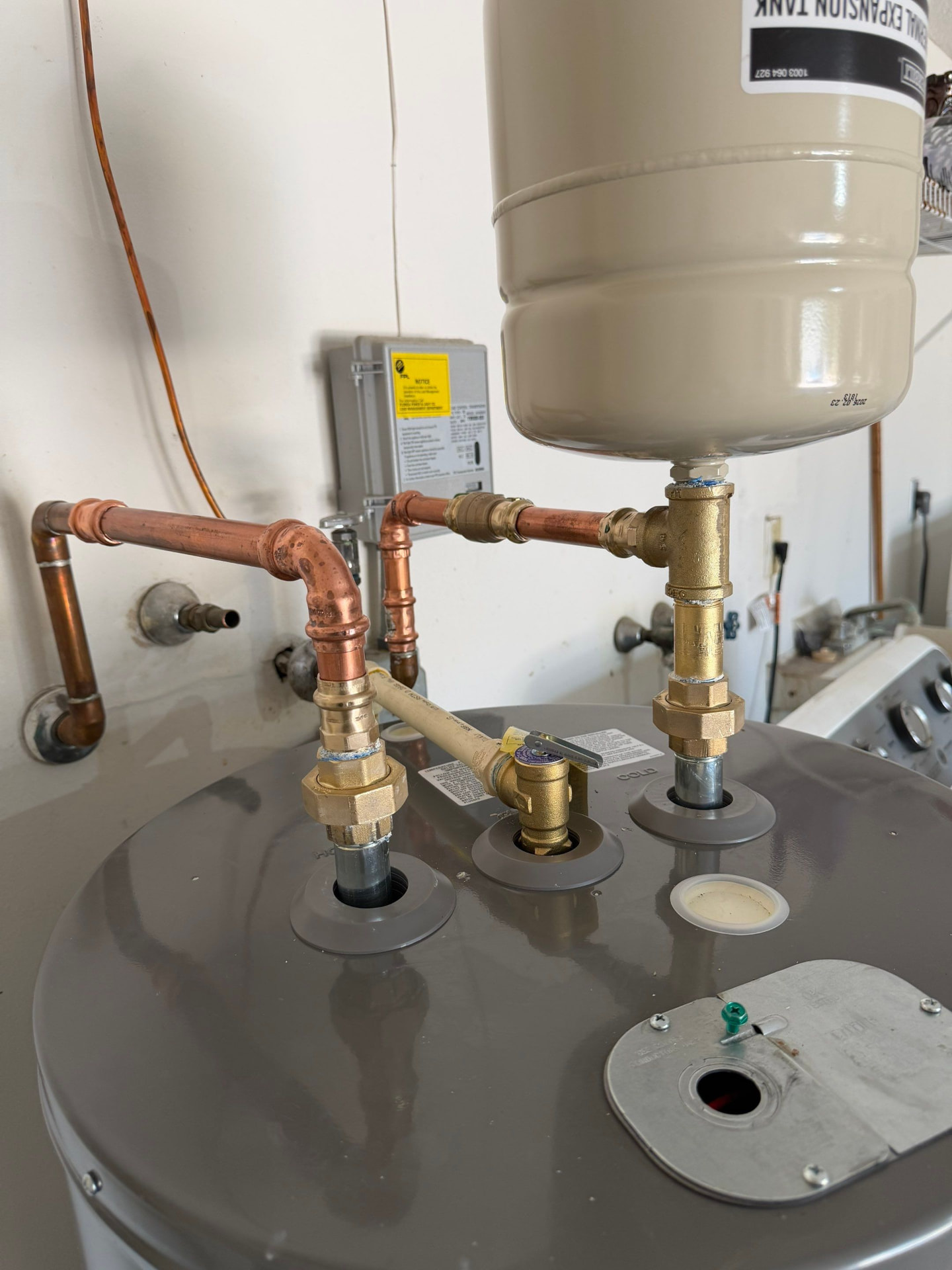
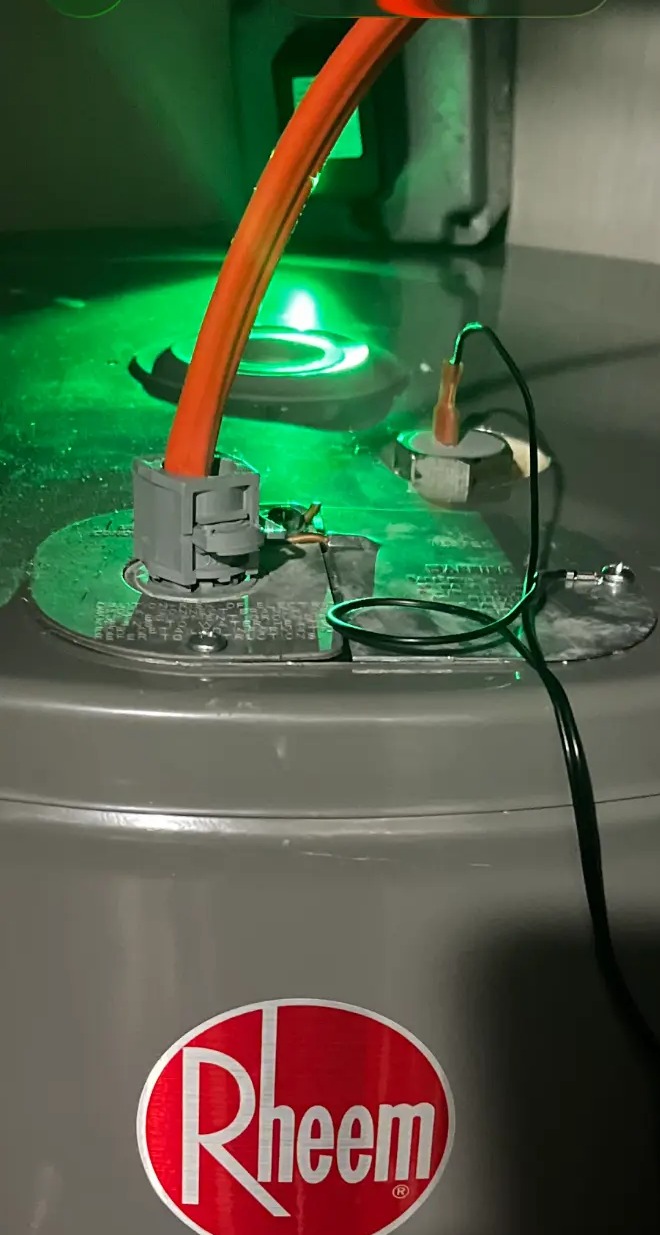
Every Rheem tank ships with a magnesium anode rod, and every one I install gets that rod replaced with a Corro-Protec powered titanium anode at the time of install. That’s not an upsell; it’s the standard. Lakewood Ranch water is hard, and if you add a softener — which most of my Lakewood Ranch customers do — softened water eats a magnesium rod faster. A powered anode doesn’t sacrifice itself; it protects the tank electrically for the life of the tank. On a heater in this water, it’s the difference between an 8-year tank and a 12-year one.
Also standard on every install: a thermal expansion tank (next section), dielectric protection at the connections so the copper and the steel nipples never touch — I’ve written a whole post on the $17 brass fitting that prevents galvanic corrosion (read it here) — and quarter-turn brass-body shutoffs on the supply. If your existing heater already sits in a pan with a drain line run outside, the new one goes back in it and I tie into what’s there.
Code
The Expansion Tank — Required, and Here’s the Physics
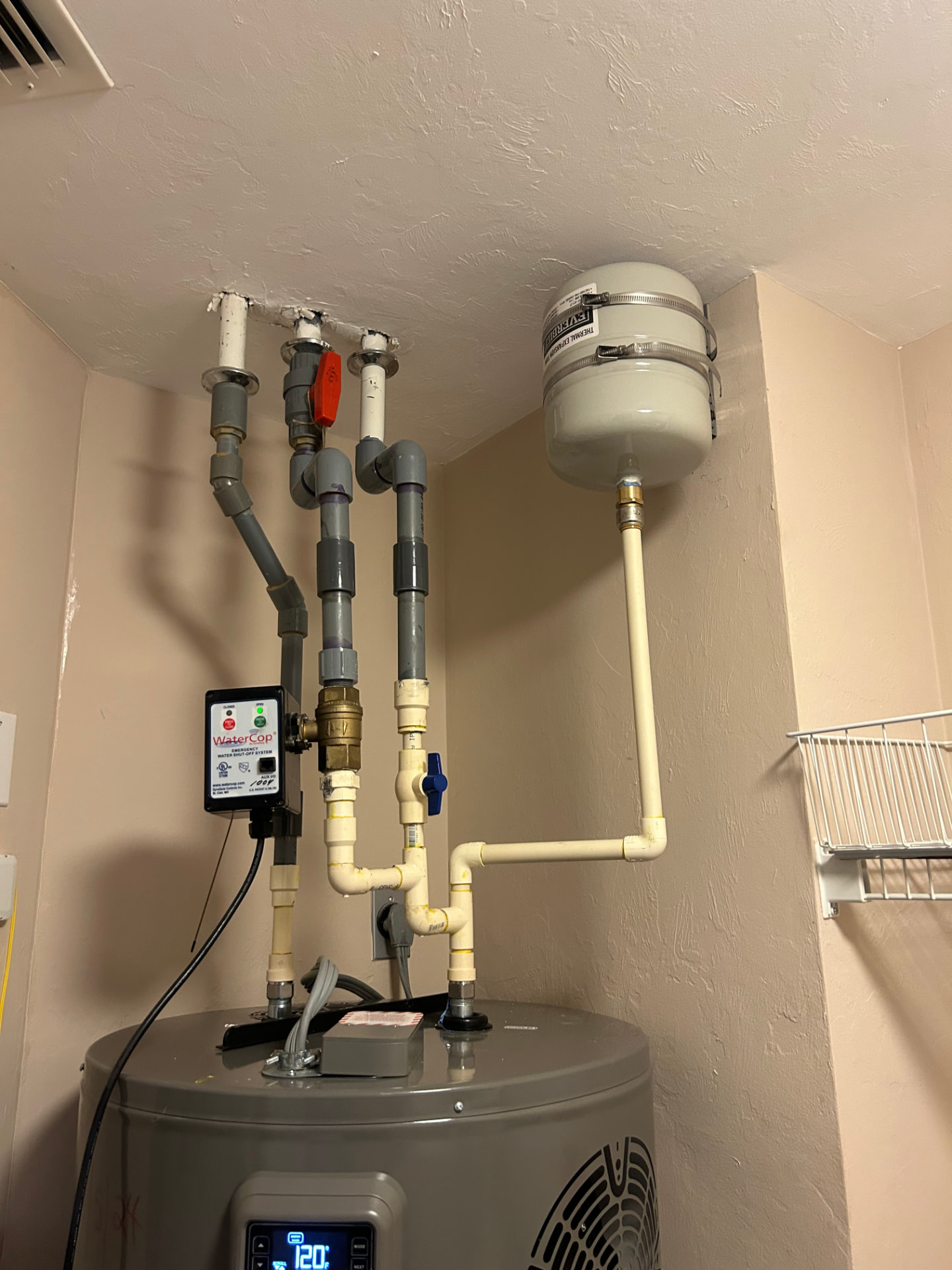
Every Lakewood Ranch home on county water has a backflow preventer at the meter. That makes your plumbing a closed system — water can come in, but it can’t push back out to the street. When the water heater heats 50 gallons, that water expands, and in a closed system the expansion has nowhere to go. Pressure climbs past what your pipes, your fixtures, and the tank itself are rated for. The symptoms are the ones nobody connects to the water heater: the T&P valve weeping, a toilet fill valve that won’t shut off, a dishwasher solenoid that fails, a pinhole in a supply line, and a tank that dies years early.
Florida Building Code Section 607.3 requires thermal expansion control on closed systems — original install and every replacement. The standard method is an expansion tank: a small bladder tank on the cold side that absorbs the expansion. Skipping it is a code violation, it voids the manufacturer’s warranty, and in a Lakewood Ranch CPVC-era home it’s a documented cause of burst pipes. It goes on every heater I install, and I check the pre-charge against your actual house pressure, not the factory setting. The full expansion-tank explainer is on the blog →
Tankless
Tankless — Why It Works Better in Lakewood Ranch Than Anywhere Up North
Every tankless spec sheet lists flow at a given temperature rise, and every national article sizes for a 50–55°F inlet — northern groundwater. Florida groundwater comes in at roughly 72–77°F. To get 120°F water, a Lakewood Ranch tankless unit only has to produce a 45–50°F rise, not 70. That moves the same unit several columns to the right on its own chart.
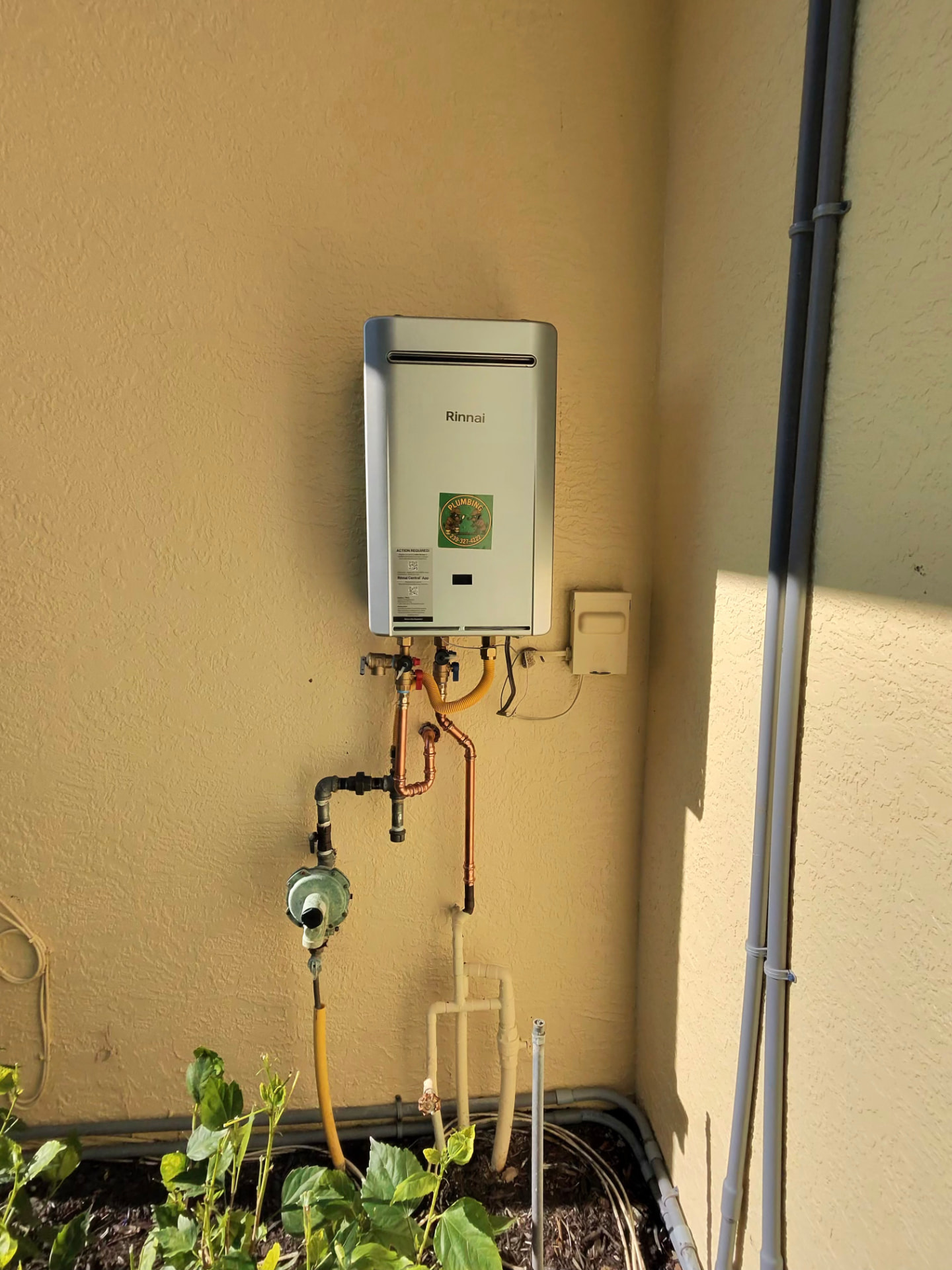
Navien NPE-240A2 — my recommendation on natural gas. 199,900 BTU, 0.95 UEF. At a 45°F rise it delivers 8.7 gallons per minute; at 50°F, 7.8. That’s three simultaneous showers plus a fixture in a Lakewood Ranch estate home. The same unit in Ohio is a two-shower appliance. Navien’s buffer tank and shorter gas-run tolerance make it the right fit for a retrofit. One trap to know: Navien’s heat-exchanger warranty drops from 15 years to 5 if a recirculation loop is installed without a proper control — I install it correctly or I don’t install the loop.
Rinnai RU199iP — my recommendation on propane, for the electric villages that want gas performance with no main. Dedicated LP hardware, 199,000 BTU, 0.95 UEF, 11 GPM maximum. No utility rebate on propane, so it’s a performance and outage-resilience decision, not a rebate decision.
Rheem RTGH-95XLN — the mid-tier alternative on natural gas, outdoor-rated, 9.5 GPM maximum, 12-year heat exchanger warranty.
There’s one tankless brand I deliberately don’t install because of its warranty and financial disclosures, and I’ll tell you which one in person if you ask.
The gas line is the job. A tank heater runs on a half-inch line. A 199k tankless usually needs three-quarter, and its modulating valve has almost no tolerance for pressure drop. Most tankless “failures” I get called to look at are gas lines starving the unit. That’s licensed plumbing scope — a Florida plumbing contractor’s license expressly covers natural gas and propane piping — and it’s a permitted, pressure-tested piece of the install, not an afterthought. Tankless Water Heater Installation for the full fuel-and-sizing breakdown.
The maintenance you’re signing up for. Tankless in Lakewood Ranch water means annual descaling. Not optional. Skip it and the heat exchanger scales, output drops, gas use climbs, and eventually the unit throws a thermal fault. It’s a 60–90 minute service. Budget for it, or a tank is the more honest choice.
Heat Pump
Heat Pump Water Heaters — The Right Answer for the All-Electric Village
If your house is electric and there’s no gas main coming, a heat pump water heater in the garage is usually the best thing you can do — better than an electric tank, and better than an electric tankless, which most Lakewood Ranch panels can’t feed.
A heat pump unit doesn’t make heat; it moves it, pulling warmth out of the garage air and putting it into the tank. Florida is the best climate in the country for it. The federal lab data is measured, not marketed: a monitored Florida installation ran at a coefficient of performance of 2.2, cut water heating energy 64% versus an electric-resistance tank, and modeled annual operating cost at $64 a year versus $177 for an electric tank, $138 for a gas tank, and $81 for gas tankless. A side effect Lakewood Ranch garages will appreciate: the unit exhausts air 10–15°F cooler and drier than it takes in. It dehumidifies the garage while it works.
Where the space matters — and nobody tells you this. A heat pump unit needs air to breathe. The manufacturer wants 700-plus cubic feet of open space and 24 inches of clearance on all sides for a non-ducted install. A two-car Lakewood Ranch garage clears that by a mile. An interior utility closet doesn’t — it needs louvered doors with real net free area or a ducting kit, or the unit runs inefficiently and Rheem won’t stand behind it. Two more things that catch people: an 80-gallon ProTerra is 74 inches tall and 261 pounds dry, so a low platform or an overhead shelf can kill the install; and it produces condensate, so it needs a drain. I check all three at the estimate.
The circuit is the last detail — and the one that decides whether it passes code. The 80-gallon ProTerra on a dedicated 30-amp circuit hits 87 gallons first-hour and clears the 74 FHR your house needs. The 15-amp plug-in version doesn’t. If your panel can’t take a 30-amp circuit, that’s an electrician conversation before it’s a plumbing one.
Water Chemistry
What Lakewood Ranch Water Does to a Water Heater
Manatee County’s own 2025 testing puts total hardness between 106 and 279 mg/L — 6.2 to 16.3 grains per gallon, and up from the year before. The federal classification calls anything over 180 mg/L “very hard,” and national-lab guidance recommends softening above 140. Manatee’s peak is nearly double that threshold.
Here’s what that does inside the tank, from the national lab study on water quality and water heaters:
- Calcium carbonate is inversely soluble — it precipitates more as water gets hotter. Your water heater is the single hottest point in the house, so it’s where the scale concentrates.
- Scale cuts equipment life 25 to 40 percent. The 8-to-12-year tank rating becomes 5 to 7 in unsoftened Lakewood Ranch water. If you’re on your third heater in a 2002 house, this is why.
- Gas tanks take a permanent hit. Sediment on the bottom of a gas tank insulates the burner from the water, driving heat into the steel and the glass lining instead. The lab found that cleaning a gas tank doesn’t fully restore its efficiency, because the burner surface can’t be completely cleaned. Electric tanks recover after a flush and element replacement; gas tanks don’t, entirely.
- Setpoint changes everything. At 140°F, a 50-gallon tank builds a sixteenth of an inch of scale in about four years. At 120°F, the same buildup takes closer to thirty. Turning the dial down from 140 to 120 slows scale formation by roughly seven times — and that sixteenth of an inch on a heat exchanger costs about 11 percent efficiency. Free fix, and I set it at install.
The maintenance schedule for this water: tanks get flushed annually, with a T&P test and an anode inspection on the same visit. Tankless units get descaled annually — every two years only if you’re on a softener and testing soft. The cold-water inlet filter gets rinsed on the same schedule.
The softener conversation. Most of my Lakewood Ranch water heater installs end with one. A softener pulls the calcium and magnesium out before they ever reach the tank — it’s the only thing that actually stops the scale rather than managing it. One honest caveat the lab study makes and I’ll repeat: softened water is slightly more corrosive to steel, which is why softener plus a powered anode is the combination, never a softener alone on a magnesium rod. That’s exactly why the Corro-Protec is standard on my installs. Water softener & filtration in Lakewood Ranch →
Plumbing Detectives LLC Professional Opinion
If your Lakewood Ranch home is electric and your panel can take a 30-amp circuit, put a heat pump water heater in the garage before you put an electric tankless anywhere. The tankless sales pitch is “endless hot water”; the electric tankless reality in a 3,100-square-foot house is a 120-amp draw that most 150-amp panels can’t feed alongside the AC. The heat pump unit costs a third as much to run as the tank it replaces, cools the garage, and clears code on first-hour rating. It’s the least glamorous and the most correct answer in this market.
Permits
Manatee County’s Permit Rule — Exactly One Exemption
Manatee County publishes exactly one water heater swap that doesn’t need a permit: “electric to electric ONLY, same size, same location.” That’s it. Everything else is permitted work requiring a licensed contractor:
- Electric to tankless, electric or gas — permit
- Any gas or propane water heater, new or replacement — permit
- Electric to gas, or gas to electric — permit
- Electric to electric with a size change (a 50 to an 80 for a heat pump unit) or a location change — permit
- Tankless replacement — permit, on its own $91 line
The fees are small — $62 for a gas water heater on the residential express line, $48 if the inspection is done virtually, $91 for tankless — and the county’s permitting office is physically in Lakewood Ranch at 9000 Town Center Parkway. Inspections schedule online or by automated phone 24/7, cancel by 4 p.m. the day before. I pull the permit, I schedule the inspection, and the passed inspection is on your invoice.
Waterside and Lakewood Ranch South are Sarasota County parcels — same requirement, different office (Sarasota County Planning and Development Services). Which one depends on your parcel, not your mailing address.
One Visit, One Permit
Repiping? Replace the Water Heater the Same Day.
If you’re in a 1995–2008 village replacing brittle CPVC, look at the date on your water heater before we start. A 25-year-old Lakewood Ranch home is on its second or third heater, and if the current one is past eight years, replacing it during the repipe is the cheapest it will ever be: the tie-ins are open, the expansion tank is already part of the job, the gas line (if you have one) is already being run to a new trunk, and Manatee County bills a residential re-pipe and a gas water heater on the same permit line. One mobilization, one inspection trip. And the same scale that just cracked your CPVC is sitting on the bottom of that tank right now. Whole-house repiping in Lakewood Ranch →
Plumbing Detectives LLC Tips
- 💡 Turn your setpoint from 140°F to 120°F today. It slows scale formation roughly seven times and it’s the single cheapest thing you can do for the heater’s life.
- 💡 If your T&P valve drips or your toilet fill valve won’t shut off, check for an expansion tank before you replace either one. That’s pressure, not a bad valve.
- 💡 Before you order a tankless, call Peoples Gas at (877) 832-6747. Gas main or no gas main decides the unit, the rebate, and the permit.
- 💡 Heat pump in the garage: measure from the floor to the lowest thing overhead. An 80-gallon unit is 74 inches tall, and a shelf you forgot about has ended more than one install.
Pricing
What It Costs
I quote water heaters after I’ve seen the house — the fuel, the panel, the space, the gas line, and the water — because two 50-gallon replacements in the same village can be very different jobs. What I’ll tell you here is what’s in every quote, so you can compare mine against anyone’s line by line: the unit, the Corro-Protec powered anode on tank installs, the thermal expansion tank, dielectric protection at the connections, new shutoffs, the permit and the inspection, haul-away of the old unit, and a pressure test before I leave. On tankless, the gas line sizing and venting are itemized, not buried. If a competing quote is cheaper, ask which of those it left out.
The numbers that are fixed and public: Peoples Gas rebates of $350 to $700 depending on what you’re replacing with what; Manatee County permits of $48 to $91. Operating cost, from the federal lab’s Florida modeling: about $64 a year for a heat pump unit, $81 for gas tankless, $138 for a gas tank, $177 for an electric tank.
Why Us
Why Plumbing Detectives LLC
Most Lakewood Ranch water heater pages are a city name dropped into a template — no brands, no sizing, no rebate, no permit rule, no mention of the water. We’re a licensed master plumber — CFC1434139, BBB accredited — who sizes to the code table, names the equipment and why, puts a powered anode and an expansion tank on every tank install as standard, runs and tests the gas line on every tankless, files the Peoples Gas rebate paperwork with your invoice, and pulls the Manatee County permit for every job that needs one — which is every job except an electric-for-electric swap. If the heater is one piece of a bigger project — a repipe, a softener, a gas line — it’s one phone number. Tankless Water Heater Installation · Whole-House Repiping Lakewood Ranch · Water Softener Lakewood Ranch. Fully insured.
FAQ
Frequently Asked Questions — Water Heaters in Lakewood Ranch, FL
The right water heater for a Lakewood Ranch home depends on which village you’re in, what your panel can carry, whether there’s a gas main in the street, and what 16-grain water is going to do to it for the next decade. Those are four questions, and a “50 gallons for four people” rule of thumb doesn’t answer any of them. Call 239-388-3631. I’ll size it to the code table, tell you which rebate you actually qualify for, pull the permit Manatee requires, and put an anode in it that’ll still be working when the warranty runs out.
Plumbing Detectives LLC | Venice, FL | License CFC1434139 | BBB Accredited
239-388-3631 | plumbingdetectivesfl.com
Serving Lakewood Ranch, Bradenton, Sarasota, Venice, Venice Gardens, Nokomis, Laurel, Englewood, Wellen Park, and Bradenton Beach.