
Water Leak Repair in Venice, FL
A leak inside a wall doesn’t wait for a convenient time to show up — and in a Venice home, it’s rarely just “bad luck.” It’s usually your water, your pipe material, and your house’s age doing exactly what the chemistry says they’ll do.
Call Now239-388-3631I’ve cut into enough Venice walls to know that “just patch it” is the wrong first question. The right first question is why did this pipe fail here, on this water, at this age — because that answer decides whether you need a $300 spot repair or a conversation about the whole system. Here’s how I actually work through that, and what I’ve learned about why Venice homes leak the way they do.
Why Here
Why Venice Pipes Fail — It’s Not Bad Luck, It’s Chemistry and Age
Most of Venice runs on chloraminated water. Sarasota County Public Utilities has disinfected its distribution system with chloramine — not plain chlorine — for fifty years, precisely because chloramine holds its disinfecting power longer across a large system. That’s good for water safety. It’s also an oxidant that sits in contact with your copper, your CPVC, and your fittings for the entire service life of the pipe. The research on copper pitting backs this up directly: disinfectant chemistry, flow velocity, and pH interact to drive the exact kind of localized pitting that eventually opens a pinhole.
Two things worth knowing about your own water, specifically:
If you’re in 34292 or 34293 — east Venice, South Venice, Venice Gardens, Jacaranda — you’re most likely on Sarasota County Public Utilities, chloramine-treated. If you’re in 34285, the City of Venice, you’re on a separate utility with its own water report. I’ll be straight with you: I don’t have the City’s exact chloramine/pH numbers pinned down publicly, so if you’re on city water and want the specifics, their Water Production Division can pull your Consumer Confidence Report.
Then there’s your house’s age, and this is where it gets specific to your ZIP code instead of “Florida homes are old”:
34285
City of Venice
More homes were built in the 1970s than any other decade — over 5,000 of them. Roughly 9,400 units in this ZIP predate 1980. That's copper-era and galvanized-era construction, right in the window where pinhole leaks start showing up.
34293
South Venice / Venice Gardens
About 9,600 units went up between 1970 and 1989 — squarely inside both the copper pinhole window and the 1978–1995 polybutylene installation window. If your house falls in that build range, polybutylene is a real possibility, not a scare tactic.
34292
East Venice
Newer stock — over 6,000 units built 2000–2019. Your risk profile shifts away from copper pinholes and toward CPVC fitting failures, PEX brass connections, and worn-out shutoff valves and supply lines instead.
There’s real data behind why age matters this much: homes 30 years or older are three times as likely to have a plumbing supply or drainage problem. Most of core Venice has already crossed that line.
Failure Modes
The Leaks I Actually See, and Why They Happen
Pinhole copper leaks. Copper protects itself with a thin oxide layer, and a pinhole happens when that layer breaks down in one spot. A few specific things drive it, and I can usually tell which one I’m looking at:
- Chloramine, velocity, and pH working together to pit the inside of the pipe over years — this is the slow, system-wide version.
- Leftover soldering flux from the original install, sitting inside the pipe and preventing the copper from re-forming its protective layer at that spot. This is why you sometimes see an “early” pinhole 7–15 years in, instead of the 20–30 year timeline for general corrosion.
- Erosion from an unreamed cut edge — when a copper tube isn’t deburred before it’s fit into an elbow, water scrubs that one spot from the inside until it wears through. These show up as a distinctive U-shaped pit pointing upstream, and I can usually point to exactly why that fitting failed.
- High water pressure pushing a marginal weak point over the edge. If your house runs hot on pressure, I’ll check it — a pressure-reducing valve set to 55–65 psi is cheap insurance.
CPVC failures. I want to correct something the internet gets wrong constantly: CPVC is still fully code-approved for water distribution in Florida. It’s not banned, and Florida sun isn’t what’s killing it either — manufacturer testing actually shows UV has limited effect on CPVC’s strength. What actually fails CPVC: hot chlorinated water breaking the material down slowly from the inside (thermal-oxidative degradation), stress cracking at fitting joints — especially where the original installer left a sloppy cement drip that dried, shrank, and left a stress point — and thermal expansion cycling in attic runs that aren’t accounted for. If your 34292 home is in that 2000s CPVC-era build window, this is usually what I’m looking for first.
Polybutylene. Gray (sometimes white, blue, or black) flexible pipe stamped PB2110, installed mostly between 1978 and 1995. Nationally, it’s estimated that about 1 in 5 homes built in that window has it, and Florida’s explosive growth in the ’80s and early ’90s means we’ve got more than our share. I check under sinks, at the water heater, and at accessible wall penetrations — usually I can tell in one visit. Color alone isn’t reliable (some PB was painted, and gray PEX exists too), so I’m looking for that PB2110 stamp specifically.
One thing I want Venice homeowners to know plainly: the old polybutylene class-action settlement fund closed years ago. If someone tells you there’s still settlement money available for a PB failure, that’s outdated — the fund is closed and the administrator is gone. Your options today are insurance and repiping, not a settlement check.
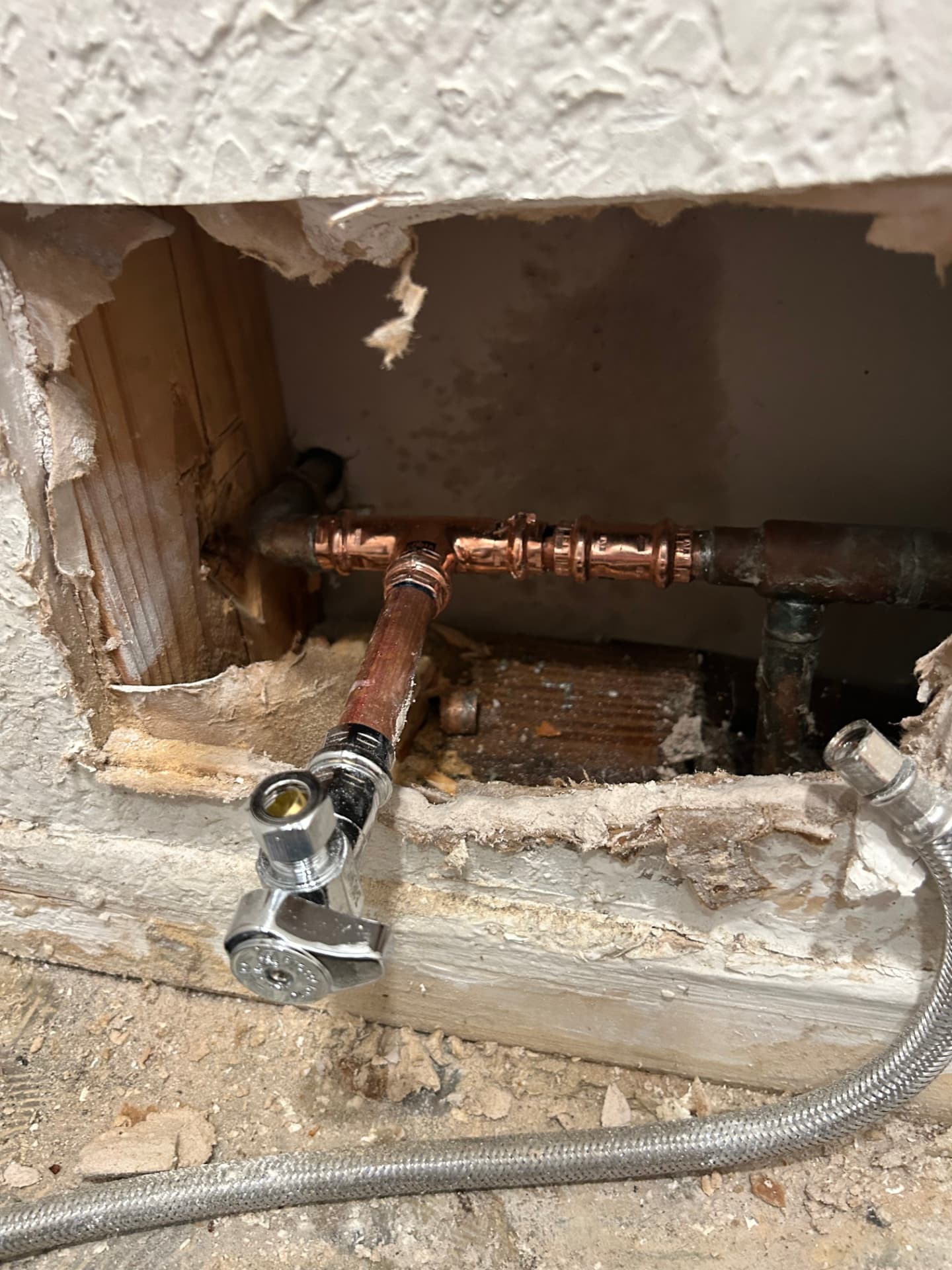
Shutoff valve failures. Sarasota’s water leaves mineral buildup on valve stems, and over years an old gate valve calcifies until the handle either won’t turn or turns without actually shutting off flow. If you’ve got an original multi-turn shutoff from the ’70s or ’80s, I usually recommend swapping it for a quarter-turn ball valve when I’m already in there — sediment can’t lodge in a ball valve the way it does in a gate valve’s seat.
Supply line failures. Toilets, washing machines, ice makers, and water heaters all depend on a length of hose or braided line that nobody thinks about until it fails. The numbers on this are worth knowing: a burst washing machine hose causes about half of all washing-machine water damage claims, averaging over $6,000 per incident. Toilet supply line and fill valve failures run $2,000–$10,000 per incident. Braided stainless lines are the better choice over plain rubber, but even those wear out — plan on replacing them every 5–8 years regardless of how they look, since the rubber core inside the braid is the actual weak point, not the braid itself.
The Method
How I Actually Find a Hidden Leak
I’m not going to tell you a thermal camera “sees” water through your wall, because it doesn’t. Here’s what real diagnosis looks like, in order:
Step 1
Confirm it's actually leaking, and where.
Every fixture off, watch the water meter's low-flow indicator. If it's still moving, water's escaping somewhere in the pressurized system.
Step 2
Isolate hot from cold.
I close the cold inlet at your water heater. If the meter stops, it's a hot-side leak downstream of the heater. If it keeps moving, it's cold-side. That alone cuts the search area in half.
Step 3
Pressure-test the isolated section.
Cap it, hook up a gauge, bring it to pressure, and watch for a drop. A section that won't hold pressure has a leak in it. If you're on a PEX manifold system — common in the newer 34292 homes — I can test individual runs at the manifold to find the exact one that's failing.
Step 4
Thermal imaging to narrow the search area — with real limits I'll tell you upfront.
A thermal camera reads surface temperature patterns, not moisture. It can't see through walls or inside pipes. It works best with a real indoor/outdoor temperature difference, and honestly, Venice doesn't hand us that for much of the year — a cold-water leak in a well-conditioned house can produce almost no thermal signature. Carpet, glass, and thick concrete can all mask or fake a reading. That's exactly why I never call a leak “found” off a thermal image alone.
Step 5
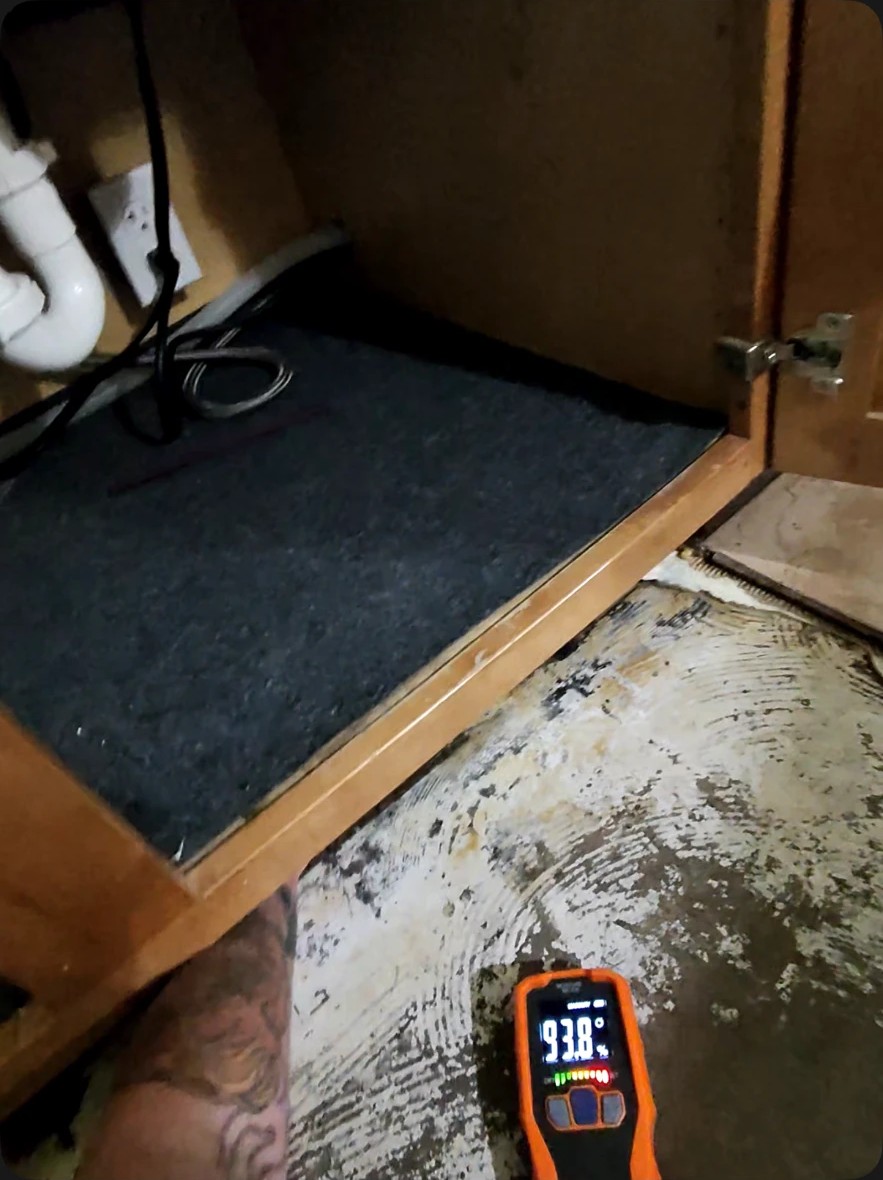
Moisture meter confirms it.
This is the instrument that turns “that looks damp” into an actual recorded number at a specific location. When the thermal pattern and the moisture reading agree at the same spot, that's a real diagnosis — not a guess.
Step 6
Only then do we open the wall.
Once the anomaly and the moisture reading line up, or when the leak's actively causing damage and waiting costs more than the drywall.
The Threshold
Repair the Spot, or Talk About a Repipe?
I don’t upsell a repipe on a first pinhole. Here’s the honest threshold I actually use:
| What I’m looking at | What I recommend |
|---|---|
| First-ever pinhole, copper under 20 years old, no other leaks | Spot repair, monitor |
| Leak at a fitting, valve, or connection point | Spot repair — that's a point failure, not a material failure |
| Two or more pinholes in different spots within 12–24 months | Repipe — that's active corrosion along the whole line |
| Copper 25+ years old with any pinhole | Whole-house repipe conversation |
| Confirmed polybutylene | Repipe, regardless of how many leaks you've had |
| Galvanized pipe with rust-colored water or restricted flow | Repipe — internal buildup can't be spot-repaired |
Realistically, once a system starts pitting, more pinholes tend to show up within 6–24 months. If you’ve already had two or three spot repairs in a couple of years, we should talk about whether you’re funding a repipe in installments anyway.
Typical Ranges
What This Costs
I’d rather give you a real range than make you call five plumbers to find one out. These are typical Southwest Florida ranges, not fixed quotes — your actual price depends on what I find during an in-person diagnosis.
Basic leak diagnosis (accessible area, straightforward)
typical range roughly $100–$300
Advanced diagnosis (thermal imaging, moisture mapping, harder to access)
typical range roughly $200–$600
Simple spot repair, pipe already accessible
typical range roughly $150–$500
Spot repair requiring wall access
typical range roughly $500 and up, depending on how much needs to come out and go back
Shutoff valve or supply line replacement
quoted directly rather than guessed at a range — it's quick, and honestly one of the cheapest ways to head off a much bigger claim later
Whole-house repipe
typical range $4,500–$15,000 for most Sarasota-area repipes depending on home size and material, and that should include permits, inspection, and wall patching
Worth doing the math on: two leaks a year on aging copper can run $7,000–$12,000+ over a decade in repeated spot repairs. A repipe once might cost less than that over the same span — and it stops the phone calls.
All figures above are typical ranges only. Final pricing follows an in-person diagnosis.
Insurance
The Insurance Conversation Nobody Else Has With You
This is the part most plumbers skip, and it’s often more important than the repair itself.
Florida homeowners policies generally cover water damage that’s “sudden and accidental” — a pipe that bursts without warning, a washing machine hose that snaps, a water heater that ruptures. What they typically deny: a pipe that’s been dripping slowly behind a wall for months, treated as gradual damage or deferred maintenance. Some policies include language about a leak that’s been going on 14 days or more — I’ll be straight that this is common policy wording, not a blanket Florida law, so read your actual policy.
Here’s something most homeowners don’t know: if an insurer denies your claim by calling it “gradual damage,” the burden is on them to prove it — not on you to prove it was sudden. That’s Florida law.
When I finish a leak repair, here’s what you actually get from me, not just a “fixed it” invoice:
- What failed, exactly, and why (the mechanism, not just “old pipe”)
- Timestamped photos of the damage and the source
- Moisture meter readings with locations recorded
- Pressure test results showing which line failed and that the rest holds
- The failed piece itself, kept for your adjuster if you need it
- An invoice identifying the new material, plus permit and inspection sign-off if the job needed one
If you’re dealing with a four-point inspection flagging your plumbing for a renewal, I can give you a documented assessment and a repipe estimate that’s often exactly what turns a cancellation notice around. Citizens won’t insure a home with active polybutylene — full stop — so if that’s your situation, let’s talk about it before your renewal, not after a denial letter shows up.
One more thing worth knowing if you’re in a condo or villa: under Florida law, the association generally covers the common-element plumbing and has the right to access a unit to stop an active leak, while your own unit’s interior finishes are usually your policy’s responsibility. A written, timestamped cause-and-origin report from a licensed plumber is often what settles the question of who’s actually paying.
Permits
Permits — and a Common Misunderstanding
Any plumbing alteration, addition, or removal in unincorporated Sarasota County requires a permit — minor repairs that don’t rearrange pipes or fixtures are the exception. And I want to flag something a lot of homeowners are getting wrong right now: Florida’s new law exempting small residential projects under $7,500 from permitting (effective July 2026) specifically excludes plumbing work. A leak repair over that dollar threshold still needs a permit regardless of what you may have read about the exemption.
FAQ
Straight Answers
Why Me
Why Homeowners Call Me First


I’d rather tell you exactly what’s wrong and why than sell you the biggest job I can. If you’ve got a slab leak instead of an above-ground one, I’ve got a dedicated process and equipment for that too — Leak Detection in Venice, FL. And if this is turning into a repiping conversation, here’s what that actually looks like — Repiping Services in Venice, FL.
Suspect a hidden leak in your Venice home? Let’s find out what’s actually happening before it gets expensive.
Plumbing Detectives LLC | Venice, FL | License CFC1434139
239-388-3631 | plumbingdetectivesfl.com