
Sewer Line Repair · Bradenton, FL
Sewer Line Repair in Bradenton, FL
Camera-verified diagnosis first, always. Licensed master plumber CFC1434139. Emergency service available — call 239-388-3631.
Call Now239-388-3631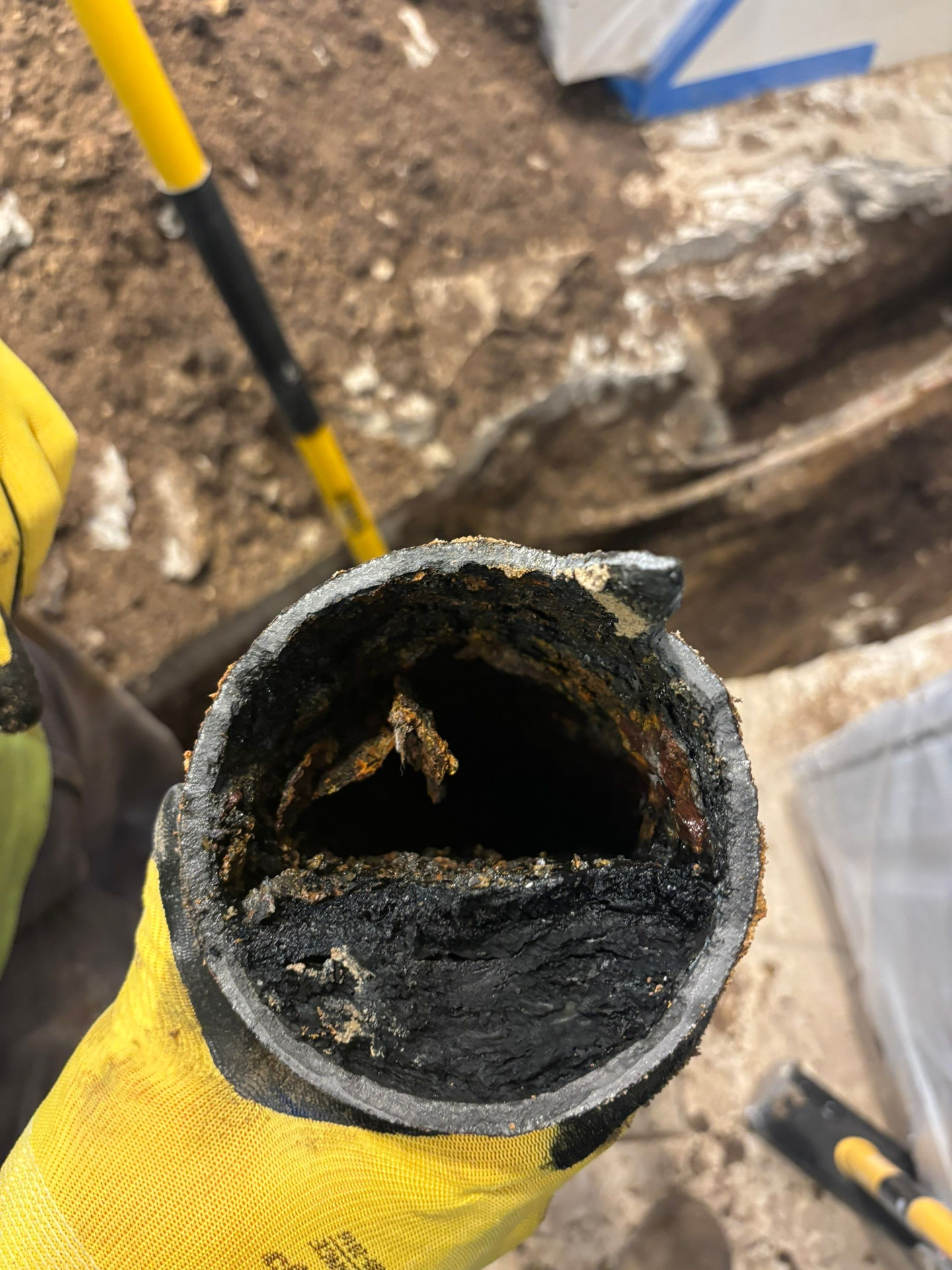
Camera log · one line, 43 feet
What the camera actually found, foot by foot
These are real stills off one inspection, with the footage counter burned into the picture. Nothing staged, nothing borrowed — this is how a failing line reads on camera from the cleanout out to the collapse, including a second belly at 37 feet.
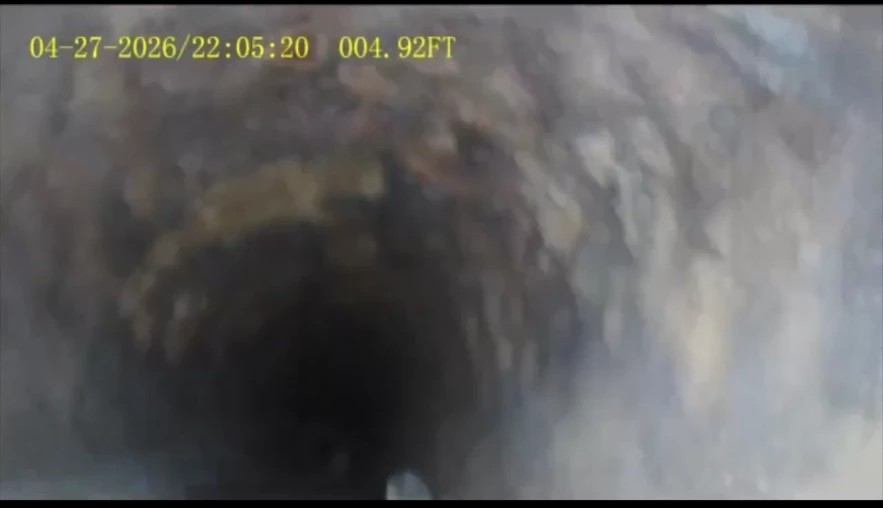 4 ft
4 ftScale building on the pipe wall
Four feet in and the scale is already obvious — the inside of the pipe is no longer smooth. That rough, built-up surface is what catches paper and grease and starts the backups.
I run calls in Bradenton regularly, but I’m not from here, and I’m not going to pretend Bradenton is one simple market. It’s a city with its own aging, well-documented sewer infrastructure problems, wrapped around by unincorporated Manatee County, containing at least two neighborhoods that couldn’t be more different from each other: a single-developer mid-century community built in one year, and a century-old arts district built when Bradenton General Hospital still stood on the site.
Get the neighborhood wrong and you’ll misjudge the pipe. Get the jurisdiction wrong and you’ll pull a permit from the wrong office. Both mistakes are easy to make here if you’re pricing off the Bradenton name instead of the actual address.
My name is Mike Reynolds. I’m the owner of Plumbing Detectives LLC and a licensed master plumber, license CFC1434139, based just south in Venice. Here’s what a Bradenton homeowner needs to know before spending a dollar on sewer work.
Two Neighborhoods, Two Governments
Bradenton Isn’t One Market — It’s Two Neighborhoods and Two Governments
The incorporated City of Bradenton runs its own building and permitting division. Unincorporated Manatee County — which includes Bayshore Gardens and most of West Bradenton — runs a completely separate one, Manatee County Development Services, out of 1112 Manatee Ave W. A Bradenton mailing address doesn’t tell you which office has jurisdiction, and the two neighborhoods that define this market’s oldest housing sit on opposite sides of that line: Village of the Arts is legally inside City of Bradenton limits, and Bayshore Gardens is unincorporated county territory.
Those two neighborhoods also happen to be the best illustration of why “Bradenton” isn’t one construction era either. I’ll walk through both, because the pipe under your home depends heavily on which one you’re in — or whether you’re in neither.
A Single-Era Community
Bayshore Gardens — A Single-Era Community Built by One Company in 1956
Bayshore Gardens is a genuinely rare thing in this business: a neighborhood with a documented, near-uniform construction story, the same way Venice Gardens is for my Venice-area customers. A New York syndicate started developing it in 1955, held its grand opening in 1956, and by April 1958 had already built 400 homes — all constructed by Bayshore Gardens Inc., all designed by the same Bradenton architect, all concrete block, slab-on-grade construction, originally selling for $8,000 to $15,000. Individual property records across the neighborhood confirm build years clustering in 1957, 1960, 1961, 1962, and 1963.
That means most original Bayshore Gardens homes are now 55 to 69 years old — squarely in the window where cast iron drain-waste-vent pipe fails from the inside out, the same corrosion mechanics I describe on my Venice Gardens sewer line repair page: hydrogen sulfide gas converting to sulfuric acid at the pipe crown, decades of scale narrowing the channel, sandy soil settling under an unsupported line.
Here’s what makes Bayshore Gardens unusual: it’s currently the subject of a University of Florida-led effort, running since 2014, to document and potentially designate it as the state’s largest and most historically significant collection of mid-century residential architecture. A lot of these homes have never been substantially renovated — which means the original 1950s–60s plumbing is often still in place, not something to assume was already addressed. Bayshore Gardens is unincorporated Manatee County, so permits here route through the county, not the city.
Bradenton's Oldest and Most Unpredictable Pipe
Village of the Arts — Bradenton’s Oldest and Most Unpredictable Pipe
Village of the Arts is a different story entirely — older, smaller, and far less uniform. This 36-acre live-work arts district just south of downtown, more than 275 properties across two dozen blocks, is built predominantly on 1920s and 1930s wood-frame bungalows and Florida Cracker-style homes. Some of this housing predates even the cast iron era — meaning galvanized steel or very early-generation cast iron DWV is a real possibility, not just cast iron.
The site was previously home to Bradenton General Hospital starting in 1937. By the 1990s the housing stock here was widely described as dilapidated, before a 1999 artist-revitalization effort restored many of the structures for mixed live-work and commercial use — galleries, studios, small restaurants. That revitalization is exactly why I can’t tell you what pipe is under any given Village of the Arts property without a camera: you’ve got original-era pipe, mid-century patch repairs, and modern retrofits for commercial code compliance — extra bathrooms, extra fixtures for gallery and restaurant use — often coexisting in the same hundred-year-old structure. Village of the Arts sits inside City of Bradenton limits, so permits here route through the city, using its Accela online system as of late 2024.
What the Camera Found
A Real Job From a Home This Age — What the Camera Found
I’ve documented a job in a 1980 South Venice slab home that shows what decades does to a cast iron drain line — a useful reference point for Bayshore Gardens’ 1950s–60s construction, even though that neighborhood’s pipe has another two decades of age on it. The homeowner’s only symptom was a guest toilet gurgling louder over the course of a week.
The toilet was cemented in — I had to break the bowl for camera access. Within the first ten feet, the camera hit standing water under a bedroom closet in the next room. Past that section, the pipe was bone dry — the water wasn’t flowing, it was pooling in a sag and seeping into the sand through pipe that had rotted from the inside out. Further along, in the kitchen run, the 4-inch trunk line had narrowed to what looked like 2-inch pipe from interior buildup. Near the end of the kitchen the camera could barely pass at all — the line had sunk so badly it was remarkable there hadn’t been a backup yet. When the floor came open, the pipe was more than half full of black, soot-like buildup, with a sagging fitting that had to be seen to be believed.
The camera also showed the last fifteen feet of that run — past the master bath — was still in good condition. So it stayed. That’s the standard I bring to a Bayshore Gardens home from a comparable era.
For Village of the Arts specifically, I’ll be honest: I don’t have a documented job from a home this old and this architecturally mixed to show you yet. What I can tell you is that a hundred-year-old structure retrofitted for commercial use needs a camera pass before anyone assumes what material they’re dealing with — guessing “cast iron” on a home this old could just as easily mean galvanized steel, or three different materials joined together over a century of patchwork repairs.
What Your House Is Telling You
The Warning Signs
A toilet that gurgles when the washing machine or dishwasher runs, slow drains at multiple fixtures at once, recurring clogs in the same spot, sewage odor inside or outside the home, wet or unusually green patches in the yard along the lateral path, and unexplained moisture at the floor in slab homes — all standard symptoms, all worth acting on early in a market with this much aging pipe.
One symptom deserves special attention in Bradenton specifically: backups that get noticeably worse during or right after heavy rain. Bradenton’s public sewer system has documented, ongoing inflow and infiltration problems — groundwater and stormwater entering cracked public sewer main through age and storm damage. If your backups track closely with rain events rather than your own household use, that’s worth mentioning when you call, because it can point toward the public system contributing to what you’re experiencing, not just your private lateral. Either way, the camera is what sorts out what’s actually happening on your side of the connection.
The Camera Comes First
Diagnosis First — The Camera Comes Before the Quote
I will not quote a sewer repair I haven’t seen from the inside — and in a market with two structurally different historic neighborhoods sitting under two different permitting authorities, guessing off a ZIP code is a bad idea here specifically.
Every job starts with a camera inspection. I run a camera with a self-leveling head, a distance counter, and a 512 Hz locator — which means I can see the condition of the pipe, measure exactly where each problem is, and mark its location from above. If I see something, I call you over and show you on the screen in real time, then you get a written report of the findings.
That’s a separate service with its own transparent pricing: Camera Inspection & Surface Locate is $325, and the optional recorded-video add-on is +$70 — the full footage is delivered by Google Drive within 24 to 48 hours ($395 total). In Bradenton, the camera is what actually tells me whether you’re dealing with cast iron, galvanized steel, or a mix of both — not the decade your neighborhood was platted.
For a closer look inside the line before repair planning, see Sewer Camera Inspection and Locating in Bradenton.
Plumbing Detectives LLC Professional Opinion
I’ve noticed something researching this market: a lot of Bradenton plumbing companies mention “camera inspection” as a checkbox line item rather than something they actually document and hand you. In a market with pipe this old and this variable — a 1956 concrete block ranch is not the same job as a 1920s bungalow retrofitted for a gallery — a camera inspection isn’t a formality, it’s the only honest way to know what you’re actually paying to fix. Ask to see the footage. If a company can’t show it to you, that tells you something.
The Honest Decision Tree
Repair, Reline, or Replace — The Honest Decision Tree
Spot repair. When the camera shows an isolated problem — one separated joint, one crushed section, one root intrusion point — in an otherwise sound line, the answer is a targeted repair: open the floor or yard at the marked location, replace the failed section with new PVC at correct pitch, and put everything back.
Trenchless relining (CIPP). Right when the host pipe has internal corrosion and scaling but is still structurally intact and still holding its pitch — well-suited to a lot of Bayshore Gardens’ cast iron stock. Lining doesn’t fix gravity — a bellied section from decades of soil settlement will still hold water under a liner. Since April 2024, Florida code requires a video camera survey both before and after any CIPP relining.
Pipe bursting. A fit where a line needs upsizing or has offset joints but requires clearance for the bursting head — a real consideration in Village of the Arts’ dense lot spacing and live-work storefronts close to the street, where open-cut excavation would disrupt business operations.
Excavation and full replacement. When the line has collapsed sections, severe bellies, or buildup so advanced it can’t be restored. In Village of the Arts specifically, this sometimes means confirming and replacing more than one material in the same structure, given the mixed-era retrofit history.
Septic-connected homes. Manatee County’s septic-to-sewer conversion program status for this area is currently in flux, and some pockets of the broader Bradenton market remain on septic. If your home runs to a septic tank, the pipe between your house and that tank is still ours to diagnose and repair, same decision tree as above. We don’t install septic systems themselves — a new tank or drainfield is a licensed OSTDS contractor’s scope, not ours.
Section by Section, Not All or Nothing
How I Replace a Sewer Line — Section by Section, Not All or Nothing
Sometimes the camera can’t get through the worst section. I’m not going to quote work on pipe I haven’t seen. So I give you a price for the section the camera has documented. Once the floor is open and I’ve cleared the bad section, I run the camera upstream and diagnose the next stretch, and tell you honestly whether we should keep going or stop there — the same way I handled the South Venice job, where we stopped once the camera confirmed the remaining fifteen feet was sound.
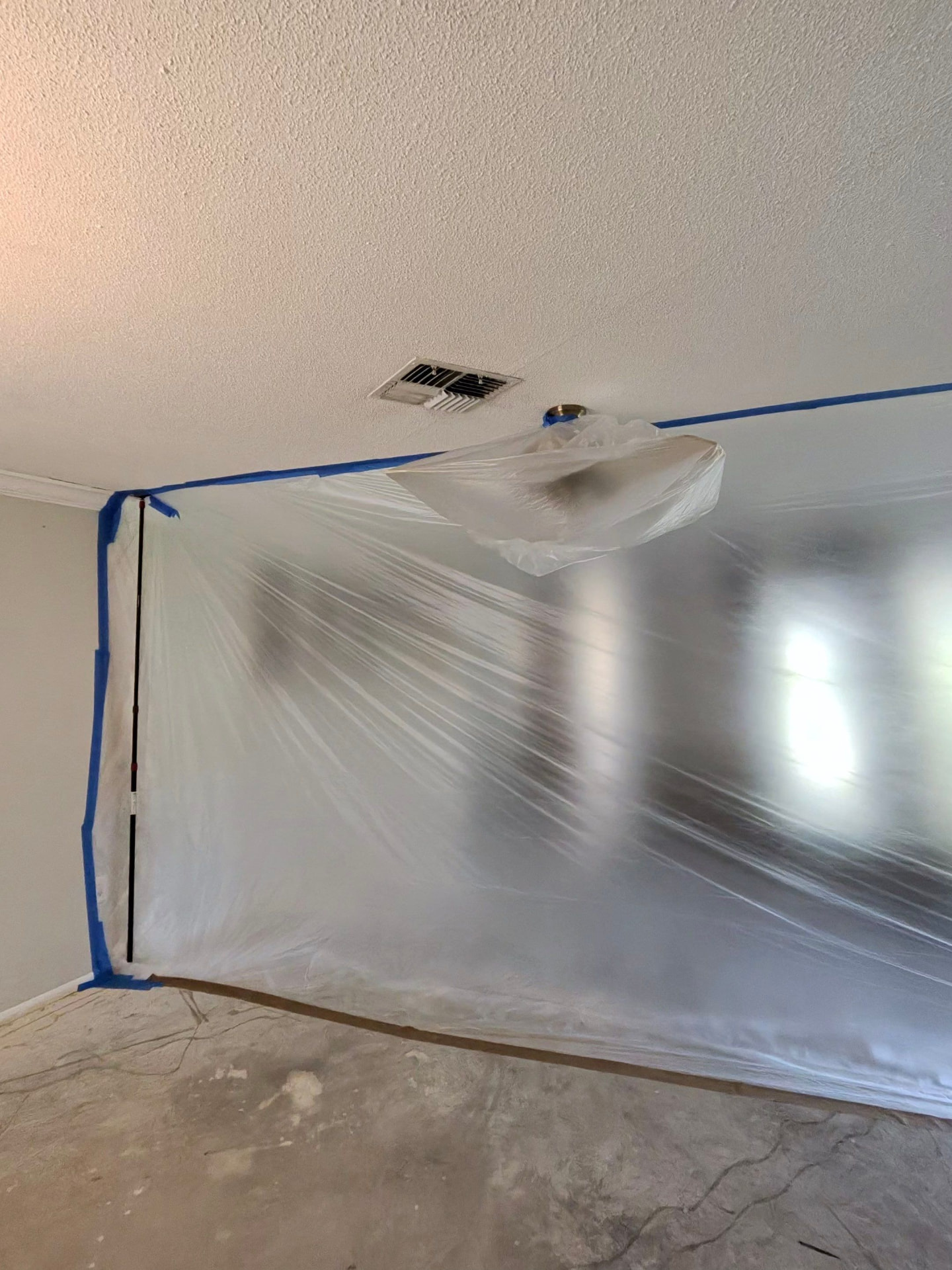
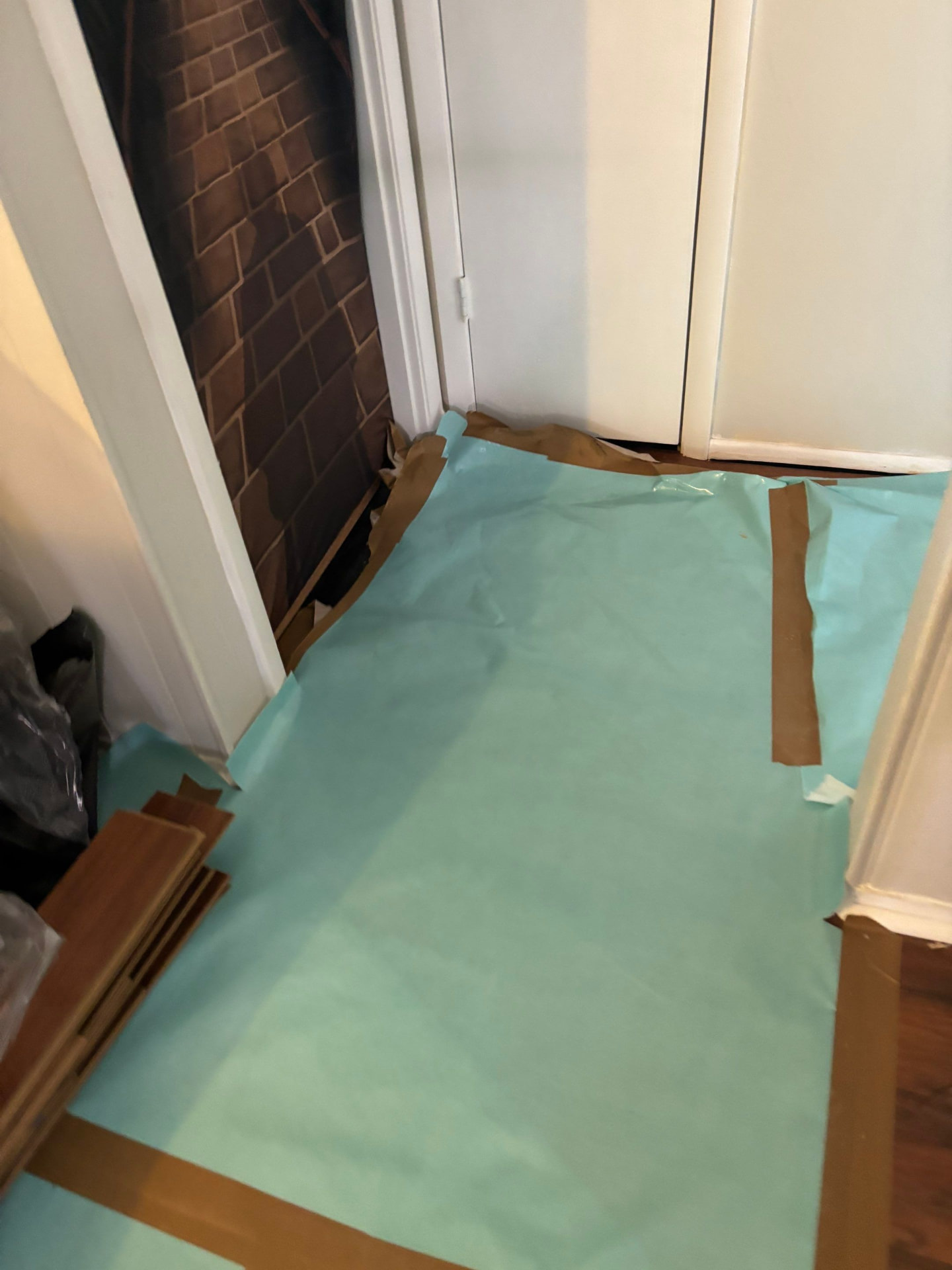
The white glove approach. A sewer replacement inside a Bradenton home means concrete saws, excavation, and spoil — handled with extra care inside a hundred-year-old Village of the Arts structure or an unrenovated Bayshore Gardens original. On every interior job: wall protection goes up, floor protection goes down, dust control is in place, and the work area stays clean and contained.
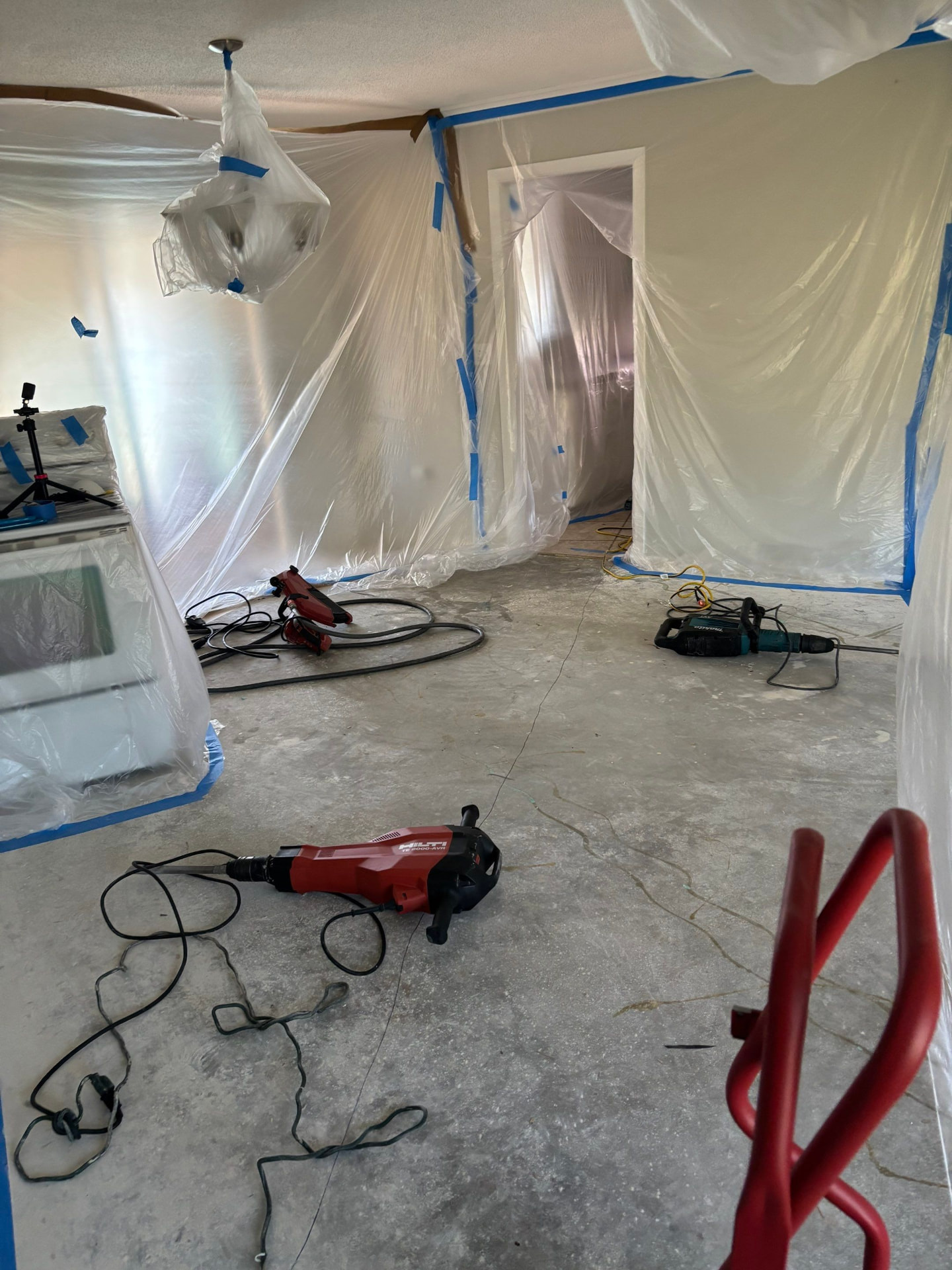
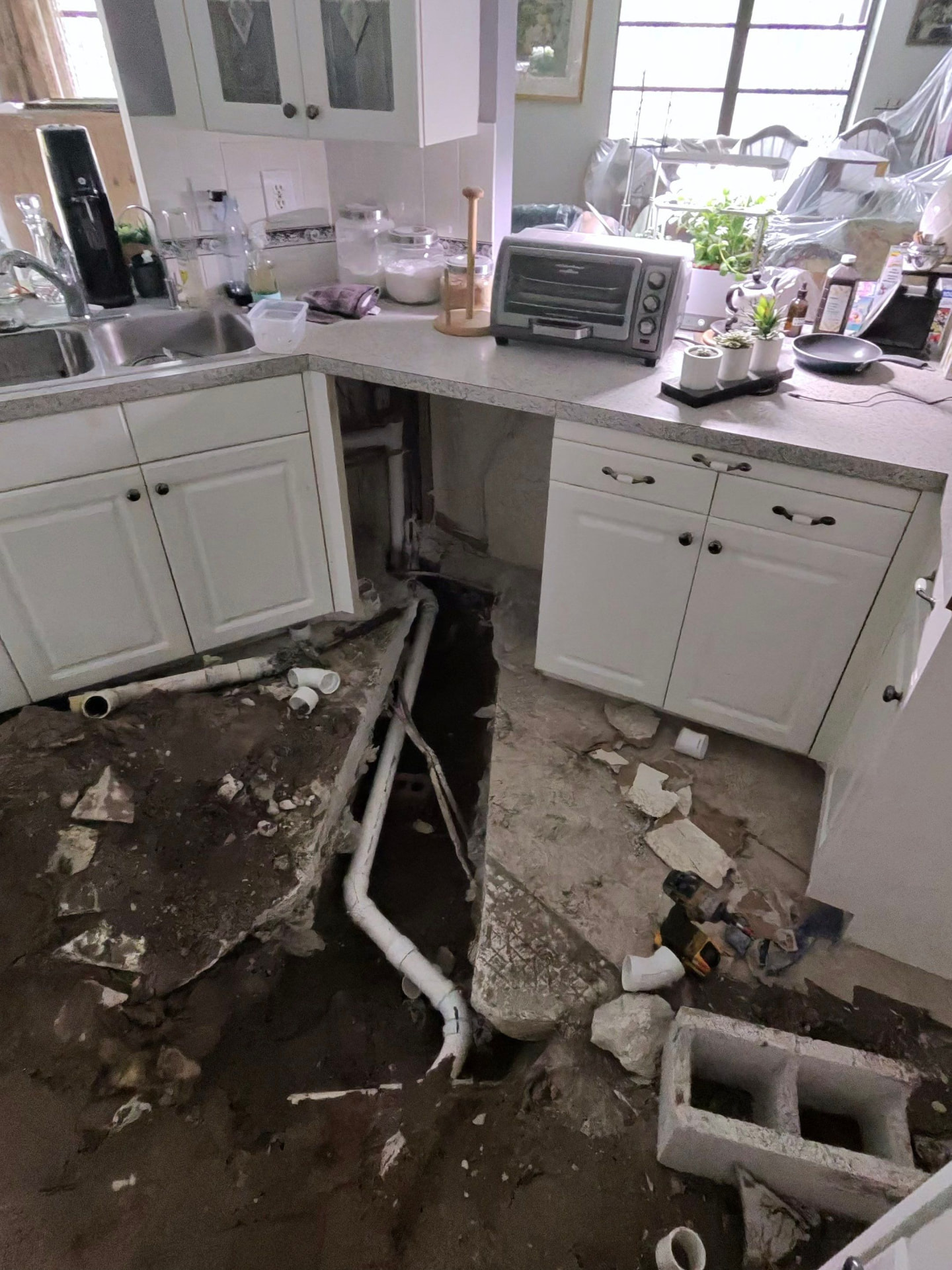
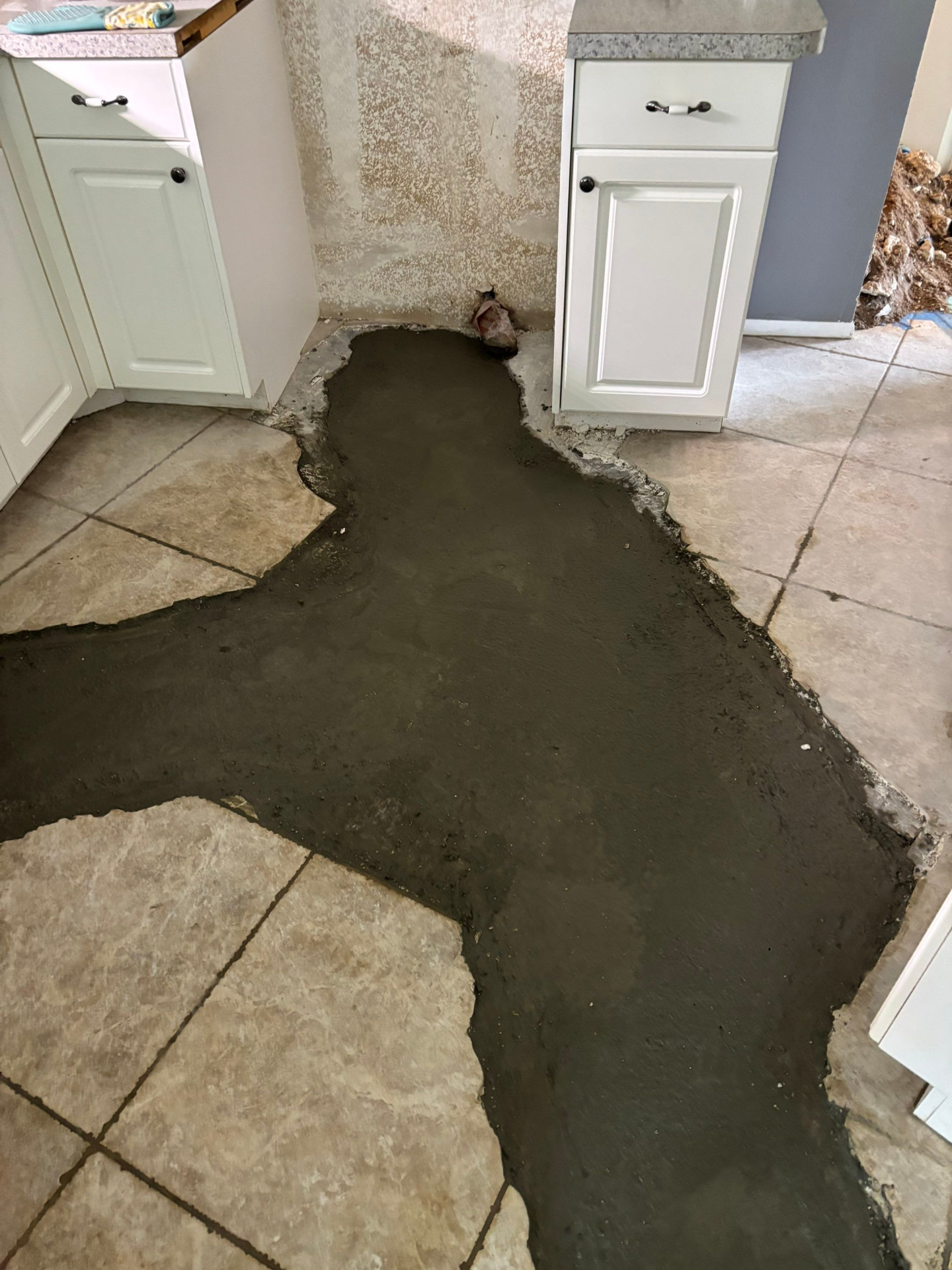
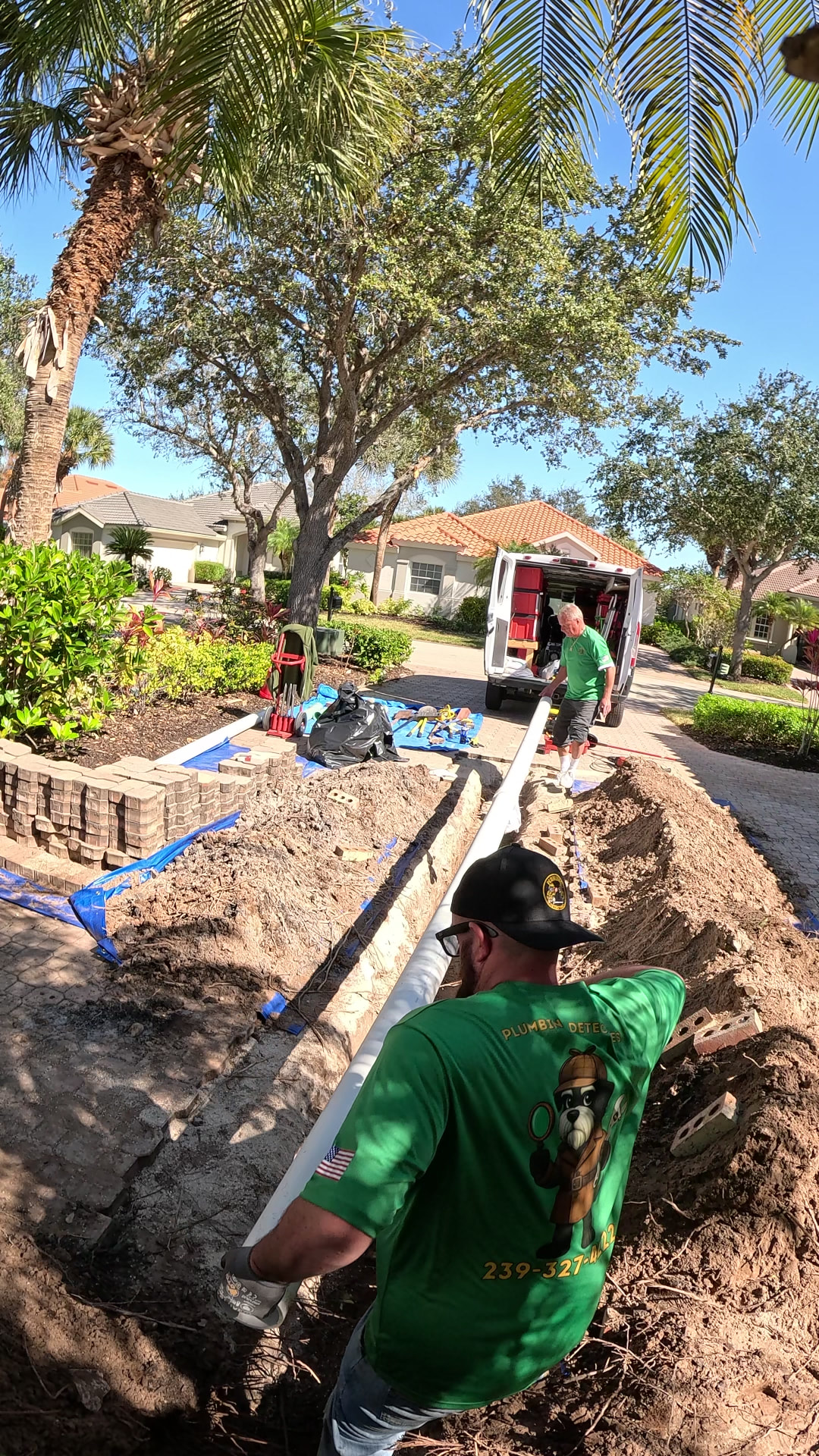
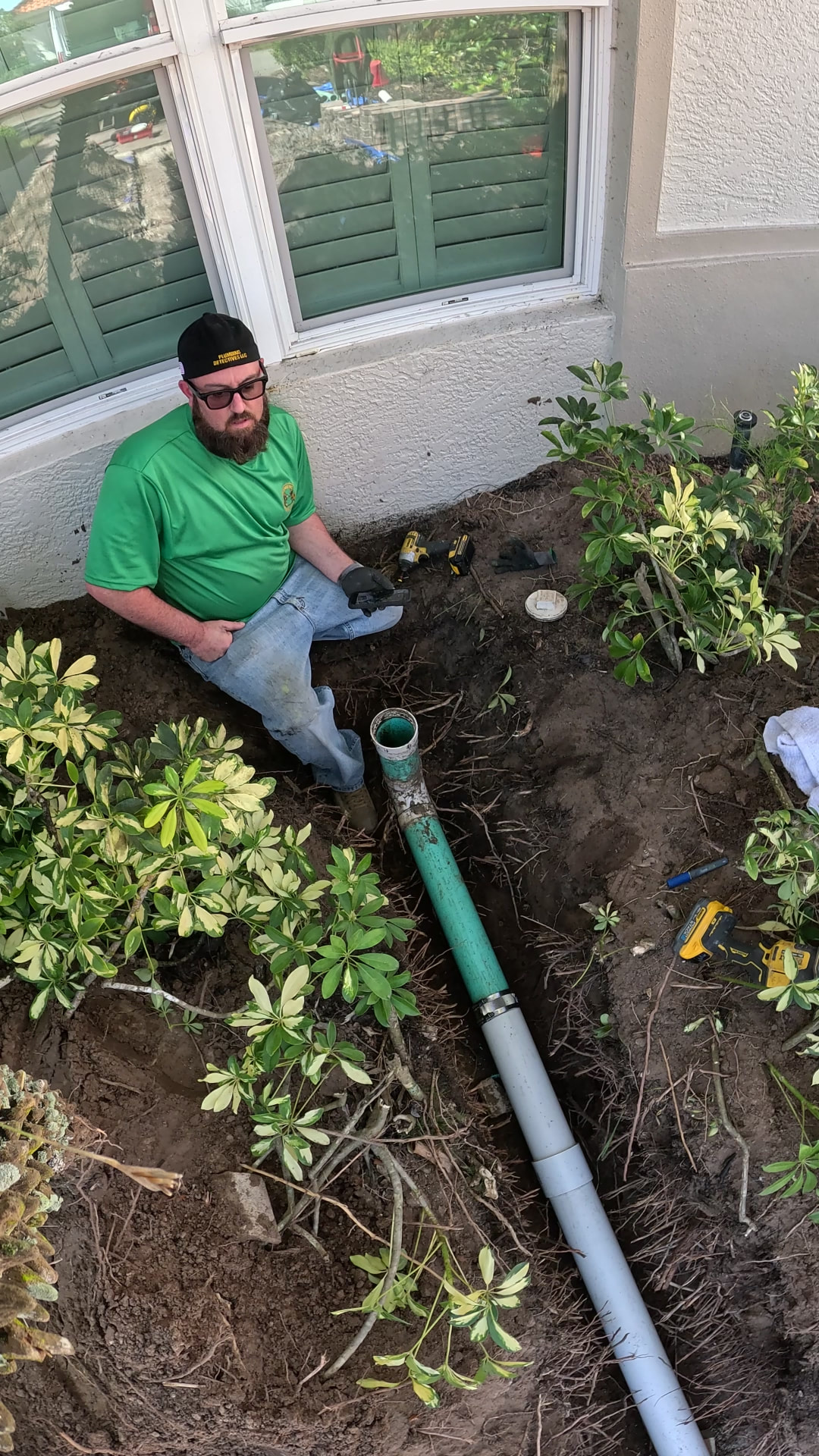
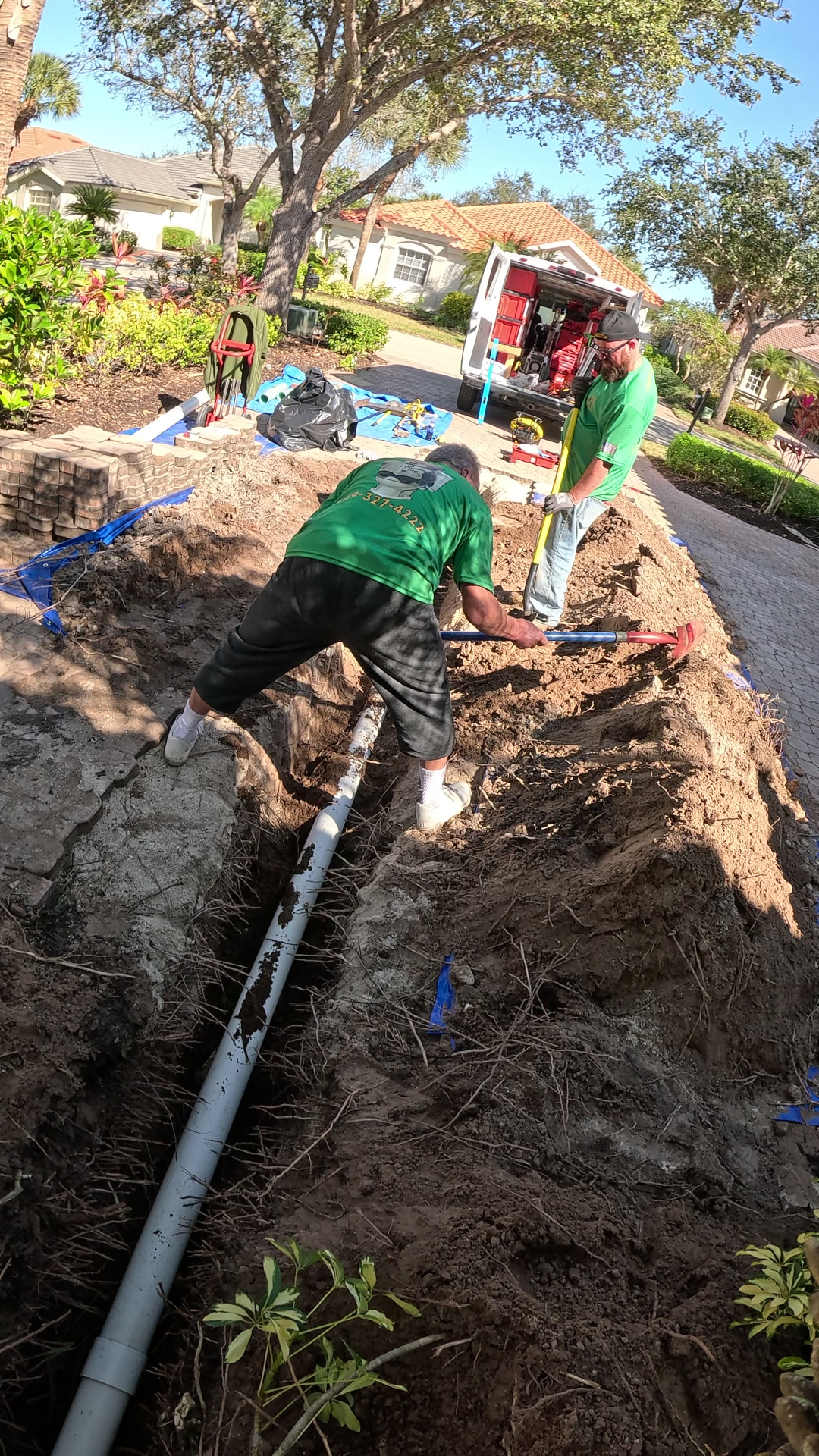
How the new pipe gets supported. Manatee County soil is broadly sandy, consistent with the Gulf coastal lowlands pattern across this whole region, with a shallow water table during wet season capable of settling unsupported pipe over time — especially relevant in Bayshore Gardens and Village of the Arts given decades of uncontrolled soil movement around original, non-engineered pipe runs. I tamp the native sand, add bedrock, and tamp again until firm — at least 8 to 9 inches of compacted base under the pipe wherever I have the height — then set cinder blocks or bricks for support where height is tight, checking pitch continuously before backfill goes in.
Cleanouts to code. Every replacement includes cleanouts where the Florida Plumbing Code requires them — at the junction of the building drain and building sewer, at the base of stacks, at horizontal runs over 100 feet, and at direction changes exceeding 45 degrees. In homes the age of Bayshore Gardens or Village of the Arts, it’s common to find no cleanout at all, since these requirements postdate the original construction — retrofit cleanout installation is a routine add-on scope item on jobs in these neighborhoods.
Permit and inspection. City of Bradenton permits — including Village of the Arts — route through the City’s Building and Permitting Division using the Accela system. Unincorporated Manatee County permits — including Bayshore Gardens and West Bradenton — route through Manatee County Development Services at (941) 748-4501. If your Bradenton-area home is in a flood zone and wasn’t built to current FEMA elevation standards, a major sewer line replacement can also count toward the City’s 50% substantial-improvement threshold, which has its own dedicated permit packet — something we flag before scoping a large job on an older, non-compliant structure. We verify jurisdiction and pull the correct permit before work begins on every job.
Gurgling toilet? Backups that get worse when it rains? Not sure if you’re City or County?
Call 239-388-3631. The camera comes first, you see everything I see, and you get a straight answer before anyone talks about opening a floor.
Bradenton Context
Repair Method Quick Reference — Bradenton Context
| Method | Best For | Not Appropriate When | Typical Regional Cost Range |
|---|---|---|---|
| Spot / Point Repair | One isolated failure in an otherwise sound line | The camera shows failures at multiple points | $800–$5,000 per national data; Florida sewer repairs average $3,430, most homeowners paying $980–$7,350 (CostWhale FL data) |
| Trenchless Relining (CIPP) | Structurally intact pipe with internal corrosion/scale that still holds its pitch | Bellies, sags, or sections out of pitch | $8,000–$20,000 typical Southwest Florida range; roughly $80–$250 per linear foot |
| Pipe Bursting | Structurally failed pipe on a straight run where a new pipe can be pulled through the old path | Tight access, offset joints, or material transitions that would deflect the bursting head | Roughly $60–$200 per linear foot nationally; one Bradenton-specific provider quotes $150–$400 per linear foot |
| Excavation & Replacement | Collapsed, rotted, or severely bellied pipe — restored to new PVC at correct pitch with proper bedding | Rarely wrong when done correctly — the tradeoff is floor/yard access | $12,000–$30,000+ typical for a single lateral; roughly $100–$300 per linear foot |
| Septic Line to Tank (Pipe Only) | A broken, blocked, or failed pipe between the house and an existing septic tank | Not applicable to the tank or drainfield itself | Priced the same as a sewer lateral repair |
| Septic Tank / Drainfield Installation | New systems or full drainfield replacement | This is not our scope | Handled by a licensed OSTDS septic contractor |
All figures are typical published market ranges — not quotes for your property. Every Bradenton job starts with confirming jurisdiction and system type, then a camera diagnosis, priced section by section, in writing, before any work begins.
Oak, Ficus, and 70 Years of Bayshore Gardens Landscaping
Roots — Oak, Ficus, and 70 Years of Bayshore Gardens Landscaping
Live oak, ficus, and willow are repeatedly identified regionally as the most aggressive-root, highest-risk species for sewer line intrusion, with recommended setbacks of 20 to 30 feet from a sewer lateral for large canopy species. Florida’s subtropical climate means live oaks grow roots year-round rather than seasonally, making them a persistent rather than occasional threat to nearby pipe.
Bayshore Gardens is the highest-probability root-intrusion zone in this market: a fully landscaped, planned community since 1956, meaning roughly 70 years for street trees and yard plantings to reach full root spread — directly overlapping the neighborhood’s 55-to-69-year-old cast iron pipe stock. Village of the Arts carries a similar risk from an even older baseline, with a century of tree growth over dense, closely-spaced century-old lots.
On the camera, root intrusion looks like a curtain of fine hair at first, then a mat, then a mass that catches everything flowing past it. One thing worth knowing if part of your home has already been repiped: root intrusion in PVC happens almost exclusively at joints and fittings, not through intact pipe wall — so finding roots in a “newer” repaired section usually means one defective joint, not a reason to replace the whole run. I’ll give you the same honest answer here I give every homeowner who asks if I can just cut the roots out again: I can, with a Spartan 300 machine running a claw head — and they’ll be back, because if roots are inside your pipe, your line is already compromised.
Your Lateral and Bradenton's Own Infrastructure Crisis
Who Owns What — Your Lateral, and Bradenton’s Own Infrastructure Crisis
The standard rule applies in Bradenton the same as anywhere else: you own your sewer lateral — the pipe from your house to the connection with the main — and you’re responsible for keeping it free-flowing and watertight. The city or county utility owns and maintains only the main itself.
I want to be straight with you about something most companies won’t bring up: the City of Bradenton’s own public sewer system has serious, well-documented problems that have nothing to do with your private lateral. The city’s collection system runs 270 miles of pipe connecting roughly 4,200 manholes, and as of recent reporting, about half of the city’s 62 miles of outdated clay, cast iron, and metal pipe — some dating to the 1930s — had been repaired under a 598-page settlement agreement requiring a $50 million treatment plant expansion and $120 million to rebuild or relocate 64 lift stations. Reporting on that settlement describes the city as having struggled to meet its own benchmarks due to permitting delays and administrative turnover — meaning this is an ongoing, unresolved situation, not a completed fix.
Why that matters to you: if your backups happen mainly during heavy rain, it’s worth considering that the public system’s documented inflow and infiltration problems could be a contributing factor, not just your private line. That’s not a reason to skip a camera inspection of your own lateral — it’s a reason to get one, so you know for certain which side of the connection the problem is actually on.
Standard homeowners insurance generally treats lateral failures from wear, corrosion, or root intrusion as maintenance issues, not covered perils. A service line endorsement — commonly under $3 a month in Florida, with coverage limits around $10,000 — is usually available as a separate add-on and worth a look given this market’s older housing stock.
Read This Before the Contract
Buying or Selling in Bradenton? Read This Before the Contract
Florida Statute 689.301 requires sellers to disclose known defects in a property’s sanitary sewer lateral before executing a sale contract, and Florida’s general seller-disclosure duty (established in Johnson v. Davis) covers known, material defects that aren’t readily observable — a known cast iron failure in an older Bradenton home falls squarely under that. I’m not a lawyer and this isn’t legal advice, but if you know of a defect, the obligation exists.
4-point inspections are a routine, frequent event given Bayshore Gardens’ and Village of the Arts’ housing age — most Florida insurers require one on homes over roughly 25 to 30 years old. A standard home inspection almost never includes a sewer camera inspection, so a pre-listing scope is cheap insurance before you list or close, especially in a market with this much variation in pipe material.
For Village of the Arts specifically: if you’re buying a property with a live-work commercial component — a gallery, studio, or small restaurant space — ask directly whether the commercial retrofit plumbing was permitted and inspected, and don’t assume the whole structure shares one pipe material.
The Part You'll Never See
If I Could Redesign One Thing About Homes This Age
For the drain side of homes from this era — whether it’s a 1956 Bayshore Gardens ranch or a 1920s Village of the Arts bungalow — my answer doesn’t change: none of them were vented the way I’d vent them today.
Homes from these periods were plumbed before modern wet venting was standard, and what I typically find instead is a bathroom group with one vent serving three fixtures. My preference, on the vast majority of the work I do, is the traditional approach: vent each fixture individually. Every fixture with its own air path gives you the best flow, the quietest drainage, and the most serviceable system. So when we’re replacing a section of an older Bradenton home’s drain system anyway, the venting gets evaluated too.
What I Find in Bradenton Sewer Work
Common Mistakes I Find in Bradenton Sewer Work
Assuming one pipe material for the whole house. Especially in Village of the Arts, where a hundred years of patchwork repairs and commercial retrofits means a single structure can have more than one material in it.
Guessing the wrong permit office. City of Bradenton and Manatee County are two separate departments with two separate systems — an easy, costly mistake to make on the wrong side of a neighborhood boundary.
Treating a septic-connected home as entirely someone else’s job. It isn’t. The pipe running to the tank is exactly the kind of work we camera and repair — only tank and drainfield installation is outside our scope.
Camera inspection as a checkbox, not documentation. A lot of Bradenton companies mention “camera inspection” without actually delivering the footage. Documented video with a distance counter is accountability, not a formality.
Unsupported pipe. When I camera a Bradenton line another company already “fixed” and find it bellying again, I’d bet money nobody accounted for this soil’s water table.
Lining over a belly. Selling CIPP on a line the camera shows is out of pitch. Lining doesn’t fix gravity.
Blaming the homeowner’s lateral for a public system problem. Given Bradenton’s documented public infrastructure issues, a rain-driven backup deserves a camera check before assuming it’s your line at fault.
Plumbing Detectives LLC Tips
If you’re in Bayshore Gardens, know that a lot of these homes have never been substantially renovated — don’t assume the original 1950s–60s plumbing has already been addressed just because the neighborhood looks well kept.
If you’re in Village of the Arts and buying or leasing a live-work space, ask specifically whether the commercial-use plumbing retrofit was permitted — don’t assume it matches the rest of the structure.
Track whether your backups get worse during heavy rain. That single detail helps sort out whether the issue is on your side of the connection or tied to Bradenton’s documented public system problems.
Before you sign any lining or repair proposal in Bradenton, ask for the recorded camera footage with the distance counter visible — not just a verbal description of what was found.
What 2024's Three Storms Did
Storm Context — What 2024’s Three Storms Did to Bradenton’s Sewer System
I want to be straight about this section: it’s grounded in documented news reporting and public settlement records, not my personal storm-repair work in every affected home — and it’s some of the most extensively documented public-infrastructure trouble of any market I serve.
Bradenton took three named storms in roughly nine weeks in 2024: Tropical Storm/Hurricane Debby in August, Hurricane Helene in late September, and Hurricane Milton in October. During Debby alone, the city reported 25 million gallons of sewage released, then another 25.6 million gallons days later, prompting a Florida DEP warning letter for more than 50 million gallons dumped into the Manatee River that August. The cumulative Debby/Helene/Milton total for Bradenton is reported at over 136 million gallons — including an additional 18 million gallons of non-dechlorinated treated wastewater discharged after Milton due to a chemical shipping delay. Across the broader Sarasota/Manatee/DeSoto region, those three 2024 storms combined released 177.8 million gallons, described as more sewage pollution from three storms than any period in at least the prior five years.
This isn’t a closed chapter. As of January 2025, “solids overload” events were still causing partial treatment bypasses — 450,000 gallons released over two days that month, plus a separate 2,000-gallon raw sewage spill into Wares Creek from a lift station malfunction in November 2024. A lightning strike separately knocked out a lift station in July 2024, spilling roughly 200,000 gallons of untreated sewage toward local waterways. And in March 2026 — well over a year after Milton — roughly 14,000 gallons spilled into nearby waters after a concrete vault over an air-release valve failed, a failure the city attributed to erosion caused by the 2024 hurricanes. The City posted advisories along the Manatee River warning the water was unsafe for fishing or swimming after repeated spill events.
Two practical takeaways. First, if your Bradenton home took on any backup or unusual drainage behavior during or after these storms and hasn’t been inspected since, that’s worth doing now. Second, given how much of this damage is still surfacing more than a year later, don’t assume a rain-triggered backup today is unrelated to storm damage from 2024 — it’s a documented, ongoing pattern in this specific city’s system.
The Differentiator
Why Plumbing Detectives LLC
Bradenton has plenty of plumbing companies, several offering trenchless service and several sticking to traditional excavation only. What I do differently: I confirm your neighborhood and jurisdiction before I talk permits, I run a camera before I talk price and actually hand you the footage, and I’ll tell you plainly when something — a septic tank installation, a public-system issue on the city’s side — is outside what I do.
Camera first. Documented findings you actually receive. Section-by-section honesty. White glove protection of your home. Proper bedding you’ll never see but will never have to think about again. And if you’re on septic, we still run the camera and fix the pipe between your house and the tank — we just don’t install septic systems themselves.
License CFC1434139. Fully insured. We verify City-of-Bradenton versus Manatee County jurisdiction and pull the correct permit before every job. Emergency sewer service available in Bradenton and nearby areas — call for priority scheduling.
Answers
Frequently Asked Questions — Sewer Line Repair in Bradenton, FL
If you’ve read this far, you understand why Bradenton doesn’t get a one-size-fits-all answer — a single-developer mid-century community and a century-old arts district, split across two governments, sitting on top of a city sewer system with its own well-documented problems. You know why the camera answers the pipe-material question instead of the neighborhood name, and why a rain-triggered backup deserves a real look before anyone blames your lateral. If your Bradenton home is showing any of the signs on this page, call me at 239-388-3631. The camera goes in first, you see everything I see, and you get the truth before you get a price.
Plumbing Detectives LLC | Venice, FL | License CFC1434139
239-388-3631 | plumbingdetectivesfl.com