
More people are calling me before they close on a house now than when I started here. That’s a good thing. But it still doesn’t happen most of the time, and when it doesn’t, I usually meet the new owner a few months later — standing in their hallway, looking at a camera screen, learning what the inspection didn’t cover.
This isn’t a knock on home inspectors. It’s about what a home inspection actually is under Florida’s rules, what a sewer scope actually is under a widely used industry standard, and the gap between the two that nobody explains to a buyer.
What a Florida Home Inspection Is Required to Cover
Florida law defines home inspection services as a “limited visual examination” of a home’s readily accessible installed systems — plumbing included (Florida Statutes §468.8311). The state’s standard of practice for the plumbing system says the same thing a different way: the inspector examines the visible and readily accessible plumbing components (Florida Administrative Code Rule 61-30.806). Neither one calls for running a camera inside the drain line.
So Florida’s minimum home-inspection standards call for a limited visual examination of accessible plumbing; they do not require an internal sewer-camera inspection as part of every standard home inspection. An inspector can recommend one, and a good one will on an older home. But it isn’t built into the baseline, and the buyer usually doesn’t know that.
The Second Gap: A Sewer Scope May Not Include the Slab
Some buyers know to order a separate sewer-scope inspection on an older home. Smart move. Here’s the part that catches people off guard.
InterNACHI, a professional home-inspector association, publishes a standard of practice for sewer scopes. It describes the inspection as covering the main or exterior lateral sewer line from a cleanout or roof vent — the run out toward the street, HOA connection, or septic tank. It states that the inspector is not required to “scope or inspect underfloor or in-house portions of the building drain or sewer system,” and is not required to pull a toilet to get access (InterNACHI Sewer Scope Inspection Standards of Practice).
Read that again if you own or are buying a slab home built in the 1960s, ’70s, or ’80s. The section under the house — the original cast iron, the part I get called about — can be outside the scope of the sewer inspection you paid for, unless you specifically asked for it and the inspector could physically get there. The same standard says the scope can be modified by agreement between the client and the inspector before the inspection. In plain terms: you can ask for the under-slab section. You just have to know to ask.
That’s one association’s standard, not Florida law, and it doesn’t describe every company’s service. Some inspectors go further. The point is that you have to ask.
What I Actually Found in a 1980 Venice Home
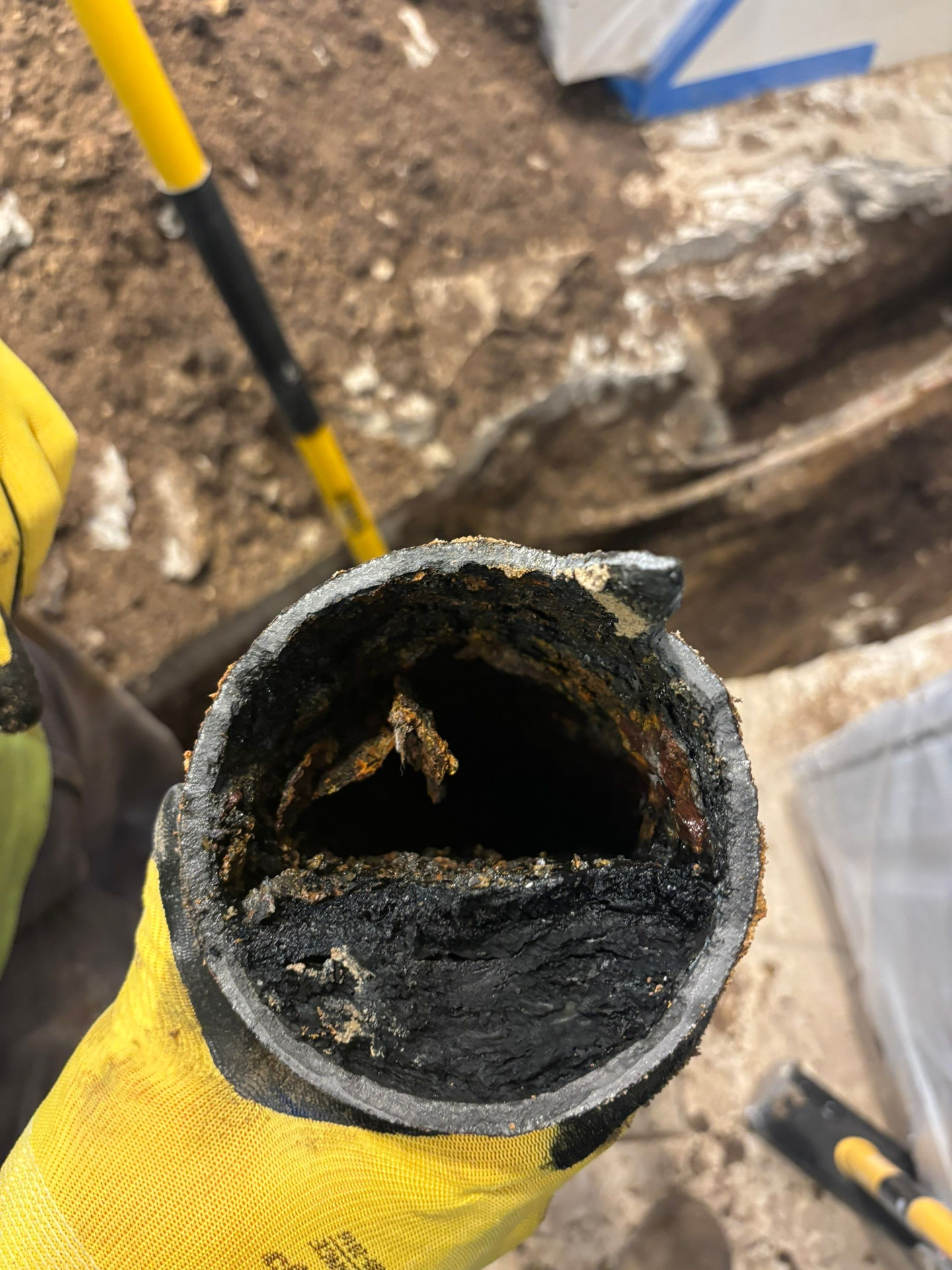
This past April I got a call from a homeowner in Venice: her toilets were gurgling whenever she ran the wash. Block house on a slab, built in 1980. I ran the camera from the back of the house and got about fifteen feet before I knew we had to open it up.
The drain line was the original cast iron — forty-six years old, which is under the 50-to-60-year guideline InterNACHI publishes for below-ground cast iron in its Florida and national service-life charts. The bottom of the pipe was packed with black deposits, like soot out of a charcoal furnace. When I picked up a cut-out section, it crumbled in my hand. Fittings had collapsed and cracked.
We ended up replacing roughly three-quarters of the drain piping inside that house. We stopped before the master bath, because that pipe looked to be in good condition — and I don’t replace pipe because of its age. I replace what’s actually bad.
I’ll say plainly what I can and can’t claim from a job like that. I can tell you what I saw: heavy scale, deposits, a pipe that had lost the metal that gave it strength, and fittings that had let go. I can’t tell you from a photo exactly which corrosion process did it — that takes a lab, not a plumber with a camera. And one house isn’t a statistic. But it’s a house that looked fine from the outside, and a standard visual inspection would not have shown the inside of that concealed pipe.
Why I Think Venice Cast Iron Gets Like This
This is my opinion from the field, not a study. I cut out a lot of old cast iron in New York before I moved here. What I see in Venice is different: the pipe crumbles, and the scale build-up is ridiculous. The failures I find most often here are scale choking the line, fittings settling, no-hub bands coming apart, and bellies — low spots that hold standing water.
My guess at why: the water, plus constant warm sand and a rainy season that moves things, compared with clay up north that holds a pipe like a rock. I could be wrong about the mix. As far as I know, nobody has a clean Florida-versus-New-York comparison to point to, and I’m not going to pretend I do. Warmth, what’s in the wastewater, moisture trapped under deposits, and the soil around the pipe can all play a part. What I can do is show you what’s actually in your pipe.
What a Camera Inspection Can and Can’t Tell You
I use two cameras: a smaller one for sinks and branch lines, and the main-line camera with a locator for the trunk. The camera goes as far as the pipe lets me. What usually stops me is a belly — once the lens is underwater, I can’t see. If there’s no cleanout, I’ll usually pull a toilet, because you want to see the main trunk line. I’ll go through a roof vent if there’s no other option.
Here’s how I run every one of these, and I tell every customer the same thing: you watch the screen with me. If the camera finds a belly or a break, or can’t go any farther, I show you what we can see and tell you what’s still unknown. Opening the floor to get at that section is a separate repair step — it only happens if you decide to authorize it. Once the line is open, I run the camera in both directions from there and report back, and if it needs to keep going, we decide that together. I can’t honestly tell you what I can’t see — and any inspection report that doesn’t say which sections it couldn’t reach is leaving something out.
A camera documents the visible interior of the sections it reaches. It doesn’t measure how much pipe wall is left, and a clean run through the sections I could see doesn’t prove the sections I couldn’t. That’s not a sales pitch for more work. It’s the honest limit of the tool, and you should hear it from whoever inspects your line.
Six Questions to Ask Before You Close
Six Questions to Ask Before You Close on an Older Venice Home
- Did anyone actually run a camera in this drain line — or is the report based on the home’s age and area? A standard home inspection is a limited visual exam. Check whether an internal camera inspection was actually performed and documented.
- If a sewer scope was done, did it include the pipe under the slab, or only the run from the cleanout out to the street? Under a common industry standard, the underfloor and in-house sections can be excluded unless you ask. Ask which sections were covered, in writing.
- What access point was used, and where did the camera stop? From a cleanout, a pulled toilet, or a roof vent — and did it reach the main trunk line under the house, or stop at a belly or a blockage?
- Which sections are cast iron, and which are PVC or something else? An older home may have been partially repiped. Knowing what’s original tells you where to look harder.
- Which sections couldn’t be seen, and why? Standing water, deposits, offsets, no access. A report that doesn’t list what it missed isn’t complete.
- Do I get the recording and a written summary — and what do the findings mean? Clean, monitor, spot-repair, or replace a run. Age alone isn’t a replacement order; what’s actually in the pipe is.
If the answer to several of these is “I don’t know,” that isn’t a failed inspection. It’s a gap you can close before closing. A sewer camera inspection is a separate service, and it’s the practical way to see inside the accessible line without opening the floor — instead of inferring its condition from the year the house was built.
What I Tell Owners Who Already Have Old Cast Iron
If you’ve got 1970s or ’80s cast iron and no symptoms, my honest answer is: ride it out, but understand that one day it will need to be replaced. It’s a matter of when, not if. If you’re planning any remodeling — a bathroom, a kitchen, opening up the floor for any reason — that is the time to seriously consider redoing the piping, because the floor’s already open.
Gurgling toilets when another fixture runs, slow drains that keep coming back, wet spots or a smell you can’t place: those are reasons to get a camera in there now, before it becomes a backup.
The Bottom Line
A home inspection and a sewer scope are both worth having. A standard Florida home inspection doesn’t automatically include a camera inside the drain line, and a separately purchased sewer scope can leave out the pipe under the slab depending on the agreed scope and the access available. If I’m being honest about my own opinion, a sewer camera inspection before closing on an older home should be standard — it isn’t, and I don’t think that’s right. Until it is, ask the six questions, get the answers in writing, and know what you’re buying.
Plumbing Detectives LLC serves homeowners throughout Venice, Nokomis, Sarasota, Laurel, Englewood, and surrounding areas. Florida Plumbing Contractor License CFC1434139. (239) 388-3631 | plumbingdetectivesfl.com