
Reverse Osmosis Water System Installation in Venice, FL
Bottled water for drinking and cooking, without the trips to the store. A properly installed reverse osmosis system gives you water that's cleaner than what comes out of the tap — installed by a licensed plumber, not a big-box return desk.
Get a Free QuoteWhy It Fits Here
Venice already trusts reverse osmosis. We're just bringing it to your kitchen sink.
Here's something most homeowners don't know: the City of Venice's own municipal water treatment plant is a reverse osmosis plant. The city treats brackish groundwater pulled from 14 supply wells through a full-scale RO system, producing roughly 4.48 million gallons a day for the whole system. RO isn't some boutique add-on technology here — it's literally how your tap water gets made safe to use in the first place.
What a point-of-use RO system under your sink does is extend that same idea the last five feet, from the pipe to your glass. City treatment handles bulk safety and disinfection for the whole distribution system. A dedicated RO system at your kitchen sink adds another layer specifically for the water you drink and cook with — pulling out dissolved solids, and whatever's picked up on the way from the treatment plant to your house, right at the point where it matters most.
The System
What we install: the Safety Zone RO-4
We install the Safety Zone RO-4, a 4-stage system sold through plumbing supply wholesalers to licensed contractors rather than sold directly off a store shelf. That matters for a practical reason: when you need a new cartridge, it's ordered back through us, not chased down through a warranty maze — and the system is installed to code by someone licensed to do it, not caulked in on a Saturday afternoon.
The four stages, in order:
- 5-micron sediment filter — pulls out sand, rust, and larger particulate before it can foul anything downstream.
- 5-micron carbon block filter — reduces chlorine taste/odor and a range of organic compounds.
- TFC reverse osmosis membrane — the core of the system. Water is forced through a thin-film composite membrane under pressure, rejecting dissolved solids down to a molecular level.
- GAC (granular activated carbon) post-filter — a final polish stage right before the water reaches your dedicated faucet, for taste.
Typical performance on this system is 90-95% reduction in total dissolved solids (TDS), stored in a 3.2-gallon pressurized tank so you've got ready water on demand instead of waiting on the membrane in real time. Daily production is in the neighborhood of 50 gallons — plenty for a household's actual drinking and cooking water use, which typically runs somewhere in the 2-5 gallon per day range per family, not the 50+ gallons a whole-house system would need to handle.
Honest Positioning
Where this system fits — and where it doesn't
We'll say this plainly: we're not going to tell you the RO-4 out-performs every WQA-certified consumer unit on the market on paper, because we don't have the lab data to back that up, and neither does anyone selling you a system honestly. What we can tell you is what actually matters for a homeowner: it's installed correctly the first time, on a documented commissioning process, with a "quick-change" cartridge design that doesn't need a service call for routine maintenance, sized realistically for what a household actually drinks and cooks with rather than an inflated number that looks good on a sales sheet.
Requirements
The specs that actually matter
Not every RO system installs the same way, and not every home qualifies for one without extra work. Here's what the RO-4 needs to run correctly:
- Working water pressure
- 40-125 psi (40 psi minimum — if your home runs lower than that, we'll talk about options before we quote the job)
- Tank precharge
- 7 psi (this is what pushes water from the tank to your faucet — it's also why the tank needs to sit within about 5 feet of the faucet it feeds; farther than that and you need a booster/delivery pump)
- Water temperature
- 39°F-100°F
- Feed water pH
- 5-10
- Turbidity
- under 1.0 NTU
- Hardness
- under 300 ppm
- Chlorine
- 0-3 ppm
That hardness limit is the one that catches well-water customers off guard. Private wells out here commonly test around 390 ppm hardness — over the RO-4's limit. That's not us upselling you a water softener you don't need; it's a real spec requirement, because hard water scales the membrane and shortens its life. If you're on a private well with hard water, we'll talk about a softener ahead of the RO system, not instead of it — they solve two different problems in two different parts of the house, and a lot of homes end up running both.
Installation Standards
How we install it — the right way
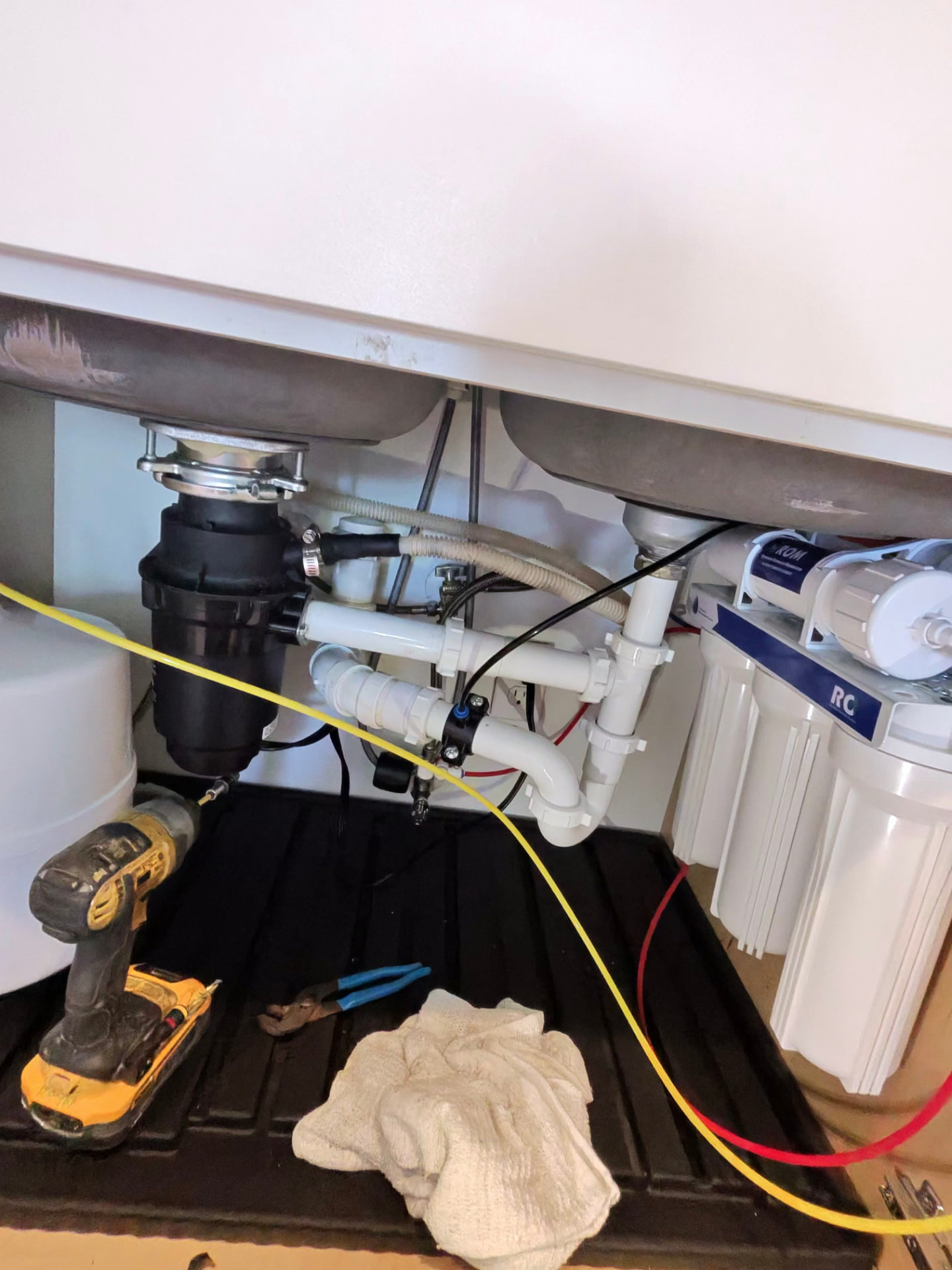
A saddle valve — the kind that pierces straight into a pipe with a self-tapping needle — is the fastest way to tap a cold water line, and it's also a documented leak point that some jurisdictions won't even sign off on. We don't use them for RO feed connections. We tie in with a proper tee fitting and a dedicated stop valve, so the connection is a real fitting, not a puncture.
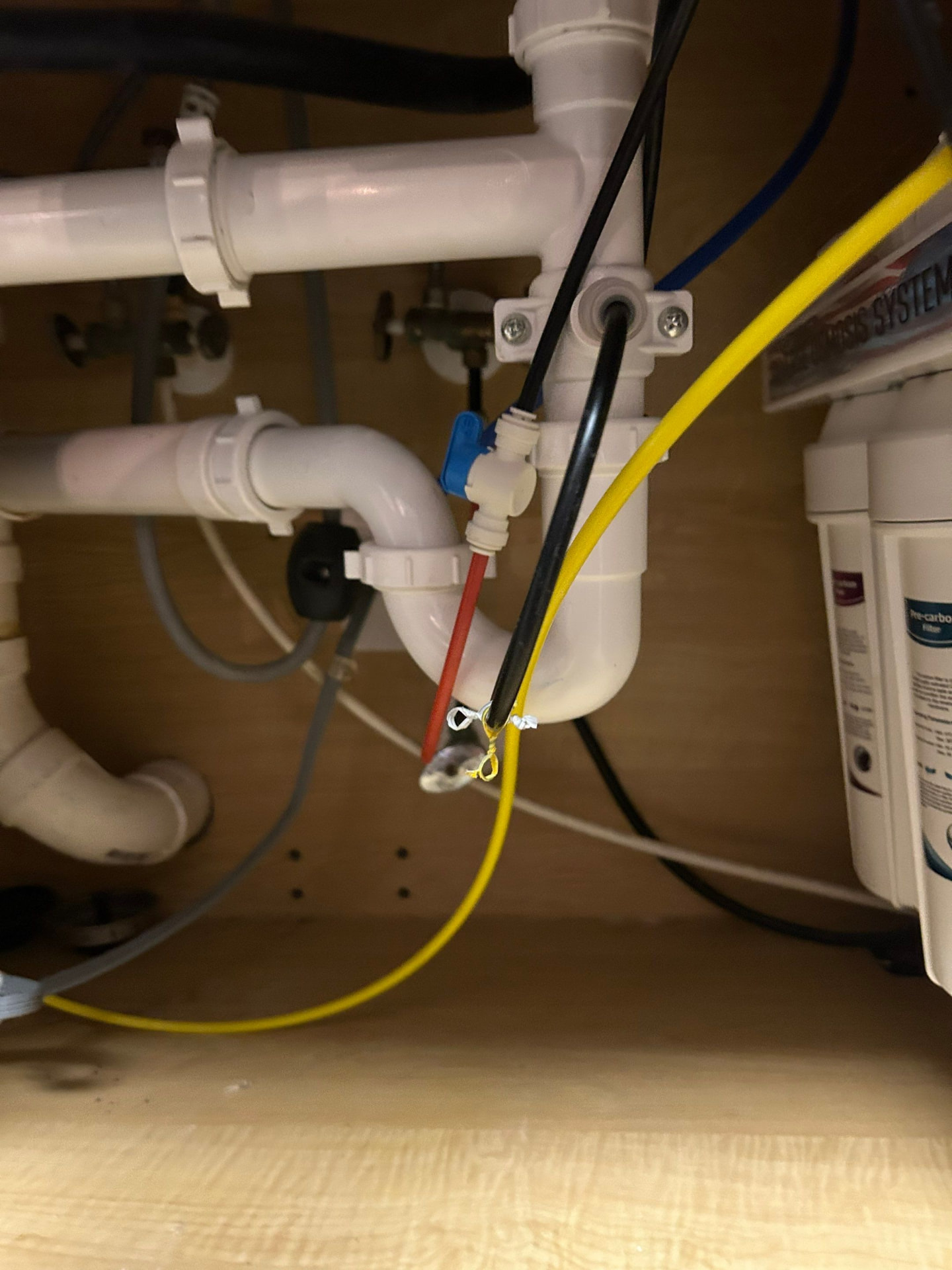
On the drain side, the saddle for the RO drain line goes on the sink's drain pipe — on the horizontal run, positioned downstream of the garbage disposal if you've got one, with a high loop built into the tubing before it ties in. That loop is what keeps drain water from ever siphoning back into the system. Tubing gets cut square with a proper tube cutter, not scissors or a utility knife, because the quick-connect fittings this system uses depend on a clean, square cut to seal. The tubing itself is color-coded so anyone servicing it later can tell at a glance what's what: orange for the feed line, blue to the faucet, black to drain, yellow to the tank.
Once it's installed, we don't just turn it on and leave. The system gets commissioned with a two-flush protocol: fill the tank and let it sit over two hours, then run the faucet until the tank empties completely, refill, and flush it empty a second time. After that second flush, the system is fully operational and the water is ready to drink. Skipping that step is how people end up with air in the lines or a chemical taste from a fresh membrane that never got its first proper flush.
Code Position
On air gaps and faucet code
Some states require an air-gap style RO faucet by law; Florida's code position is different, and we install to Florida's actual requirements as licensed plumbers — not to another state's rule. If you have a specific preference for an air-gap faucet regardless (some homeowners just like the added assurance), we're happy to install one; we just won't tell you it's required here if it isn't.
Maintenance
Cartridge life — and what "quick-change" actually means
This system is built around swappable cartridges rather than a full teardown at service time:
- Sediment, carbon block, and GAC post-filter: roughly every 12 months under normal household use, or every 6 months if you're running heavy volume
- RO membrane: roughly every 3 years under normal use, or every 2 years under heavy use
The "quick-change" design means these swap out without a wrench or a service call in most cases — order the cartridge through us when it's due, and it's a homeowner-level swap. We're also the ones who'll tell you honestly when it's actually time, rather than on a generic subscription schedule that doesn't match how much water your household actually runs through it.
Straight Answers
Straight answers to the questions people actually ask
Condos
If you live in a condo
Under-sink cabinet space is tighter in a lot of Venice condos, and the RO-4's tank needs real clearance — both for the install itself and for that 5-foot proximity to the faucet we mentioned above. Upper-floor units sometimes run lower water pressure too, which can mean a booster pump is part of the job. And depending on your association, there may be plumbing modification rules worth checking before we schedule anything. We'll walk your specific kitchen with you and tell you honestly if there's a wrinkle before we start, not after.
Why Plumbing Detectives
Why homeowners in Venice choose us for this
Venice's population skews heavily toward homeowners 65 and older, and for a lot of our customers the honest selling point isn't a TDS percentage on a spec sheet — it's not hauling cases of bottled water in from the car anymore. Cold, clean water straight from the tap, for less than what a lot of households already spend on bottled water over a year.
We're licensed (CFC1434139), we install this system to the manufacturer's actual specs and Florida's actual code, and we tell you plainly what it can and can't do rather than what sounds best in a sales pitch. If a softener needs to come first, we'll say so. If your pressure's too low, we'll say so. And if we can't confirm a certification claim, we're not going to make one up.

Ready for clean water straight from the tap?
Let's look at your kitchen and give you a real number.
Plumbing Detectives LLC | Venice, FL | License CFC1434139