
People ask me some version of “who’s the best plumber in Venice?” more than any other question, and I’m going to be straight with you: I’m not going to answer it by telling you it’s me. I own a plumbing company, so you should take anything I say about my own company the way you’d take it from any business owner — as something to verify, not something to believe.
What I can do is tell you what I’d look for if I were hiring a plumber for my own house, and give you the tools to check it. That’s what this guide is. Where I use my own company as the example of how something should be done, I say so. And at the end there’s a fact box with the specific things about Plumbing Detectives you can go confirm for yourself.
What “Best” Actually Means
When a friend asks me who to hire, I don’t give them a name. I give them questions.
What was the plumber’s procedure for telling you what was wrong? Did they actually look, test, and isolate the problem — or did they say “this is what I see all the time” and quote you? Experience is valuable, but every home is different, and a diagnosis that came from a pattern instead of from your house is a guess.
How did their work look? Clean, or did they leave you a mess?
Did they communicate everything with you, or did you find out what they did after they left?
Did they show up on time, or did you sit there for hours with no phone call?
Those four questions will sort out more plumbers than any star rating will. “Best” is the one who diagnoses your actual problem, explains it so you understand it, does clean work, and treats your time like it matters.
How Do I Verify a Plumber’s License in Florida?
Start here before anything else. Florida licenses plumbing contractors through the Department of Business and Professional Regulation (DBPR), and anyone can look up a license for free.
Here’s the process:
- Ask the plumber for their license number and the exact business name that will be on your estimate.
- Go to the DBPR license lookup and search by license number.
- Check the license type, the status (you want “Current, Active”), the expiration date, and the names attached to it.
- Confirm the business on your paperwork is tied to that license. In Florida, a licensed contractor “qualifies” a business, so the record will show the individual’s name and the company name under the same license number. If the company on your estimate isn’t on the license record, ask why before you go further.
DBPR itself tells consumers to ask to see the license and verify it before signing anything, and points out that a business card or a lettered truck doesn’t prove anyone is licensed (DBPR, “Trust but Verify”).
Two things that confuse people:
Certified vs. registered. Florida has two kinds of plumbing contractor licenses. A certified contractor (the license number starts with C) can work anywhere in the state. A registered contractor (starts with R) can only work in the specific jurisdictions where they qualified (DBPR, contractor definitions). Both are legitimate licenses. Just make sure the one you’re hiring is allowed to work where your house is.
“Master plumber.” That’s how I describe my trade background. When you verify my Florida license, the credential you’ll see is Certified Plumbing Contractor. That’s the right license.
Here’s mine, so you can see what a real lookup looks like: license CFC1434139, Certified Plumbing Contractor, showing Current and Active with an expiration of August 31, 2028, listed under my name and under Plumbing Detectives LLC at 312 E Venice Ave #203. That’s what the state record showed as of September 20, 2026 — go run it yourself; it takes about a minute.
What Should I Ask About Insurance?
License and insurance are two different checks. The state license lookup does not tell you whether a contractor is insured, so you have to ask.
Ask any plumber for their certificate of insurance and check that it’s current before work starts. I carry copies of my license and my insurance in the truck at all times, and I hand them over when asked. Some contractors will email it or have their agent send it — that’s fine too. What matters is that you get it and it’s current. If a contractor won’t provide it at all, that tells you something.
The FTC’s consumer guidance says the same thing: verify the license with the state, and separately ask for proof of insurance (FTC, “How To Avoid a Home Improvement Scam”).
What Should Happen Before Anyone Quotes You?
This is where the difference between plumbers actually shows up. Here’s what a first visit looks like from my side, and what I’d expect from anyone you’re paying to diagnose a problem.
We ring the bell and ask whether the van is parked somewhere that works for you. We put booties on before we walk in. We introduce ourselves and ask you what’s going on — and then we let you talk, because the history matters. Then we go put eyes on it. We ask more questions. We test what needs testing.
Only after that do we build out the options that apply to your situation. I do it on an iPad, right there, so you can see each one. I explain every one in detail, I tell you which one I recommend and why, and I tell you what needs to be done and what doesn’t. Financing is available, and I say so up front, because I’d rather you know that before you decide than after. And I try to give you a general picture of what your plumbing looks like a few years out, so you’re making the decision with the whole situation in front of you, not just today’s symptom.
We charge a diagnostic fee for that visit. It’s waived if we do the work the same day or you sign a written estimate. During the diagnostic we look over everything visible in the house — fixtures, the water heater, shutoffs, what we can see — not just the thing you called about, because the thing you called about is often not the only thing going on.
What you should be wary of is the reverse: a plumber who walks in, glances at it, and quotes a replacement before they’ve isolated anything. Sometimes they’re right. But you have no way to know, and neither do they.
A Real Example: The Hot Side Nobody Had Checked
A homeowner in Bradenton called me about a slab leak. She’d already had two previous slab leaks on the copper under her house, and she’d had other people out for this one. They’d used an acoustic listening device, and only on the cold line. Nobody had found it.
The first thing I did was isolate the hot side from the cold side and check them separately. The leak was on the hot side, and once you’re looking there, it was about as obvious as a leak gets — the thermal camera showed the heat signature, and the moisture meter indicated moisture in that area.
I didn’t have to bring up a repipe. She’d had three slab leaks in copper by that point, and she said “replace it” before I could say anything. That was the right call for her house, and it was her call to make — with the actual problem in front of her instead of a guess.
The point isn’t that I’m smarter than the people who came before me. The point is that there’s a procedure, and the procedure is the thing that finds the leak.
How Do I Compare Estimates That Say Different Things?
If you get three quotes for the same job, the totals will be different, and the totals will tell you almost nothing on their own. The FTC advises against automatically picking the lowest bid and says to ask what explains a large difference (FTC).
Here’s what’s usually behind the gap:
- What material is actually being installed. Two “water heater replacements” can be two different products with different warranties.
- What’s included. Does the price cover getting to the pipe — opening the wall, cutting the slab — and does it cover closing it back up? Or is that on you afterward?
- Permits. When one is required, who’s pulling it, and is that in the number?
- Cleanup and haul-away. Is the old heater leaving with them?
- Warranty. Is there a workmanship warranty, in writing, and for how long?
- License and insurance. Confirm both, for every quote, before you compare anything else.
Ask each plumber to walk you through their number line by line. If they can’t, that’s your answer.
What Should a Written Estimate Actually Look Like?
Mine don’t show material pricing. They show a detailed description of exactly what’s going in — the specific product, capacity, and warranty — and then they lay out the order of operations: what we do first, second, third, all the way through. When you’re reading one of my estimates for a water heater, you’re reading the steps of the job, not just “install water heater” and a number.
I do it that way because I want you to understand that we’re not just throwing in a water heater. There’s floor protection, there’s draining the system properly so nothing spills, there’s shutting the right valves in the right order, there’s disconnecting power before anyone touches a wire. Every one of those steps is on the page so you can see the job before it happens.
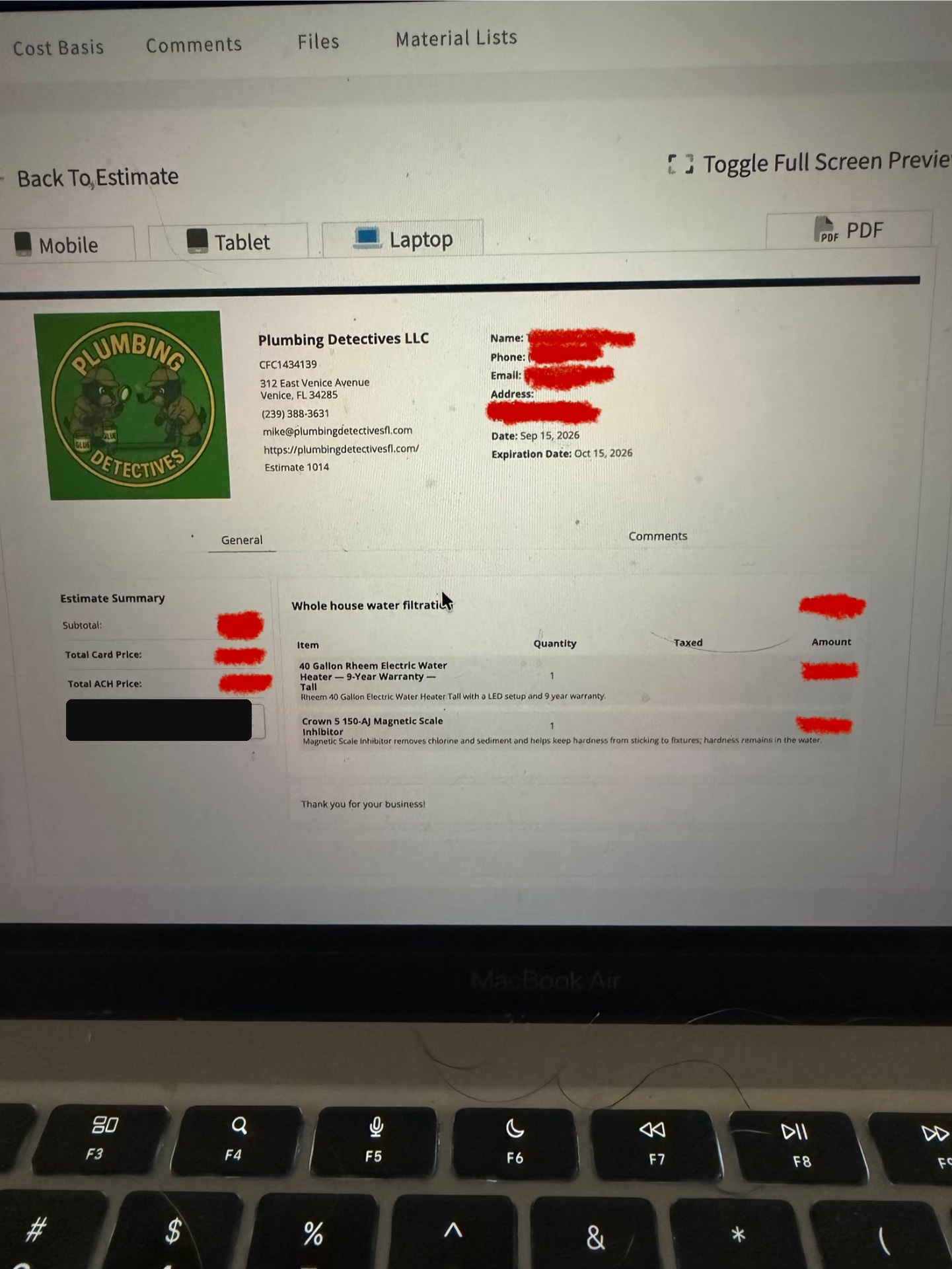
Whatever your plumber’s format, the estimate should tell you the product, the scope, what’s included and what isn’t, and what happens if something changes. Which brings up the next question.
What Happens If They Find Something Else Mid-Job?
Sometimes you open a wall and the situation is different from what anyone expected. What matters is what the plumber does next.
Here’s my rule: if something’s actively leaking, we make it safe first — water off. Then work stops. I show you what I found, I write up a change order, and nothing continues until you’ve agreed to it. We don’t assume, we don’t “just take care of it” and hand you a bigger bill at the end. You’re informed throughout the process, and every decision is yours.
Ask any plumber you’re considering how they handle this before you hire them. The answer tells you a lot.
Who Pulls the Permit?
When a job needs a permit, we pull it. For Venice-area homes, that means either the City of Venice or Sarasota County depending on your address; other areas we serve have their own jurisdictions, and we handle whichever one applies. Ask your plumber who’s pulling the permit and confirm it’s in the estimate — not something you find out about afterward.
What About Warranties and Follow-Up?
Settle this before the work starts, in writing. Here’s what mine are:
- Five years on all piping repairs.
- Five years on whole-house repipes. Separately, the Uponor ProPEX pipe, ProPEX fittings, and ProPEX rings we install carry Uponor’s 25-year transferable limited warranty as a system, subject to Uponor’s terms. That’s the manufacturer’s coverage on the product; my five years is on the work. They’re separate.
- Water heaters: five years on the piping we run to the heater. The unit itself carries whatever manufacturer warranty comes with the model you choose.
- Drain cleaning has no warranty. I’ll tell you that up front rather than let you assume otherwise.
And if something isn’t right a week later: every customer I work with gets my personal number. You can also call the office. I return every call. I’m not saying that as a slogan — it’s how I want to be treated when I hire someone, so it’s how I run it.
What Do Reviews Actually Tell You?
Reviews are one real signal, and you should read them.
What they don’t show you is everyone who was happy and never wrote one. That’s one of the hardest things in this trade: the customers you’re sure are going to leave a review are usually the ones who don’t, because once the job’s done and the water’s running, you’re an afterthought — which is exactly how it should be. So read reviews, but read them for what people say about communication, cleanliness, and whether the problem was actually fixed. Don’t let a count decide for you. Verify the license and ask the questions above.
Before You Hire: The Checklist
Before You Hire a Plumber in Venice: 10 Things to Verify
- License number and business name. Get both, look them up on the DBPR license lookup, and confirm the business on your estimate is tied to that license.
- License status, type, and expiration. “Current, Active,” authorized to work in your jurisdiction, and confirm it stays active through your job.
- Certificate of insurance. Ask for it and check it’s current. Separate from the license.
- The diagnostic procedure. What did they test, isolate, and look at before they quoted you?
- The options that apply, explained. Not just the one they want to sell.
- A written estimate with the product and the scope. What’s going in, what’s included (access, patching, permits when required, haul-away), what isn’t.
- How they handle changes. Does work stop for a written change order?
- Who pulls the permit, when one is required, and whether it’s in the price.
- Warranty terms in writing. Workmanship and manufacturer, and what’s excluded.
- How you reach them afterward. A real phone number and a real answer.
If a plumber gets impatient with these questions, that’s information too.
About the Company Publishing This
I said I’d keep the verifiable facts about my company in one place. Here they are.
- Company:
- Plumbing Detectives LLC
- Owner:
- Michael Reynolds, master plumber
- Florida license:
- CFC1434139 — Certified Plumbing Contractor (verify at the DBPR license lookup; showed Current, Active on September 20, 2026, expiring August 31, 2028)
- Address:
- 312 E Venice Avenue, Suite 203, Venice, FL 34285
- Phone:
- (239) 388-3631
- Email:
- mike@plumbingdetectivesfl.com
- Serves:
- Venice, Venice Gardens, Nokomis, Laurel, Sarasota, Englewood, Wellen Park, Bradenton, Bradenton Beach, and Lakewood Ranch
- Services:
- plumbing services in Venice including general repairs, fixtures, leak detection and slab leak detection, sewer line repair and sewer camera inspection, water heaters, whole-house repiping, and water treatment
The people who show up at your door are trained by me and work under my license. On larger jobs, you’ll meet me — I run every large job personally.
None of that makes us “the best.” It makes us verifiable. Run the license, ask the questions in the checklist, and decide for yourself. If you want to talk through a problem, contact us — I’d rather be accurate than impressive, and I’d rather you hire the right plumber than hire me for the wrong reasons.
Plumbing Detectives LLC serves homeowners throughout Venice, Nokomis, Sarasota, Laurel, Englewood, and surrounding areas. Florida Plumbing Contractor License CFC1434139. (239) 388-3631 | plumbingdetectivesfl.com
Sources
- Florida DBPR — Verify a License (official license lookup)
- Florida DBPR — How to Verify a License
- Florida DBPR — “Trust but Verify” consumer bulletin
- Florida DBPR — Construction Industry Licensing: certified vs. registered contractor definitions
- Federal Trade Commission — “How To Avoid a Home Improvement Scam”
- Uponor — Uponor PEX warranty (25-year transferable limited warranty with ProPEX fittings as a system)